
Back-Rank Defense
Learn the back-rank checking technique — hold a draw against a passed pawn by checking the advancing king from behind.
Try Interactive LessonIntroduction
Lesson Content
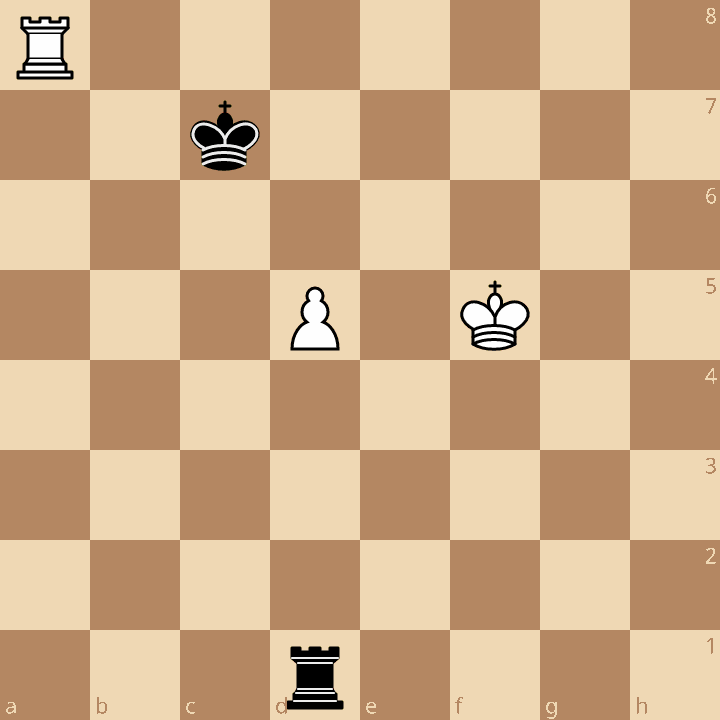
White advances the king to e6, approaching the d5 pawn. From e6, the king threatens to support d6 and eventually escort the pawn to promotion. But Black's rook is perfectly placed to disrupt this plan.
Check from behind! The rook slides along the 1st rank to e1, checking the king on e6. This is the core of the back-rank defense — the rook stays on the 1st rank (behind the pawn) and checks the king laterally whenever it advances. The king must now move, and every direction has problems.
Alternative Moves
White pushes forward to f7, heading toward the 8th rank. The king is now even further from the d5 pawn — but White hopes to loop back later. Can the rook keep up the harassment?
The rook follows! From e1 the rook slides to f1, checking the king on f7. Notice the pattern: wherever the king goes, the rook checks it from the 1st rank on that same file. The king can never settle because the rook has unlimited checking distance from behind.
White tries escaping sideways to g6. The king is now three files away from the d5 pawn — drifting further and further. But White has no choice: the checks keep pushing the king sideways.
Tracking the king! The rook moves to g1 with check. After three moves, the pattern is clear: Re1+, Rf1+, Rg1+ — the rook tracks the king across every file, checking from behind each time. The king can never shelter near the pawn because the rook's checking distance from the 1st rank is unlimited.
White retreats to f5 — back to the starting square! After three checks, the king has made a round trip (f5→e6→f7→g6→f5) and gained nothing. The back-rank defense creates an inescapable cycle.
With the king retreated below the 6th rank, there's no need to check. The rook calmly returns to d1 — back behind the pawn on the d-file. This is the key idle move: when the king is far enough away, reposition the rook behind the pawn and wait. The position is identical to the starting position — White has made zero progress.
Alternative Moves
White's last try — pushing the pawn to d6 with check! The pawn advances to the 6th rank, attacking c7 where Black's king stands. This is the most critical moment of the defense. If Black responds incorrectly, the game could be lost.
Block the pawn! The king steps to d7, planting itself directly in front of the pawn. From d7, the king prevents d7 (the pawn can't advance through its own square), and the rook on d1 remains behind the pawn ready for more checks. Critical trap: capturing with Kxd6 actually loses — White's rook and king coordinate to win the resulting position. Always block, never capture here.
Alternative Moves
White advances the king toward the pawn again, trying to support d7. From e5, the king eyes d5 and e6. But with the pawn on d6 and Black's king on d7, the same checking technique applies.
Same technique, new position! Even with the pawn advanced to d6, the back-rank defense works exactly the same way. The rook checks from e1, driving the king back. White's pawn is stuck on d6 — blocked by Black's king — and the checking cycle continues indefinitely.
White retreats to d5, getting behind the pawn. But now the king is on the d-file — directly in the rook's sights from d1.
Check on the d-file! The rook returns to d1 with check, hitting the king along the d-file. White's king is driven off d5, and the cycle repeats. The pawn is permanently stuck on d6, blocked by Black's king on d7, and White's king can never advance without being checked. This is a theoretical draw — White can try forever but never make progress against correct back-rank defense.
Key Takeaways
- Place the rook behind the passed pawn (on the 1st rank for a white pawn) — this gives unlimited checking distance
- When the king advances above the 5th rank, check it from behind on the same file — the rook tracks the king across every file
- When the king retreats below the 6th rank, return the rook behind the pawn and wait for the next advance
- If the pawn pushes forward with check, block it with the king (Kd7) — never capture the pawn (Kxd6 loses!)
- The defense works because the king can never shelter near the pawn without being harassed by checks from behind
Now play it through
Step through every move on a real board, try the wrong ones, and ask Knighty why they fail.
Summary
Ready to Practice?
Take this lesson with you
Free account requiredWith every variation — opens in Lichess & ChessBase