
King & Two Bishops vs King
Learn to checkmate with two bishops by creating diagonal barriers, coordinating your pieces, and driving the lone king into a corner.
Try Interactive LessonIntroduction
Lesson Content
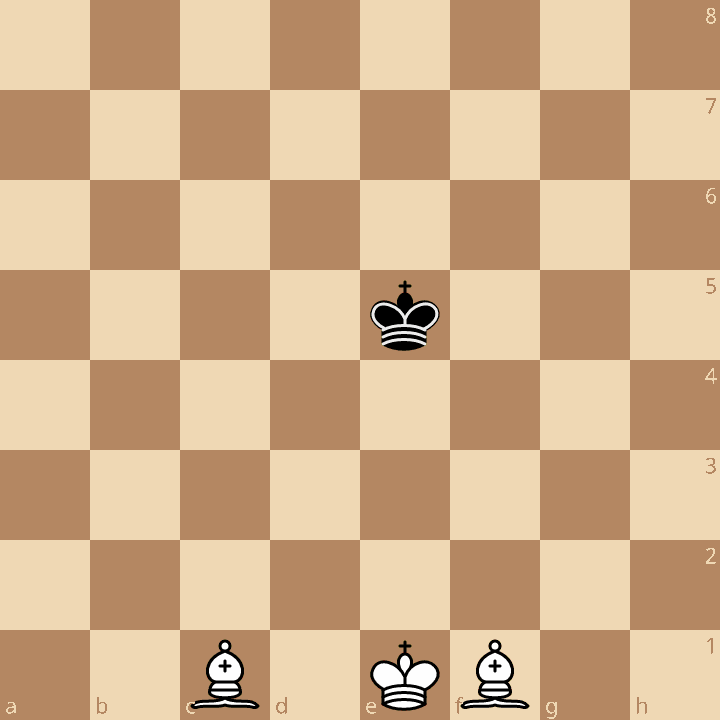
Step one: centralize the king. Unlike checkmates with a queen or two rooks, the king is essential in the two-bishop technique. It must march toward the center to support the bishops in restricting the defending king. The bishops stay on their starting squares for now — there's no rush to develop them until the king is positioned to support their barriers.
Alternative Moves
The best defense — Black charges toward White's pieces. By staying in the center, the defending king maximizes its mobility and makes it harder for White to create effective barriers.
Continuing to centralize the king. From f3, the king controls important squares and is ready to support bishop development. The king needs to reach the central zone before the bishops can begin their restricting work.
Black occupies the center, maintaining maximum mobility. This is the correct defensive idea — stay as far from the edges and corners as possible.
Now it's time to develop the dark-squared bishop. Be3 is a strong centralizing move — the bishop controls the key d4-a7 diagonal and begins to restrict the black king's options. With the king on f3 supporting, the bishop can safely take up an active post.
Black keeps the king central, the best defensive strategy. The defending king should avoid moving toward edges or corners for as long as possible.
The king advances further, pressing forward to support the bishops. From f4, the king controls e5 and d5, working with Be3 to limit the black king's central squares.
The black king retreats. Being pushed out of the center is the beginning of the end — from here, White's pieces will gradually squeeze the king toward the edge.
Developing the light-squared bishop with tempo — the check forces Black to move immediately. Bc4 activates the second bishop on the powerful a2-g8 diagonal, and both bishops now work together to create diagonal barriers that cut the board in two. This is the moment the technique clicks: two bishops on active diagonals create a net the king cannot escape.
Alternative Moves
Forced to retreat from the check. The black king moves to d6, but it's already running out of room. Both bishops now control long diagonals that restrict the king's movement.
The white king continues its relentless advance. From f5, it controls e6, e5, d6 — directly pressuring the black king's position. The squeeze is on: king on f5, bishops on c4 and e3, all working together.
Black retreats further from the center. The king is being pushed toward the queenside — exactly what White wants.
A powerful centralizing move. The king on e5 dominates the center and controls d6, which prevents the black king from returning. Combined with the bishops, White now controls a huge swath of the board.
The black king drifts toward the queenside. The center is no longer accessible — White's king and bishops have sealed it off.
A critical repositioning. The light bishop moves to b5, creating a diagonal barrier on the a4-e8 line. This cuts off the black king from returning to the kingside — the bishop acts like a wall the king cannot cross. This is the heart of the two-bishop technique: diagonal barriers restrict the king to one side of the board, then a corner.
Alternative Moves
The king retreats to the back rank. The diagonal barrier from Bb5 prevents any return to the center — the king is now confined to the queenside.
The king follows the retreating black king. In the two-bishop technique, the king must shadow the opponent's king, staying close enough to prevent escape while the bishops maintain their barriers.
Pushed to the c8 corner area. The black king is running out of room — the back rank offers fewer escape routes.
The dark bishop repositions to d4, creating a second diagonal barrier on the a1-h8 line. Now both bishops form a "V" shape — Bb5 on the a4-e8 diagonal and Bd4 on the a1-h8 diagonal. The black king is trapped between these two barriers. This is the classic two-bishop formation: the diagonals converge to squeeze the king into a corner.
The king tries to escape via the d-file, but the diagonal barriers prevent any meaningful progress. The walls are closing in.
Check! The dark bishop leaps to f6, giving check while maintaining the diagonal barrier. This forces the king back toward the corner. Notice that Bf6 controls both e7 and g7, preventing the king from escaping to the kingside. Using checks to gain tempo while keeping barriers intact is the hallmark of the two-bishop technique.
Forced back to c8. Ke8 is blocked by the Bb5 diagonal (b5 controls e8), and Bf6 controls e7. The king is being funneled toward the a8 corner.
Another forcing check! The light bishop moves to a6, checking from the a6-c8 diagonal. This drives the king further toward the corner. The bishops are taking turns checking — each check pushes the king one step closer to a8.
The only legal move. Kd8 is controlled by Bf6 (d8 diagonal), Kd7 is adjacent to Kd6, and Kb7 is controlled by Ba6. The king is forced toward a8.
The king advances to c6, controlling b7, b6, and c7 — sealing off the escape routes. The noose tightens: the king on c6 and bishops on a6 and f6 create a nearly airtight cage around the black king.
The king tries to flee via the a-file. This is the best defense — Ka8 would allow a faster mate. But the bishops and king are perfectly positioned to finish the job.
The king shadows the black king's retreat, moving to b5 to maintain control of a6, a5, a4, b6, c6. The defending king has nowhere to hide — it must go to the corner.
Into the corner — exactly where White has been driving the king for the entire game. Both Ka8 and Kb8 are equally hopeless, but the corner is the final destination.
The king moves to b6, controlling a7 and completing the cage. The black king on a8 now has only one escape square (b8), and even that is temporary. The checkmate setup begins.
The only legal move. a7 is controlled by the white king on b6. The black king shuttles between a8 and b8, but there is no escape.
Check! The dark bishop delivers a decisive check from e5, controlling the b8-h2 diagonal. The king on b8 must return to a8 — there is nowhere else to go since c8 is controlled by Ba6 and c7 is adjacent to Kb6.
Forced back to the corner. The king on a8 has no legal moves except to wait for the inevitable — Kb7 is controlled by Ba6, and a7 is controlled by Kb6.
Checkmate! The light bishop delivers the final blow from b7. The king on a8 is attacked by Bb7, and every escape is sealed: a7 is controlled by Kb6, b8 is controlled by Be5 (along the b8 diagonal), and b7 is occupied. The two bishops and king have created a perfect mating net. In 17 moves, White centralized, built diagonal barriers, drove the king to the corner, and delivered checkmate — the complete two-bishop technique.
Key Takeaways
- The king must actively participate — two bishops alone cannot force checkmate
- Centralize all three pieces (king + both bishops) before beginning the squeeze
- Create diagonal barriers with the bishops to restrict the defending king to one side of the board
- Use checks with tempo to drive the king toward a corner, but beware of stalemate traps
- Shadow the defending king with your own king, always staying close to seal escape routes
Now play it through
Step through every move on a real board, try the wrong ones, and ask Knighty why they fail.
Summary
Ready to Practice?
Take this lesson with you
Free account requiredWith every variation — opens in Lichess & ChessBase