
King, Bishop & Knight vs King
Master the hardest basic checkmate: coordinate bishop and knight to drive the lone king into the corner matching the bishop's color.
Try Interactive LessonIntroduction
Lesson Content
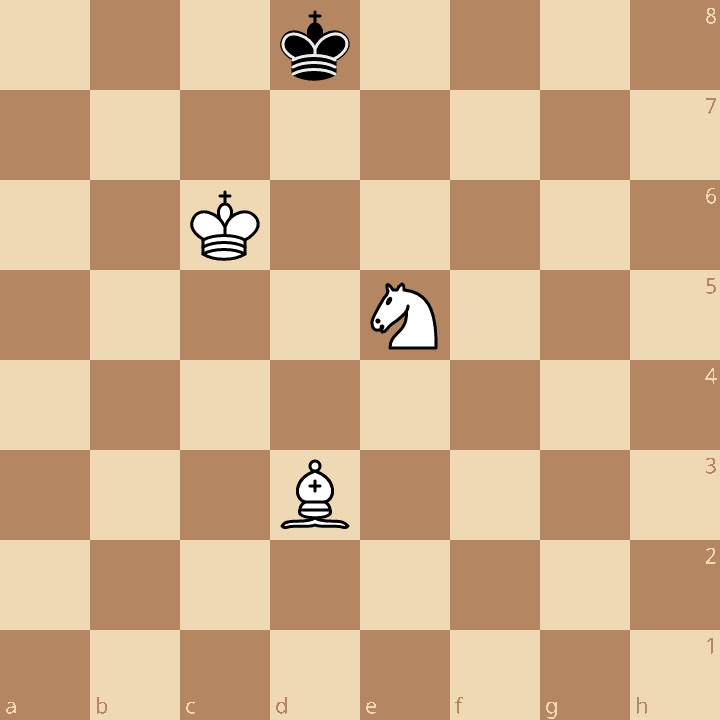
The knight leaps to g6, cutting off the e7 and f8 squares. This forces the black king toward the queenside — exactly where we want it, heading toward the a8 corner (a light square matching our bishop). Notice that the knight also controls h8, preventing the king from fleeing to the wrong corner. The knight's role throughout this endgame is to control key squares and herd the king in the right direction.
Alternative Moves
The best defense — Black steps away from the knight's influence. Kc8 would allow a faster mate since the king would already be heading toward the fatal a8 corner. By going to e8, Black maximizes distance from the danger zone.
The bishop activates on c4, controlling the a6-f1 and a2-g8 diagonals. From c4, the bishop exerts pressure toward both the a-file and the kingside, working with the knight to create a net the king cannot escape. This move also sets up a key diagonal barrier — the bishop on c4 and knight on g6 together control most of the king's potential escape squares.
Forced — the only legal move. The knight on g6 controls e7 and f8, the king on c6 controls d7, and the bishop on c4 covers e6. The black king is already running out of room.
The white king advances to d6, taking direct opposition with the black king. From d6, the king controls c7, d7, and e7 — sealing off the black king's retreat toward the center. The squeeze intensifies.
Black retreats to e8, the best defense. Kc8 would walk straight into the dangerous corner. The king tries to stay as far from a8 as possible.
The bishop repositions to d5, strengthening the diagonal barrier. From d5, it controls c6, b7, and a8 along one diagonal — covering the entire path to the target corner. The bishop is now aimed directly at a8 like an arrow.
Forced — the only legal move. With Kd6 controlling e7, Ng6 controlling f8 and e7, and Bd5 covering e6, the black king has nowhere else to go.
A powerful move — the bishop advances to c6, tightening the diagonal barrier even further. Bc6 controls b7, a8, d7, and e8. Combined with the king on d6 and knight on g6, the black king is now trapped in a shrinking box. This is the hallmark of the B+N technique: the bishop and knight take turns restricting the king's squares while the king closes in.
Forced — the only legal move. The king is pushed toward the a8 corner. With d7 and e8 controlled, Kc8 is the only square available.
The knight repositions to f4, preparing to jump into the action on the queenside. From f4, the knight controls d5, e6, and d3 — maintaining pressure while getting ready to leap toward the a8 corner. This is the beginning of the knight maneuver — the knight must reposition from the kingside to the queenside to help deliver the final checkmate. The knight's journey often traces a "W" shape across the board.
Alternative Moves
The king retreats toward b8, heading further toward the a8 corner. Both Kb8 and Kd8 delay equally, but the king is inexorably being driven into the trap.
The white king follows the retreating black king, moving to c5. The king must shadow the defending king, always staying close enough to prevent escape. From c5, it controls b6, b5, and c6 — cutting off the black king's last hope of returning to the center.
Black tries to escape via a7, but the net is closing. Ka7, Kc7, and Kc8 all delay equally — the position is hopeless regardless of which direction the king runs.
The king continues to shadow, moving to b5. Now the white king controls a6, b6, and a4 — all critical escape routes for the black king. The cordon tightens with every move.
Forced — the only legal move. The king on b5 controls a6, and the bishop on c6 controls b7 and a8. Kb8 is all that remains.
A crucial move — the king advances to b6, sealing a7 and tightening the cage to just two squares (a8 and b8). The black king is now trapped in the corner area with no hope of escape. Be careful here: Kc6 would be stalemate if the black king is on a8 later! The king on b6 keeps a7 under control while avoiding the stalemate trap.
Alternative Moves
Forced — the only legal move. With a7 controlled by Kb6 and b7 controlled by Bc6, the king must go to c8.
The knight arrives at e6 — a powerful outpost from which it controls c7, d8, and f8. The knight now prevents the black king from escaping via c7 or d8, forcing it back toward the corner. This is the knight's critical destination in the mating maneuver. From e6, it can jump to c7 next move to deliver check and help seal the cage.
Forced — the only legal move. Ne6 controls c7 and d8, Bc6 controls d7 and b7, and Kb6 controls a7 and c7. The king must retreat to b8.
The bishop repositions to d7, vacating c6 for the knight while maintaining control of key squares. From d7, the bishop controls c8, c6, e8, and b5 — it continues to restrict the black king. This is a typical pattern in the B+N checkmate: the bishop and knight take turns controlling squares, leapfrogging each other as they close the net.
Forced — the only legal move. The king enters the fatal corner. With Kb6 controlling a7 and b7, and Bd7 covering c8, Ka8 is the only square left.
Check! The knight jumps to c7, attacking the king on a8. This drives the king to b8 — the only legal square. The knight on c7 also controls a8, a6, and b5, creating a tight cage. The mating pattern is emerging: the knight and bishop will alternate checks to force the king back and forth between a8 and b8 until the bishop delivers the final blow.
Forced — the only legal move. The knight on c7 controls a8 and a6, the king on b6 controls a7, and the bishop on d7 covers c8.
Check! The knight leaps to a6, checking the king from b8. This forces the king back to a8 for the final time. The knight on a6 controls b8, completing the cage — the black king will have no escape on the next move. This is the penultimate blow — the bishop will deliver checkmate on the next move.
Forced — the only legal move. The king returns to a8 for the last time. Na6 controls b8, Kb6 controls a7 and b7. The king is trapped.
Checkmate! The bishop slides to c6, delivering the final blow along the a8 diagonal. The king on a8 is attacked by Bc6 (via b7-a8), and every escape is sealed: a7 is controlled by Kb6, b8 is controlled by Na6, and b7 is controlled by both Kb6 and Bc6. The classic B+N mating pattern: knight on a6, king on b6, bishop on c6 — three pieces creating a perfect net in the corner. In 14 moves, the defending king was driven from d8 all the way to a8 and checkmated with flawless precision.
Key Takeaways
- The defending king must be driven to a corner matching the bishop's color (light bishop → light corner)
- The knight and bishop take turns restricting the defending king's squares, leapfrogging each other
- The king must actively shadow the defender — it cannot checkmate from a distance
- Watch for stalemate traps: one careless move (like Kc6 or Bb7) can throw away the win
- The final mating pattern uses knight + bishop + king to seal all escape squares in the corner
Now play it through
Step through every move on a real board, try the wrong ones, and ask Knighty why they fail.
Summary
Ready to Practice?
Take this lesson with you
Free account requiredWith every variation — opens in Lichess & ChessBase