
Knight Stopping a Pawn
Learn how a knight can blockade a passed pawn, and why the knight must take the right path to reach the blockade square in time.
Try Interactive LessonIntroduction
Lesson Content
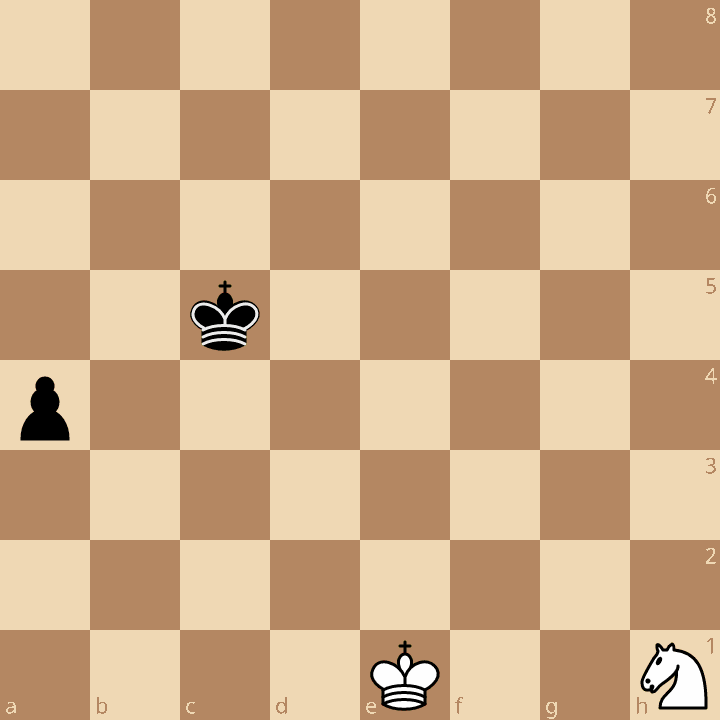
The knight must begin its journey toward the a-file immediately. Nf2 is the only knight move that draws — from f2, the knight can reach d3 in one jump, which is on the path to blockade the pawn. Ng3 looks reasonable but actually loses! After Ng3, the knight needs two more moves to reach c1 or a2 (via e2 or e4), but Black's pawn gets there first. This is the knight's key limitation — every square has a fixed minimum distance, and there are no shortcuts.
Alternative Moves
Black pushes the pawn forward. The a-pawn is now just two squares from promotion and threatening to advance further. White's knight must continue its race to the blockade square.
The only move that holds the draw! The knight jumps to d3 with check, gaining a crucial tempo. From d3, the knight can reach c1 on the next move — which controls the a2 square and blockades the pawn. Every other move loses. This demonstrates a key knight technique: using checks to gain time while navigating toward the target square.
Alternative Moves
Black steps out of check and heads toward the pawn to support its advance. The king on c4 eyes the b3 and c3 squares, preparing to escort the pawn. But White's knight is almost in position.
Again the only drawing move! The knight reaches c1, which controls the critical a2 square. The pawn on a3 cannot advance because the knight guards a2. This is the blockade — the knight has completed its three-move journey from h1 to f2 to d3 to c1. Notice that the knight on c1 also controls b3, preventing the Black king from approaching the pawn via that square. The blockader does double duty: stopping the pawn AND restricting the opposing king.
Black approaches the knight, trying to drive it off the blockade. From c3, the king threatens to go to b2, which would attack the knight on c1 directly. Can White maintain the blockade?
The knight leaps to a2 with check, solving two problems at once. It directly blocks the pawn's advance square (the pawn on a3 can't go to a2 because the knight is there) and forces Black's king to move. This is a key advantage of the knight blockade — the knight can reposition with check to maintain the blockade from a different square.
Black moves toward the knight, threatening to capture it with Kxa2. If the knight is captured, the pawn promotes freely. White must retreat the knight while keeping the a2 square under control.
The knight jumps to b4, retreating from the king but still controlling a2 from a distance. A knight on b4 covers: a2, a6, c2, c6, d3, d5. The a2 square remains blockaded even though the knight has moved away from it. This is the beauty of the knight blockade — unlike a rook or bishop that must stay on the same file or diagonal, the knight can guard the key square from multiple positions.
Alternative Moves
Black pushes the pawn to a2 — its last advance. The pawn is one square from promotion. But the knight on b4 controls a2 and can capture the pawn immediately.
The knight captures the pawn, ending the threat. The resulting K+N vs K position is a draw by insufficient material — neither side can force checkmate. The knight completed an extraordinary journey: h1 → f2 → d3 → c1 → a2 → b4 → a2 — six precise moves to stop a pawn that was only three squares from promotion. The lesson shows both the knight's strength (flexible blockade, check-gaining maneuvers) and its limitation (must take the exact right path to arrive in time).
Key Takeaways
- A knight is an excellent blockader — it stops the pawn without losing mobility since it jumps over pieces
- The knight has a fixed minimum distance to any square, and taking the wrong path can be fatal
- Use checks to gain tempo while navigating the knight toward the blockade square
- The knight can guard the same critical square from multiple positions, making the blockade flexible
- Once blockaded, a passed pawn is harmless — the knight holds it while the king can approach to help
Now play it through
Step through every move on a real board, try the wrong ones, and ask Knighty why they fail.
Summary
Ready to Practice?
Take this lesson with you
Free account requiredWith every variation — opens in Lichess & ChessBase