
King & Queen vs King
Learn the box method to checkmate with King and Queen against a lone King — the most fundamental endgame technique.
Try Interactive LessonIntroduction
Lesson Content
The queen moves to the center, immediately creating a box around the black king. From c6, the queen controls the entire 6th rank and c-file, confining the king to a smaller area. This is the essence of the box method — use the queen to draw invisible walls that restrict the enemy king's movement.
Alternative Moves
The black king tries to stay in the center where it has the most room to maneuver. Moving toward the edge voluntarily would make White's job easier.
A critical principle: the queen cannot checkmate alone — your king must help. White begins marching the king toward the center to assist. The queen maintains the box while the king advances.
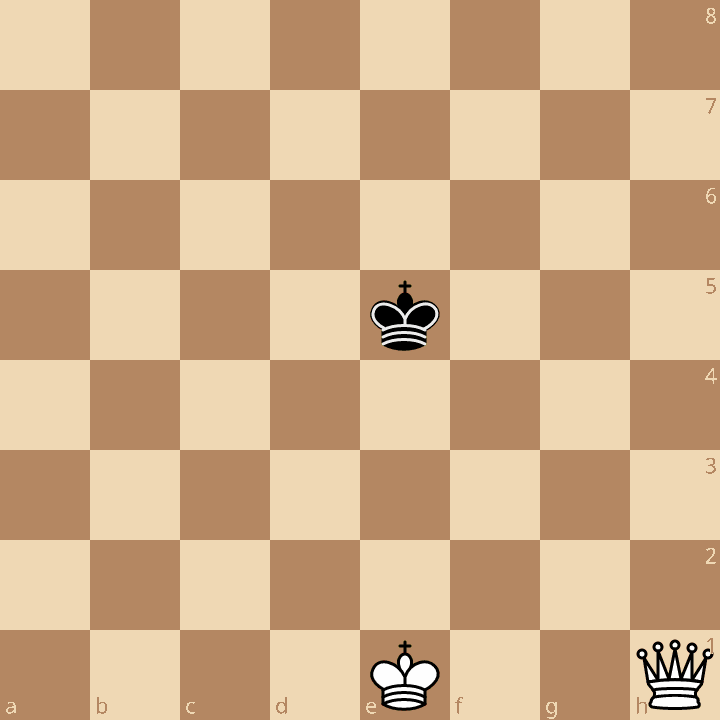
The black king retreats to e5, staying as central as possible. Black has no way to escape the queen's control — the "box" created by the queen on c6 keeps the king confined.
The white king continues its march toward the center. Notice the steady approach — there's no rush. The queen holds the box while the king walks up to help.
The black king tries to slip toward the queenside, hoping to escape the tightening net. But the queen's control of the c-file prevents any real escape.
The queen repositions to shrink the box. From b5, the queen cuts off the 5th rank and b-file, pushing the black king toward the edge. The key is to progressively reduce the king's available area — never let the box get bigger.
Alternative Moves
The black king is pushed toward the queenside. It's running out of room — the queen's barrier on the b-file and 5th rank leaves very little space.
The white king follows the black king, staying close. This is essential — the king must be nearby to deliver the final checkmate. Notice how White's king and queen work as a team: the queen restricts, the king approaches.
The black king retreats further toward the edge. It has been pushed from the center (e5) to the second rank — the box method is working.
Another box-shrinking move. The queen drops to b4, maintaining the b-file barrier and now controlling the 4th rank. The black king is confined to just the first two ranks and the a-c files — a tiny box.
Alternative Moves
The black king is pushed to the back rank. This is exactly what we wanted — the box method has successfully driven the king to the edge, which is a prerequisite for checkmate.
The white king moves in for the final phase. With the black king trapped on the back rank, White needs the king close to deliver checkmate. The queen controls the escape routes while the king closes in. Stalemate warning: Be careful not to take away ALL the black king's moves with the queen. Always leave one square for the king until you can deliver checkmate.
The black king has nowhere to go but d1. It's trapped on the back rank with the white king closing in — checkmate is inevitable.
Checkmate! The queen delivers the final blow from b1. The black king on d1 has no escape: the queen controls the entire first rank, and the white king on d3 covers c2, d2, and e2. This is the classic K+Q vs K checkmate pattern — the enemy king is trapped on the edge with your king nearby to seal off the escape squares.
Key Takeaways
- The queen alone cannot checkmate — your king must participate
- Use the box method: confine the enemy king to a shrinking rectangle
- Advance your king steadily while the queen maintains the barrier
- Drive the enemy king to the edge of the board before delivering checkmate
- Watch out for stalemate — always leave the enemy king one legal move until you can deliver mate
Now play it through
Step through every move on a real board, try the wrong ones, and ask Knighty why they fail.
Summary
Ready to Practice?
Take this lesson with you
Free account requiredWith every variation — opens in Lichess & ChessBase