
King & Rook vs King
Learn the box method to checkmate with King and Rook against a lone King — a fundamental endgame skill requiring patience and coordination.
Try Interactive LessonIntroduction
Lesson Content
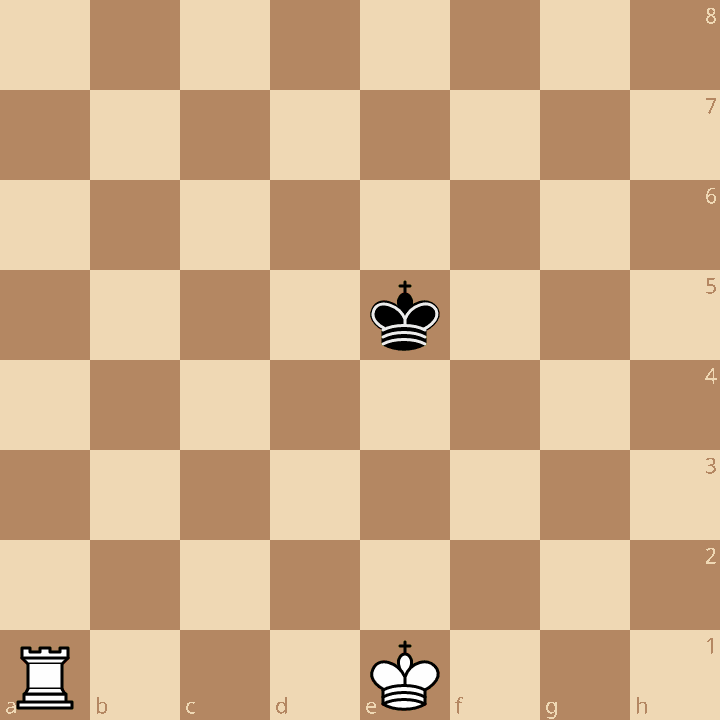
The king begins its march toward the center. In K+R vs K, the king must actively participate — the rook cannot force checkmate alone. Centralizing the king first is the optimal approach.
Alternative Moves
The black king heads to the center where it has maximum mobility. Staying central is the best defense — running to the edge early only helps White.
The white king continues advancing toward the center. There is no rush — steady king progress is key.
Black mirrors centrally, maintaining the best possible defensive position.
The white king reaches a dominant central position on e4. From here, it controls key squares in every direction and is ready to support the rook.
The black king retreats slightly, yielding the center. It cannot maintain the opposition against the well-placed white king.
Now the rook springs into action, creating the first barrier on the 5th rank. This is the box method — the rook draws an invisible wall that the black king cannot cross. The king is now confined to ranks 6-8. With the king already centralized, this barrier is immediately effective.
Alternative Moves
The black king stays within its restricted area, heading to the queenside where it has more room to maneuver.
The rook repositions along the 5th rank barrier, maintaining the restriction while keeping distance from the black king. A well-placed rook stays far from the enemy king to avoid being chased.
The black king moves to the queenside, trying to find room but still confined above the 5th rank.
The white king follows to the queenside to support the rook. Always keep your king close — it must work together with the rook to tighten the box.
The black king oscillates, unable to cross the 5th rank barrier or find a constructive plan.
The white king advances further, getting into position to support checks. The king and rook are now well-coordinated on the queenside.
The black king is pushed to the b-file, running out of space.
The first check! The rook gives check on the 6th rank, forcing the black king off the 6th rank entirely. This is a key technique: use well-timed checks to shrink the box and push the king toward the edge. The barrier jumps from the 5th rank to the 6th rank.
Forced off the 6th rank, the black king retreats to c7. The box has been tightened — the king is now confined to ranks 7-8.
The white king follows immediately, maintaining close coordination with the rook. The king needs to stay near to support the next check.
The black king is being pushed toward the edge. It retreats to b7, with fewer and fewer options.
Second check! The rook checks on the 7th rank, forcing the black king to the back rank. The box has been tightened again — the king is now confined to the 8th rank only.
The black king is now on the back rank. This is exactly where we want it — checkmate is near.
The white king takes a commanding position on c6, controlling b7, c7, and d7 — all the escape squares the black king would need to leave the back rank.
The black king moves to b8, still trapped on the back rank. It is heading toward the corner.
A crucial waiting move — the rook repositions to the 4th rank, maintaining control while preparing the final approach. The rook cannot immediately deliver mate, so patience is required.
The black king leaves the back rank briefly, moving along the edge. But there is no escape — the white king and rook are perfectly coordinated.
The rook seals the back rank. From d8, it controls the entire 8th rank, preventing the black king from returning. The king is now trapped on the a-file edge.
The black king has only one move — retreating along the a-file. The mating net is almost complete.
Checkmate! The rook delivers mate from a8. The black king on a6 has no escape: the rook controls the entire a-file from a8, and the white king on c6 covers b5, b6, and b7. This is the classic K+R vs K mating pattern — the enemy king trapped on the edge with the rook delivering check along the file and your king blocking all escape squares.
Key Takeaways
- The rook alone cannot checkmate — your king must actively participate
- Centralize your king before activating the rook barrier
- Use the rook to create barriers on ranks or files, confining the enemy king
- Use well-timed checks to push the king toward the edge of the board
- In the final position, the rook controls the edge file/rank while the king blocks escape squares
Now play it through
Step through every move on a real board, try the wrong ones, and ask Knighty why they fail.
Summary
Ready to Practice?
Take this lesson with you
Free account requiredWith every variation — opens in Lichess & ChessBase