
Direct Opposition
Learn how to use the direct opposition — facing the enemy king with one square between — to force the opposing king aside and promote a pawn.
Try Interactive LessonIntroduction
Lesson Content
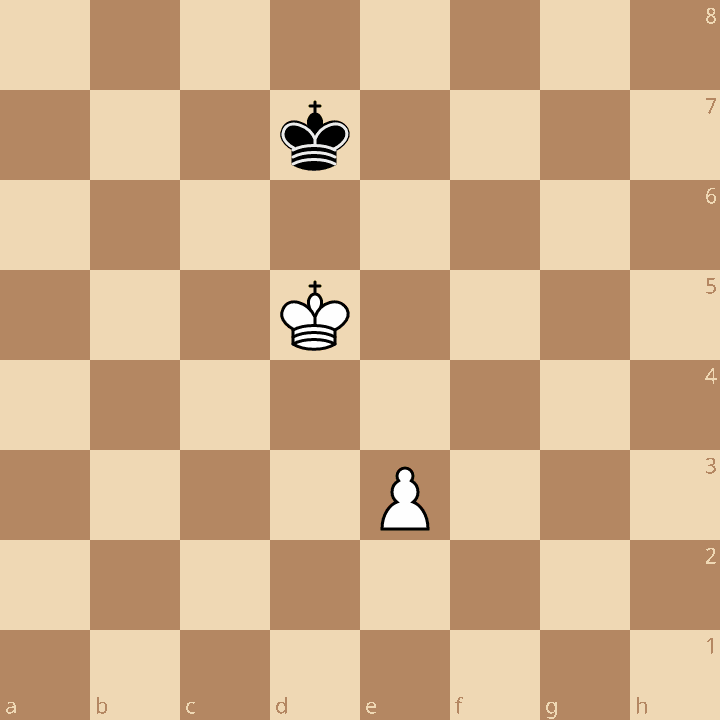
The pawn tempo — the key to this entire endgame. In the starting position, Black holds the opposition (kings on d5 and d7, White to move). By advancing the pawn, White passes the move to Black without changing the king positions. After e4, it's Black's turn to move with the kings still facing each other. White has effectively stolen the opposition using a pawn advance as a waiting move.
Alternative Moves
Black steps sideways to the e-file. This is the best defense — moving to e7 keeps the king as centralized as possible. Other moves like Kc7 or Kd8 concede ground more quickly.
Taking the opposition! This is the critical moment. Kings are now on e5 and e7 — same file, one square between them, and it's Black's turn to move. White holds the direct opposition. This is the ONLY winning move. Every other move draws. The opposition forces Black to step aside, and White can then advance toward the key squares for promotion.
Alternative Moves
Black is forced to step aside — the power of opposition in action. By moving to d7, Black tries to stay near the center and keep options open. Moving to the back rank (Kd8, Ke8) would concede even more ground.
Now White outflanks — approaching from the side. After gaining the advantage through opposition, the king advances diagonally to f6, getting closer to the key squares (d6, e6, f6) that control the pawn's path to promotion. This is how opposition and outflanking work together: opposition forces the enemy king aside, then the outflanking king occupies the vacated territory.
Black retreats to d8, the best defense. Staying on the back rank keeps the king as far as possible from the corner, maintaining defensive flexibility.
The white king slips behind the enemy king, reaching the 7th rank. From f7, the king controls e8 and g8, and is perfectly positioned to support the pawn's advance. The black king has been pushed to the back rank with no way to stop the pawn march.
Black returns to d7, trying to stay near the center and approach the pawn's path. But White's king on f7 is perfectly placed.
Time to advance the pawn. With the white king on f7 controlling the promotion square e8, the pawn can march forward safely. The black king on d7 is too far away to intercept.
Black tries to circle around to blockade the pawn from the side. But the pawn is already too advanced and the white king controls the key squares.
The pawn pushes to the 6th rank. Just two more squares to promotion. The white king on f7 continues to guard e8, making this advance safe.
Black approaches the pawn, but it's too late. The pawn on e6 is defended by the king on f7, and promotion is unstoppable.
The pawn reaches the 7th rank — one square from promotion. The white king on f7 directly guards e8. Nothing can stop the pawn from becoming a queen.
Black moves the king away, unable to prevent promotion. The pawn on e7 is shielded by the white king and will promote next move.
Promotion with check! The pawn becomes a queen on e8, delivering check along the e-file. From here, King and Queen vs King is a basic checkmate — White wins easily. The opposition made this possible. Without the pawn tempo (e4) and the direct opposition (Ke5), Black could have held the draw.
Key Takeaways
- Direct opposition means kings face each other with one square between — the side NOT to move has it
- A pawn advance can serve as a tempo move to transfer the opposition to your side
- Once you have the opposition, the enemy king is forced to step aside
- After gaining the opposition, outflank (approach diagonally) to occupy the vacated territory
- The king must reach the 6th rank ahead of the pawn to guarantee promotion
Now play it through
Step through every move on a real board, try the wrong ones, and ask Knighty why they fail.
Summary
Ready to Practice?
Take this lesson with you
Free account requiredWith every variation — opens in Lichess & ChessBase