
Queen vs Pawn on 7th Rank
Learn the winning technique against a center pawn on the 7th rank — combine queen checks with king approach to win the pawn and deliver checkmate.
Try Interactive LessonIntroduction
Lesson Content
The first priority is to bring the king closer. The queen alone cannot win the pawn — the king must participate. From e5, the king begins its march toward the d-pawn. The pawn on d2 is blocked by Black's own king on d1, so there's no rush to check immediately.
Alternative Moves
Black moves the king next to the pawn, staying ready to support promotion. This is the best defense — keeping the king close to the pawn and away from the checking queen.
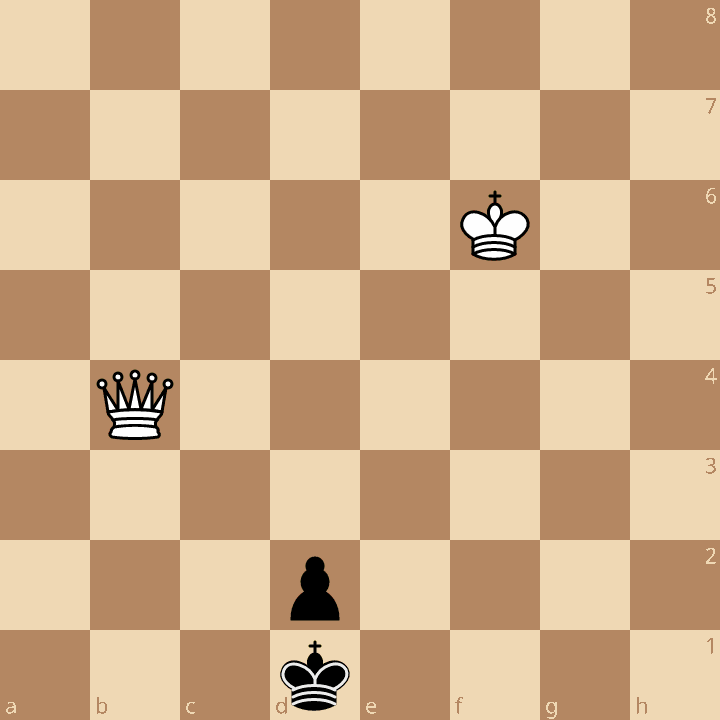
Now the check-and-approach staircase begins. The queen gives check from c4, forcing the black king to move. Notice how the queen simultaneously checks AND gets closer to the pawn — this is the diagonal approach pattern. Avoid Qxd2+ here — while K+Q vs K is a theoretical win, the staircase technique is far more efficient, winning in 16 moves vs a long K+Q vs K mating procedure.
Alternative Moves
Black retreats to b1, stepping away from the check. The king cannot stay on the d-file because the queen controls it from c4.
The queen continues the diagonal staircase — another check from b3, one step closer to the pawn. Each check forces the king to move while the queen gets nearer to d2.
Black returns toward the pawn. The defending side keeps shuttling between supporting the pawn and dodging checks — but White is getting closer with each cycle.
Another check, and now the queen is just one square away from d2! The staircase pattern is clear: Qc4+ → Qb3+ → Qc3+, each time getting closer diagonally.
This is the crucial moment: the king steps in front of its own pawn! The pawn on d2 is now blocked and cannot promote. This is exactly what White wanted — whenever the defending king blocks its own pawn, White gains a free tempo to bring the king closer.
The key technique: while the pawn is blocked by its own king, White advances the king one step closer. The queen on c3 keeps everything under control — it watches the d2 pawn and restricts the black king. This is the repeating cycle: check → king blocks pawn → advance your king.
Black's king escapes from in front of the pawn, unblocking it. But now the queen will check again, forcing the king right back in front of the pawn.
Check! The queen forces the king back toward d1. The cycle repeats — after the king blocks the pawn again, White will advance the king another step.
The king is forced in front of the pawn again. Each time this happens, White's king gets one step closer. The defense is hopeless against the center pawn.
Another king advance! White's king is now on d3, directly supporting the queen. The king has traveled from f6 to d3 through the check-and-approach technique. The pawn on d2 is doomed.
Black's only legal move. Ke1 is blocked by the queen on e3 (controls the e-file), and Kc2/Ke2 are blocked by the white king on d3. The pawn is lost.
The queen captures the pawn with check! The entire check-and-approach technique has led to this moment. Now it's a simple King and Queen vs King — a position we already know how to win.
Black's only escape. The king tries to run but is trapped on the edge with White's king and queen coordinating perfectly.
The king closes in. With the queen on d2 and king on c3, Black has no escape squares. Checkmate is one move away.
Black retreats to the corner — the only legal move. The king is trapped on a1 with no escape.
Checkmate! The queen on b2 covers all escape squares (a1, a2, b1), and the white king on c3 supports the queen. The check-and-approach staircase has led to a clean win against the center pawn. Remember: this technique works against center pawns (d, e) and bishop pawns (c, f). Against rook pawns, the defending king hides in the corner and draws.
Key Takeaways
- Against center pawns (d, e) and bishop pawns (c, f) on the 7th rank, the queen always wins
- Use the check-and-approach staircase: check → king blocks pawn → advance your king
- The queen approaches diagonally with each check, getting closer to the pawn
- Never capture the pawn until your king is close enough to support checkmate
- Against rook pawns (a, h), the defending king hides in the corner — those are usually draws
Now play it through
Step through every move on a real board, try the wrong ones, and ask Knighty why they fail.
Summary
Ready to Practice?
Take this lesson with you
Free account requiredWith every variation — opens in Lichess & ChessBase