
Rook Behind Passed Pawn
Learn Tarrasch's rule — the rook belongs behind passed pawns, both your own and your opponent's.
Try Interactive LessonIntroduction
Lesson Content
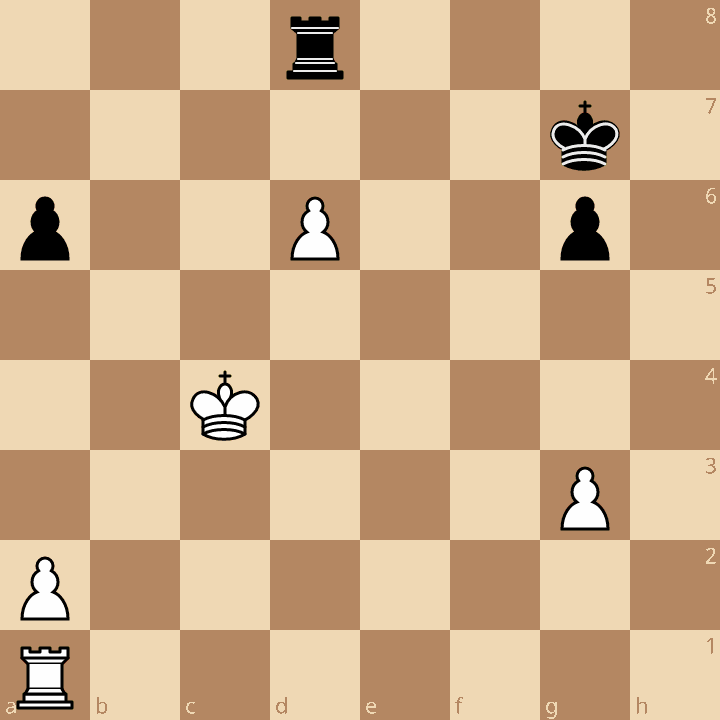
Tarrasch's rule in action! The rook moves from a1 to d1, getting behind the passed d-pawn. This is the key move of the entire lesson. From d1, the rook supports the pawn's advance along the entire d-file. Notice the contrast: White's rook on d1 is active — it gains more squares as the pawn advances. Black's rook on d8 is passive — it must stay glued to d8 to prevent the pawn from queening.
Alternative Moves
Black pushes the g-pawn, trying to create counterplay on the kingside. Since the rook is tied to d8 defending against the passed pawn, the king and pawns must try to generate threats elsewhere. But this is too slow — White's passed pawn supported by the rook is the dominant factor.
Push the pawn! The d-pawn advances to d7, one square from promotion. This is the beauty of having the rook behind the pawn — the pawn can advance freely because the rook on d1 supports it from behind. Black's rook is now in a terrible bind: it must stay on d8 to prevent d8=Q, but it's completely immobilized. Notice how the rook behind the pawn *gains* power as the pawn advances — it now controls the entire d-file from d1 through d7.
Alternative Moves
Black moves the king to h6, heading toward the kingside. With the rook chained to d8, the king tries to create counterplay. But White's king will march the other way — toward c7 to support promotion.
King marches to support the pawn! The plan is simple: bring the king to c6 and then c7 to protect the d7 pawn. While Black's king wanders on the kingside, White's king heads straight for the action. This is the winning combination: rook behind the pawn + king marching to escort it.
Black's king continues to h5. But this counterplay is far too slow — White's king is closing in on the d7 pawn, where it will shield it and force promotion.
The king reaches c6! Now Kc7 is threatened, which would shield the d7 pawn and allow d8=Q. Black's rook is paralyzed on d8 — it can't leave or the pawn promotes immediately. The position perfectly illustrates Tarrasch's rule: the rook behind the pawn controls the file, the king escorts the pawn, and the defender's rook is completely passive.
Black's rook abandons the blockade, moving to b8. Staying on d8 was hopeless — after Kc7, White threatens d8=Q winning the rook outright. By moving to b8, Black gives up the blockade but keeps the rook alive to attempt counterplay.
The rook shifts from d1 to d4 — still behind the pawn, but now also cutting off Black's king from the queenside along the 4th rank. This dual-purpose move maintains pawn support while controlling more space. Black's king on h5 is trapped on the kingside.
Black returns the rook to d8, desperately trying to restore the blockade. But with White's king already on c6, it's too late — Kc7 is coming and the rook will be forced off d8 again.
The king reaches c7! Now the d7 pawn is fully protected by the king, and d8=Q would win the rook outright. Black's rook must abandon d8 — there's no way to hold the blockade when the king supports the pawn from behind.
Black moves the rook to a8, giving up the blockade for good. Staying on d8 would lose the rook to d8=Q. The rook retreats to a8 where it defends the a6 pawn, but the pawn will promote shortly.
Precise play! Before promoting, White pushes g4 with check. This fixes Black's g-pawn on g5 and drives the king further away. In a winning position, it's always good to improve your position before executing the final blow.
The king retreats to g6, the only safe square. But there's nothing Black can do — the d7 pawn is about to become a queen.
Promotion! The d-pawn queens on d8, completing the plan that started with Rd1. What began as a simple rook repositioning led to an unstoppable passed pawn. The entire game plan flowed from Tarrasch's rule: rook behind the passed pawn, advance the pawn, march the king to escort it.
Black captures the queen with the rook — the only move to avoid losing more material. But the damage is done.
White recaptures with the king. The final position is White's king on d8 with a rook on d4 and two pawns against Black's king and two pawns — a trivially won endgame. The entire victory stemmed from one key decision: placing the rook behind the passed pawn on move one.
Key Takeaways
- Place the rook behind your passed pawn — it gains more freedom as the pawn advances and controls the entire file
- A rook in front of a passed pawn is passive — it gets squeezed as the pawn pushes forward
- Advance the passed pawn with rook support from behind, then march the king to escort it to promotion
- Tarrasch's rule also applies to your opponent's passed pawns — place your rook behind them to maximize counterplay
- A far-advanced passed pawn supported by a rook from behind ties down the opponent's pieces, creating a decisive advantage
Now play it through
Step through every move on a real board, try the wrong ones, and ask Knighty why they fail.
Summary
Ready to Practice?
Take this lesson with you
Free account requiredWith every variation — opens in Lichess & ChessBase