
Shouldering (Body Check)
Learn the shouldering technique where the king physically blocks the opponent's king from reaching the pawn, allowing it to promote.
Try Interactive LessonIntroduction
Lesson Content
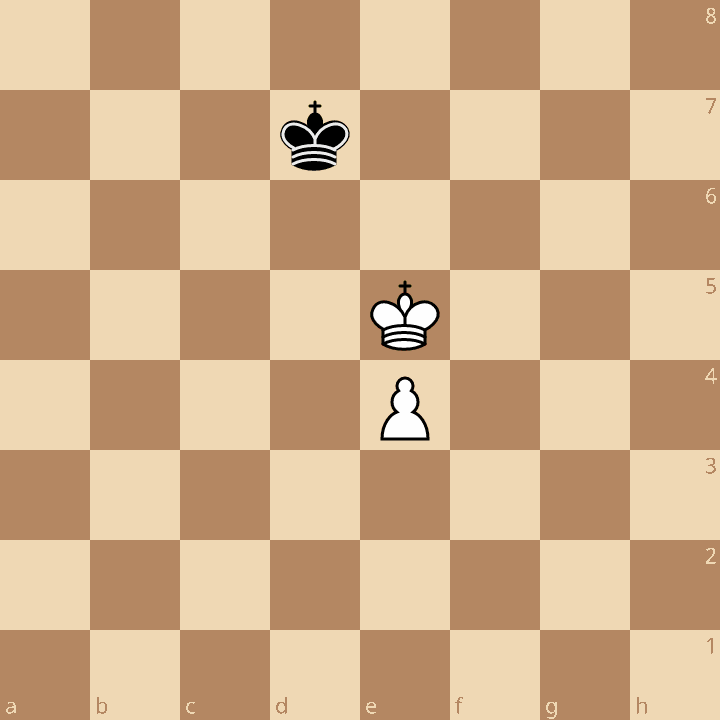
The key move — shouldering! Instead of walking in front of the pawn with Kd5, White's king steps sideways to f6. This blocks Black's king from reaching the e-file via e6 or e7. From f6, the king controls e5, e6, e7, f5, f7, g5, g6, and g7 — creating a wide wall that Black cannot cross. This is the fastest winning move. Kd5 and Kf5 also win but take longer. Stepping backward with Kd4 or Kf4 throws away the win and draws.
Alternative Moves
Black's best defense — retreating to d8 delays the loss the longest. Black hopes to shuttle back toward the pawn once White commits. Moves like Kd6 or Ke8 allow a faster win.
White continues the shoulder press, advancing the king to f7. Now White's king controls the entire e7-e8 corridor. Black's king on d8 is completely cut off from approaching the e-pawn — it can only go to the c-file or stay on the back rank. This is the heart of shouldering: the king acts as a barrier, not a pawn escort.
Black tries to escape around the side, heading to the c-file. But it's too late — White's king on f7 has created too much distance between Black and the e-pawn. The shouldering has done its job.
Now that Black's king is pushed far away on c7, the pawn marches forward. This is the payoff of shouldering: while the king held the door shut, the pawn gained a clear path. Black's king is two files away from the e-pawn and can never catch up.
Black rushes back toward the pawn, but it's a lost race. The king on d7 is still too far — White's king on f7 continues to block the direct path to e6 and e7.
The pawn advances with check, gaining another tempo. Black's king is pushed away again — it cannot stay on d7 because the pawn on e6 attacks it. The pawn is now just two squares from promotion.
Black approaches the pawn from behind, but the king on f7 still guards e7 and e8. Black's king attacks e6 but White's king defends it. The pawn is safe and will continue advancing.
The pawn reaches the 7th rank, one step from promotion. White's king on f7 guards both e8 and e7. Black's king on d6 cannot reach e8 in time to block the promotion — shouldering has guaranteed the pawn's advance.
Black retreats, helpless. The king on d5 is three squares from e8 and cannot get there in time. White promotes immediately. The shouldering technique has created an unstoppable pawn.
The pawn promotes to a queen! The resulting K+Q vs K position is a trivial win. The shouldering technique has converted a single pawn advantage into a decisive material lead. Look back at the starting position — White's king on e5 was directly in front of the pawn. The natural instinct might be to push the pawn or advance the king straight ahead. But the winning idea was to step sideways with Kf6, creating a physical barrier that Black's king could never cross.
Key Takeaways
- Shouldering means moving the king sideways to block the opponent's king — acting as a wall, not a pawn escort
- The winning king goes to the side of the pawn, not in front of it — this creates a barrier the defender cannot cross
- Once the opposing king is shouldered away, advance the pawn while the defender is too far to catch up
- Pushing the pawn too early (before shouldering) often draws — the defender reaches the key squares in time
- Shouldering works because the king controls 8 surrounding squares, creating a wide barrier across multiple files
Now play it through
Step through every move on a real board, try the wrong ones, and ask Knighty why they fail.
Summary
Ready to Practice?
Take this lesson with you
Free account requiredWith every variation — opens in Lichess & ChessBase