
Triangulation
Learn how to lose a tempo with your king to force your opponent into zugzwang — the key technique of triangulation.
Try Interactive LessonIntroduction
Lesson Content
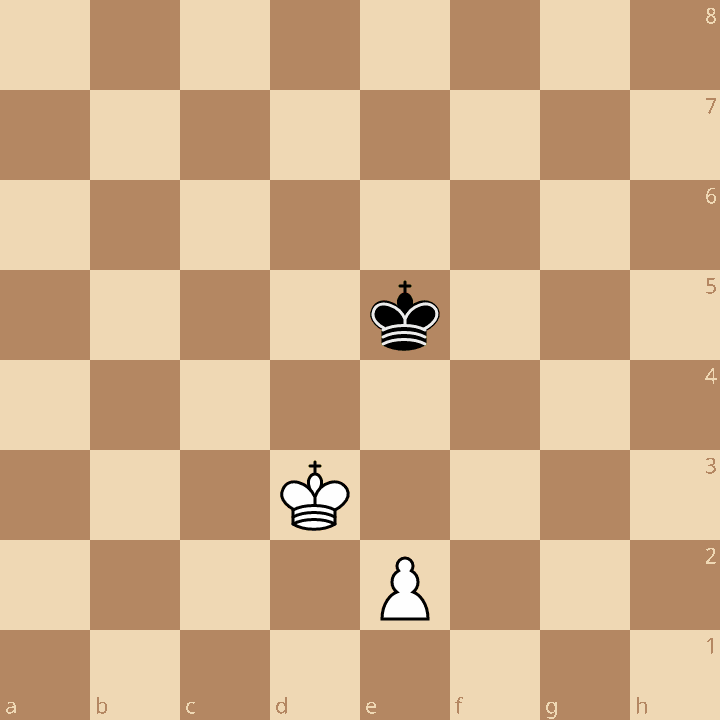
Triangulation in action! By stepping to e3, White creates a reciprocal zugzwang — the same position (kings facing each other across the e-file) but now it's Black's turn to move. This is the only winning move. From d3, White "lost a tempo" by moving to e3 instead of pushing the pawn. If Black were already on d5 or f5, White would have the opposition. The key insight: whoever must move from this symmetrical position is at a disadvantage.
Alternative Moves
Black steps to d5, the best defense. Black must move (zugzwang!) and every option concedes ground. By going to d5, Black tries to stay near the center and maintain control of key squares. But White now has a critical outflanking opportunity.
Outflanking! White sidesteps to f4, exploiting the fact that Black was forced to d5. White's king is now heading to the fifth rank via the f-file, getting in front of the pawn. This is the payoff of the triangulation — Black's king is on the wrong side.
Alternative Moves
Black retreats to e6, trying to stay in front of White's pawn and maintain the blockade. This is the best defense — keeping the king centralized and near the e-file.
White advances to e4, getting in front of the pawn. This is a critical milestone — the king is now ahead of the pawn on the same file. The golden rule of K+P vs K: the king must get in front of the pawn to win.
Black moves to d6, staying near the e-file to maintain the blockade. Black's only hope is to keep the king in front of or beside the pawn.
White outflanks again to f5! The king is now three ranks ahead of the pawn — a decisive advantage. From f5, White controls e6 and can advance to e5 or f6 next, pushing Black further back.
Black retreats to e7. The king is being pushed further from the center. White's outflanking has succeeded — the king is well ahead of the pawn.
Now it's safe to push the pawn! With the king firmly established on f5 (two ranks ahead), the pawn can begin its march. The e-pawn advances to e3.
Black tries to approach the pawn, heading back toward the d-file. But White's king on f5 controls the key squares and the pawn is well protected.
The pawn advances to e4. White maintains the king two squares ahead of the pawn — the winning formation. The pawn steadily marches forward under the king's protection.
Black retreats to e7, trying to stay near the promotion square. But White's king controls the path ahead.
White's king advances to e5 — directly in front of the pawn and controlling d6 and f6. The king escorts the pawn like a bodyguard, clearing the path for promotion.
Black retreats further. The defending king is running out of room to maneuver. White's systematic advance has pushed Black to the back ranks.
White advances to f6, controlling e7 and cutting off Black's retreat squares. The king is now three ranks ahead of the pawn, which will catch up quickly.
Black retreats to d8, the back rank. The defending king is completely pushed aside — it can no longer interfere with the pawn's advance.
White's king reaches f7, controlling the entire e8 promotion square. The pawn now has a clear path to queen. White's king will support the advance from the side.
Black moves away from the action entirely. The defending king can no longer stop the e-pawn from promoting — it's a lost cause.
The e-pawn charges forward to e5. With the king on f7 controlling the promotion square, the pawn races toward e8 unimpeded.
Black's king wanders further away — there is nothing the defending side can do to prevent promotion.
The pawn advances to e6 — two squares from promotion. The outcome is decided.
Black continues retreating. The king is too far from e8 to interfere with promotion.
The pawn reaches the 7th rank — one square from queening. White's king on f7 guards e8 perfectly.
Black's last move before the pawn promotes. Nothing can prevent the e-pawn from becoming a queen.
Promotion! The e-pawn becomes a queen. The entire game was decided on move 1: White played Ke3 instead of pushing the pawn, gaining the crucial tempo through triangulation. That single move created a zugzwang that forced Black to give ground, allowing White to outflank, get the king in front of the pawn, and escort it to promotion.
Key Takeaways
- Triangulation means maneuvering the king to put your opponent in zugzwang — forcing them to move when any move weakens their position
- Never push the pawn too early — get the king in position first
- The king must get IN FRONT of the pawn to win K+P vs K endgames
- After gaining the opposition through triangulation, outflank to advance past the defender
- Reciprocal zugzwang: the same position can be winning or drawing depending on whose turn it is
Now play it through
Step through every move on a real board, try the wrong ones, and ask Knighty why they fail.
Summary
Ready to Practice?
Take this lesson with you
Free account requiredWith every variation — opens in Lichess & ChessBase