
Wrong Bishop + Rook Pawn
Learn why a bishop and rook pawn cannot win when the bishop doesn't control the promotion square — the defender draws by reaching the corner.
Try Interactive LessonIntroduction
Lesson Content
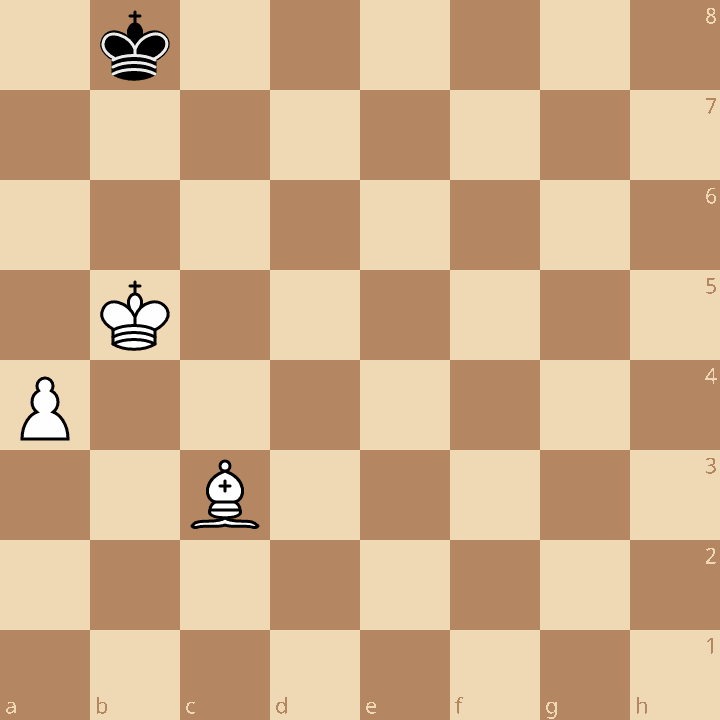
White pushes the passed pawn toward promotion. This is the natural first move — advance the pawn while the king supports it. But as we'll see, the pawn can never actually promote because the bishop is on the wrong color.
Black heads straight for the corner — the key defensive idea. The defending king wants to sit on a8, the promotion square. Since White's bishop is dark-squared, it can never attack the light-squared a8, so the king will be safe there forever.
White advances the king to b6, the ideal supporting position. From b6, the king controls a7 and b7, cutting off the defending king's escape routes. White's setup looks perfect — king on b6, pawn ready to push. But appearances are deceiving.
Black's only legal move. The king on a8 cannot go to a7 or b7 (both controlled by White's king on b6), so it must shuttle to b8. This back-and-forth between a8 and b8 is the entire defensive plan.
White tries to reposition the bishop to a more useful square. Can the bishop find a square that forces Black's king out of the a8-b8 shuttle? Let's try the long diagonal. Spoiler: no dark-squared bishop placement can ever attack a8 (a light square), so the bishop is fundamentally useless for this task.
Alternative Moves
Black returns to the corner. This is the only drawing move — Kc8 would lose because White plays a6 and then a7, promoting the pawn. The defender must stay close to a8 and never wander to the c-file.
Alternative Moves
Another bishop square, another failure. From c5, the bishop controls different diagonals but still can't attack a8. The fundamental problem remains: dark-squared bishops can only ever reach dark squares, and a8 is light.
Black shuttles back to b8, the only legal move. The defense is remarkably simple: just bounce between a8 and b8. White's bishop is completely irrelevant.
One more try — the bishop moves to e7, covering the d8 and f8 squares. But none of this matters. The bishop needs to control a8 to force the king out, and no dark square leads to a8. White has tried three different bishop positions and accomplished nothing.
Back to the corner. Again, Kc8 would lose — White pushes a6, a7, and promotes. The defender's discipline is key: never leave the a8-b8 corridor.
Alternative Moves
Bishop maneuvers have failed, so White pushes the pawn. With the king on b6 and pawn on a6, White is one step from a7. But watch what happens — the closer the pawn gets to promoting, the closer White gets to stalemate.
Black shuttles to b8 again — the only legal move. The king will return to a8 as soon as White pushes a7.
The pawn reaches the 7th rank with check! The pawn on a7 attacks b8, forcing Black's king to move. But this check actually brings White closer to the stalemate trap — with the pawn on a7 blocking the a-file and the king on b6 controlling b7, Black's king will have nowhere to go.
Forced — the only drawing move. Kc8 loses immediately to a8=Q+, promoting with check and winning easily. Black retreats to a8, sitting right on the promotion square. White's pawn cannot promote because the king is in the way.
Alternative Moves
Stalemate! Black has no legal moves: a7 is occupied by the pawn, b7 is controlled by the king on b6, and b8 is attacked by the pawn on a7. The game is drawn. This is the fundamental reason the wrong bishop + rook pawn is a draw: the bishop cannot attack the promotion square to force the king away, and every attempt to push the pawn results in stalemate. If White retreats the king instead (e.g., Kb5), Black escapes with Kxa7 and it's K+B vs K — also a draw by insufficient material. There is simply no way to win this endgame.
Key Takeaways
- A rook pawn (a or h file) + bishop that doesn't control the promotion square = draw
- The defender draws by placing the king on the promotion square (a8 or h1/h8)
- The bishop can never attack the opposite-colored promotion square — it's structurally impossible
- Pushing the pawn to the 7th rank creates a stalemate trap with the king on b6/g6
- Retreating the king to avoid stalemate lets the defender capture the pawn
- Recognize this pattern early — don't waste moves trying to win an unwinnable endgame
Now play it through
Step through every move on a real board, try the wrong ones, and ask Knighty why they fail.
Summary
Ready to Practice?
Take this lesson with you
Free account requiredWith every variation — opens in Lichess & ChessBase