开局

English Botvinnik System

A powerful English Opening setup where White builds a pawn triangle on c4-d3-e4 with a kingside fianchetto, creating a flexible positional framework.

体验互动课程

简介

The English Botvinnik System is named after Mikhail Botvinnik, the 6th World Champion, who championed this setup in the 1950s-60s. White builds a powerful pawn triangle on c4-d3-e4, combined with a kingside fianchetto — creating a flexible structure that controls the center while keeping all pieces coordinated. The key idea is that the knight goes to e2 (not f3) to keep the d-pawn flexible and avoid blocking the f-pawn. White aims for a slow buildup with Nd5 outpost play, while Black typically counters with ..f5, striking at the e4 pawn. The resulting positions are strategic and rich in long-term planning.

课程内容

8
7
6
5
4
3
2
1
a
b
c
d
e
f
g
h
1. c4

The English Opening — White controls d5 from the flank without committing the d-pawn. This is a flexible, positional opening that can transpose into many 1. d4 lines or lead to unique English systems. Black's main options: - 1. ..e5 — Reversed Sicilian - 1. ..Nf6 — can transpose to Indian setups - 1. ..c5 — Symmetrical English

中心控制空间
替代走法
e4Also excellent, but leads to different openings. c4 is more positional and flexible.
1
2
3
4
5
6
7
8
h
g
f
e
d
c
b
a
1. ..e5

Black claims central space and opens the diagonal for the dark-squared bishop. This is the most ambitious reply — the resulting positions mirror a Reversed Sicilian where White has an extra tempo. The e5 pawn controls d4 and f4, setting up a classical central structure.

中心控制空间
8
7
6
5
4
3
2
1
a
b
c
d
e
f
g
h
2. Nc3

White develops the knight to its most natural square, reinforcing control of d5 and e4. The knight on c3 is a cornerstone of the Botvinnik System — it will later support the e4 advance and potentially jump to d5. This is the main move, leading to the King's English complex.

出子中心控制
替代走法
Nf3Playable but blocks the f-pawn and limits the Botvinnik setup. Nc3 keeps more options open.
1
2
3
4
5
6
7
8
h
g
f
e
d
c
b
a
2. ..Nc6

Black develops the knight, defending e5 and controlling d4. This leads to the Closed English — a strategic battleground where both sides build up slowly before committing. Black mirrors White's development philosophy, keeping the position symmetrical for now.

出子中心控制
8
7
6
5
4
3
2
1
a
b
c
d
e
f
g
h
3. g3

Preparing the kingside fianchetto — a key component of the Botvinnik System. The bishop on g2 will control the long diagonal (a8-h1), exerting pressure on the center and queenside from a safe distance. The fianchetto also prepares castling and pairs well with the upcoming e4 push.

出子王的安全
替代走法
Nf3Develops but commits the knight to f3, where it blocks the f-pawn. g3 is essential for the Botvinnik setup.
e3Too passive — blocks the dark-squared bishop. g3 prepares a fianchetto with more scope.
1
2
3
4
5
6
7
8
h
g
f
e
d
c
b
a
3. ..g6

Black mirrors White's fianchetto plan. The bishop on g7 will be a powerful piece on the long diagonal (a1-h8), exerting pressure on the center and supporting ..f5 breaks. This symmetrical fianchetto setup leads to a strategic battle where both bishops eye the center from the flanks.

出子王的安全
8
7
6
5
4
3
2
1
a
b
c
d
e
f
g
h
4. Bg2

The bishop takes its place on the long diagonal, completing the fianchetto. From g2, it controls d5 and pressures the entire a8-h1 diagonal — especially powerful once the center opens. The Bg2 is one of White's most important pieces in the Botvinnik System, supporting both the e4 advance and Nd5 jumps.

出子子力活跃度
1
2
3
4
5
6
7
8
h
g
f
e
d
c
b
a
4. ..Bg7

Black completes the symmetrical fianchetto. The Bg7 is a powerful defensive and offensive piece — it guards the dark squares around the king and can become a monster if the center opens. With both bishops fianchettoed, the position resembles a King's Indian Defense with reversed colors.

出子子力活跃度
8
7
6
5
4
3
2
1
a
b
c
d
e
f
g
h
5. e4

The defining move of the Botvinnik System — White seizes the center with pawns on c4 and e4. This creates the signature pawn duo that controls d5, restricts Black's pieces, and prepares the ideal d3 triangle. The c4+e4 structure is extremely flexible: White can play d3 for solidity or d4 for a central breakthrough later.

中心控制空间
替代走法
d3Too modest. e4 claims the center immediately and defines the Botvinnik character.
Nf3Delays the central claim. e4 is the whole point of the Botvinnik setup.
1
2
3
4
5
6
7
8
h
g
f
e
d
c
b
a
5. ..d6

Black supports the e5 pawn and prepares ..Nge7 followed by ..f5 — the thematic counterattack against White's center. The d6 pawn also prevents White from pushing e5. This solid setup gives Black a flexible position with plans on both flanks.

中心控制兵形
8
7
6
5
4
3
2
1
a
b
c
d
e
f
g
h
6. Nge2

The knight goes to e2 — not f3! This is a hallmark of the Botvinnik System. On e2, the knight keeps the f-pawn free for a potential f4 push, avoids blocking the Bg2's diagonal, and can reroute to c3-d5 or f4. The Nge2 also supports a future d3 without blocking any pieces — a perfectly coordinated setup.

出子子力活跃度
替代走法
Nf3Blocks the f-pawn and the Bg2 diagonal. Nge2 is the Botvinnik way — more flexible.
1
2
3
4
5
6
7
8
h
g
f
e
d
c
b
a
6. ..Nge7

Black mirrors the same logic — the knight goes to e7 instead of f6 to keep the f-pawn free for the critical ..f5 break. From e7, the knight can also reroute to c6-d4 or support ..f5. Both sides are now fully committed to the double fianchetto + knight-on-e2 structure.

出子子力活跃度
8
7
6
5
4
3
2
1
a
b
c
d
e
f
g
h
7. d3

Completing the Botvinnik pawn trianglec4, d3, e4. This is one of the most solid central structures in chess. The d3 pawn defends e4 from below while keeping the position closed and strategic. White's plan is clear: castle, then use the Nd5 outpost and prepare f4 or b4 pawn breaks.

兵形中心控制
替代走法
d4Opens the center prematurely. d3 maintains the solid triangle structure.
1
2
3
4
5
6
7
8
h
g
f
e
d
c
b
a
7. ..O-O

Black castles to safety, connecting the rooks and preparing the ..f5 counterattack. With the king safe, Black can focus on the central and kingside battle. The rook on f8 will support the upcoming ..f5 push — Black's primary plan in this structure.

王的安全出子
8
7
6
5
4
3
2
1
a
b
c
d
e
f
g
h
8. O-O

White also castles, completing development. Both sides are now fully developed with mirrored fianchetto structures — the real strategic battle begins. White's typical plans from here include Nd5 (occupying the outpost), Be3+Qd2 (preparing queenside play), or f4 (if Black delays ..f5).

王的安全出子
1
2
3
4
5
6
7
8
h
g
f
e
d
c
b
a
8. ..f5

The thematic counterattack! Black strikes at White's e4 pawn, the foundation of the Botvinnik triangle. This is Black's primary plan — opening the f-file for the rook and creating kingside play. The tension on e4 forces White to make a decision: capture (opening lines), defend (keeping the structure), or counter with Nd5.

中心控制兵形威胁
8
7
6
5
4
3
2
1
a
b
c
d
e
f
g
h
9. Nd5

White occupies the powerful d5 outpost before dealing with the f5 tension. The knight on d5 is a dominant piece — it can't be easily dislodged by pawns and controls key squares (b4, c3, e3, f4, b6, c7, e7, f6). This is a classic Botvinnik idea: use the d5 square created by the c4+e4 structure to plant a piece that dominates the board.

子力活跃度空间预防性着法
替代走法
exf5Gives up the center. Nd5 maintains central dominance while the tension stays on the board.
Bd2Useful but misses the chance to occupy d5 immediately while the knight is still on c3.
1
2
3
4
5
6
7
8
h
g
f
e
d
c
b
a
9. ..Nxd5

Black trades the knight to eliminate White's dominant piece on d5. While this removes the outpost knight, it allows White to recapture with the c-pawn, fundamentally transforming the pawn structure. This trade is a key strategic decision — Black removes the strong knight but gives White a passed d-pawn potential.

子力活跃度兵形
8
7
6
5
4
3
2
1
a
b
c
d
e
f
g
h
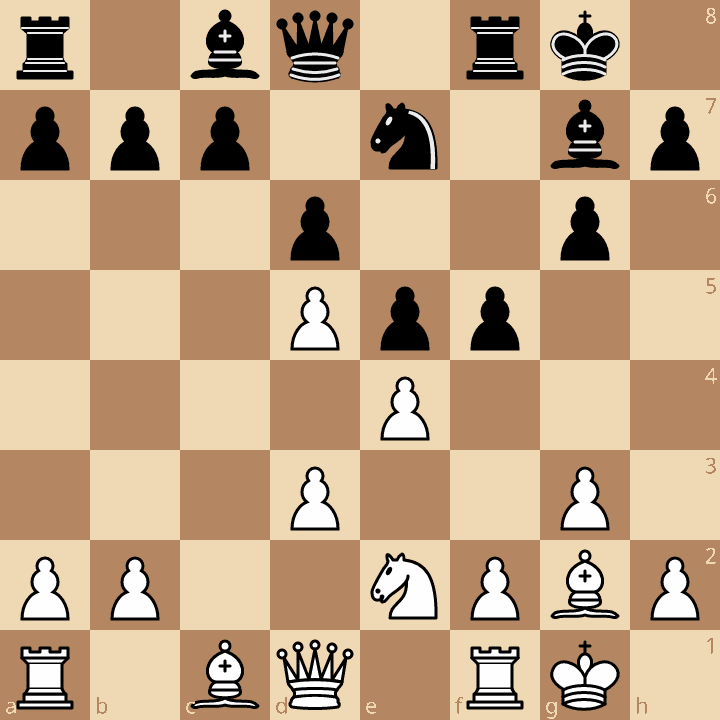
10. cxd5

Recapturing with the c-pawn creates a powerful central pawn wedge on d5. This pawn restricts Black's Nc6 and clamps down on the center. White now has a space advantage and clear plans: push the d-pawn, play on the queenside with a4-a5, or use the open c-file. The pawn on d5 is a permanent asset — it controls c6 and e6, limiting Black's piece activity.

兵形空间
替代走法
exd5Gives Black the e-file and weakens d3. cxd5 maintains the central clamp.
1
2
3
4
5
6
7
8
h
g
f
e
d
c
b
a
10. ..Ne7

The knight retreats to e7, supporting a future ..c6 break to challenge the d5 pawn. From e7, the knight also eyes d5 and f5 — key squares for Black's counterplay. The position is strategically complex: White has a space advantage and the d5 wedge, while Black has the bishop pair and potential kingside play with ..f4.

子力活跃度预防性着法

要点总结

  • The Botvinnik triangle (c4-d3-e4) creates a rock-solid, flexible center
  • Nge2 (not Nf3) keeps the f-pawn and Bg2 diagonal free
  • The d5 square is a powerful outpost for the knight
  • Black's main counter is ...f5, attacking the e4 base of the triangle
  • After Nd5 and cxd5, the central pawn wedge gives White lasting pressure

总结

You've learned the English Botvinnik System — White's powerful setup with the c4-d3-e4 pawn triangle and double fianchetto. The key ideas are Nge2 (keeping the f-pawn free), the Nd5 outpost, and maintaining a flexible center. Black counters with ..f5 to attack the triangle, leading to rich strategic battles.

准备好练习了吗?

相关课程