
Czech Benoni Defense
A solid, closed defense where Black locks the center with ...e5 and plans a kingside pawn storm with ...f5.
Try Interactive LessonIntroduction
Lesson Content
The Queen's Pawn opening — White claims the center with the d-pawn, which is immediately defended by the queen. This tends to lead to more strategic, closed positions compared to 1. e4. Black's main responses: - 1. ..d5 — Queen's Gambit and Slav setups - 1. ..Nf6 — Indian Defenses (King's Indian, Nimzo-Indian, etc.) - 1. ..f5 — Dutch Defense
Black develops the knight and controls e4, preventing White from building the ideal e4+d4 center easily. This is the gateway to all Indian Defense systems. Black delays committing a pawn structure, staying flexible to choose between King's Indian, Nimzo-Indian, Queen's Indian, and more.
White reinforces control of d5 and grabs more space. Combined with d4, the two pawns dominate the center. Now Black's response determines the opening system: - 2. ..e6 — Nimzo-Indian (after 3. Nc3 Bb4) or Queen's Indian - 2. ..g6 — King's Indian or Grunfeld - 2. ..c5 — Benoni structures - 2. ..e5 — Budapest Gambit
Black immediately challenges White's d4 pawn from the flank. This is the starting point of all Benoni structures. Black accepts less central space in exchange for asymmetry and counterplay. White almost always pushes 3. d5, gaining space but creating a closed center that Black will attack on the flanks.
Alternative Moves
White pushes past, gaining space and creating a pawn wedge on d5. The center is now semi-closed. This is the defining moment — Black must choose which Benoni structure to adopt. Black's main choices: - 3. ..e5 — Czech Benoni, locking the center completely - 3. ..e6 — Modern Benoni, creating dynamic tension - 3. ..d6 — Old Benoni, keeping options open
The defining move of the Czech Benoni — Black locks the center completely with pawns on c5, d6, and e5 facing White's c4, d5, and (soon) e4. No pawn exchanges are possible in the center. This creates a slow, strategic battle. Black plans ..f5 to break on the kingside, while White aims for b4 or a4-a5 on the queenside. The closed nature suits patient, positional players.
Alternative Moves
White develops the knight to its natural square, supporting the upcoming e4 push. The knight on c3 controls d5 and e4 — two critical squares in this closed structure. White's plan is clear: play e4 to complete the pawn chain (c4-d5-e4), then maneuver pieces to support either a kingside or queenside advance.
Black completes the pawn chain with c5-d6-e5. The d6 pawn is essential — it supports e5 and prevents White from ever playing d6. Black's structure is solid but cramped. The pawn chain runs diagonally from c5 to e5, mirroring White's c4-d5 chain. Both sides will now develop behind their pawns before launching flank attacks.
Alternative Moves
White completes the ideal pawn chain: c4-d5-e4. This structure gives White a significant space advantage, but the center is completely locked — no pawn breaks are possible here. Both sides now focus on piece maneuvering and flank play. White typically aims for queenside expansion (a4, b4), while Black prepares the ..f5 kingside break.
The bishop develops modestly to e7 rather than an active diagonal. In the Czech Benoni, the bishop's role is defensive — it supports the ..f5 break and prepares castling. The bishop may later reposition to f6 or g5 to trade off White's dark-squared bishop, which is often stronger in these structures.
Alternative Moves
White prepares to fianchetto the bishop on g2, where it will control the long a8-h1 diagonal. This is the most popular setup against the Czech Benoni. The fianchettoed bishop supports d5 and eyes the queenside — ideal for White's plan of expanding with a4, b4. White's alternatives: - 6. Nf3 — classical development, also very popular - 6. Bd3 — aiming the bishop at the kingside instead
Castle to safety before starting the kingside plan. The king on g8 is well-protected behind the e5 pawn, and the rook on f8 will support the future ..f5 break. Castling early is essential — Black needs several tempi to reroute pieces for the kingside attack, and the king must be safe first.
The bishop settles on the long diagonal, putting pressure on d5 and beyond. From g2, it supports the d5 pawn and monitors the entire queenside. This fianchetto setup is one of the most effective plans against the Czech Benoni, as the bishop's long-range influence compensates for the locked center.
The signature maneuver of the Czech Benoni! The knight retreats from f6 to e8, clearing the way for the ..f5 pawn break. From e8, the knight can reroute to g7 (supporting ..f5) or to c7 (supporting ..b5). This looks unusual — retreating a developed piece — but it's the key to Black's entire strategy. The knight on f6 was blocking the f-pawn, and the ..f5 break is Black's primary source of counterplay.
Alternative Moves
White develops the knight to e2 rather than f3, keeping the f-pawn free to advance with f4 if needed. The knight on e2 can also reroute to f4 or g3, supporting central and kingside control. This is a flexible developing move — the knight avoids f3 where it would block the f-pawn and the Bg2's diagonal.
Black develops the last minor piece, connecting the rooks. The knight on d7 supports the e5 pawn and can later move to f6 or b6 depending on the situation. With all pieces developed, Black is almost ready for the thematic ..f5 break — just ..g6 and ..Ng7 remain to prepare it properly.
Alternative Moves
White castles, securing the king and connecting the rooks. With the king safe, White can focus on queenside expansion — the typical plan involves a4, Rb1, and b4 to break open lines on the queenside.
Black prepares the ..Ng7 reroute and creates a home for the knight. The g6 pawn also supports a future ..f5 — after ..f5 exf5 gxf5, Black's pawn on f5 controls e4 and opens the g-file for the rook. This is the second part of Black's setup — after ..Ne8 (clearing f6) and ..g6 (preparing ..Ng7), the ..f5 break is nearly ready.
White prepares to fianchetto the queenside bishop on b2, adding pressure along the long diagonal. The b3 move also supports a future a4-a5 push to gain queenside space. This is the typical White plan in the Czech Benoni — slow queenside expansion while maintaining the solid d5-e4 pawn chain.
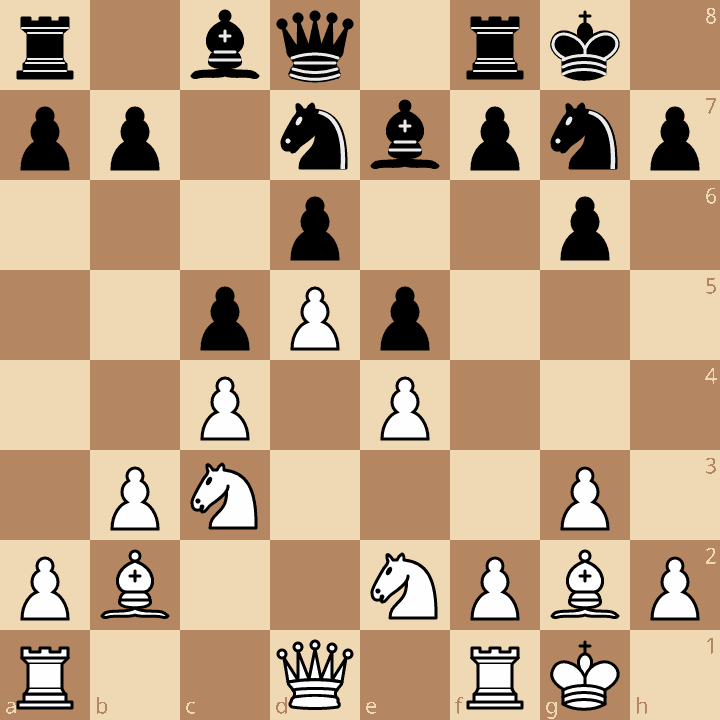
The knight completes its journey from f6 to e8 to g7. From g7, it supports the ..f5 break — Black's primary strategic goal. After ..f5, the knight can jump to f5 or e6 via the opened position. Black's setup is now complete: the pawn chain is solid, all pieces are developed, and the ..f5 break is fully prepared. This is the ideal Czech Benoni formation.
White completes the double fianchetto — bishops on g2 and b2 control both long diagonals. The Bb2 supports the e5 square (after a potential ..f5 exf5 opening) and adds pressure to Black's kingside. Both sides have completed their development. The position is a classic Czech Benoni — White will push for queenside space with a4-a5 and b4, while Black launches the ..f5 kingside attack.
Key Takeaways
- 3...e5 locks the center — no pawn exchanges possible, creating a closed strategic battle
- The knight maneuver Ne8-g7 is the heart of the Czech Benoni, clearing the way for ...f5
- Black's main plan is the ...f5 kingside pawn break, opening lines for the rook and bishop
- White's counterplay comes from queenside expansion — a4, b4, and pressure along the a-file
- Patience is key — develop all pieces behind the locked center before launching your pawn break
Now play it through
Step through every move on a real board, try the wrong ones, and ask Knighty why they fail.
Summary
Ready to Practice?
Take this lesson with you
Free account requiredWith every variation — opens in Lichess & ChessBase