
Bogo-Indian Defense
A flexible defense where Black checks with Bb4+ after 3.Nf3, avoiding the Nimzo-Indian while keeping a solid position
Try Interactive LessonIntroduction
Lesson Content
The Queen's Pawn opening — White claims the center with the d-pawn, which is immediately defended by the queen. This tends to lead to more strategic, closed positions compared to 1. e4. Black's main responses: - 1. ..d5 — Queen's Gambit and Slav setups - 1. ..Nf6 — Indian Defenses (King's Indian, Nimzo-Indian, etc.) - 1. ..f5 — Dutch Defense
Black develops the knight and controls e4, preventing White from building the ideal e4+d4 center easily. This is the gateway to all Indian Defense systems. Black delays committing a pawn structure, staying flexible to choose between King's Indian, Nimzo-Indian, Queen's Indian, and more.
White reinforces control of d5 and grabs more space. Combined with d4, the two pawns dominate the center. Now Black's response determines the opening system: - 2. ..e6 — Nimzo-Indian (after 3. Nc3 Bb4) or Queen's Indian - 2. ..g6 — King's Indian or Grunfeld - 2. ..c5 — Benoni structures - 2. ..e5 — Budapest Gambit
Black prepares ..d5 or ..Bb4 (Nimzo-Indian). This is a flexible move that keeps many options open. If White plays 3. Nc3, Black can pin with ..Bb4 (Nimzo-Indian); if 3. Nf3, Black can play ..b6 (Queen's Indian) or ..Bb4+ (Bogo-Indian).
White develops naturally but avoids 3. Nc3, which would allow the Nimzo-Indian (3. ..Bb4). By playing Nf3, White sidesteps the Nimzo — but opens the door to the Bogo-Indian and Queen's Indian instead. This is the Anti-Nimzo-Indian move order, popular among players who prefer to avoid the doubled pawns that can arise in the Nimzo.
The Bogo-Indian Defense! Black gives check with the bishop, forcing White to block and disrupting normal development. This is the defining move of the opening — named after Efim Bogoljubov. White must decide how to block: - 4. Bd2 — most popular, leading to quiet play - 4. Nbd2 — the Grünfeld Variation, keeping the dark-squared bishop active
Alternative Moves
White blocks the check with the bishop. This is the most popular response, played in over 13,000 master games. The bishop on d2 is somewhat passively placed, which is a small concession. The alternative 4. Nbd2 (Grünfeld Variation) keeps the dark-squared bishop free but blocks the queen's knight from its natural c3 square.
The Nimzowitsch Variation — Black's queen moves to e7, maintaining the pin on the Bd2 and keeping the bishop on b4 protected. The queen on e7 also supports a future ..e5 push and prepares kingside castling. This is the most popular reply with over 6,000 master games, used by Anand and Ivanchuk.
Alternative Moves
White prepares to fianchetto the kingside bishop to g2, where it will control the long diagonal. This is the most natural setup in the Bogo-Indian — the fianchettoed bishop aims at the center and queenside.
Black develops the knight to its most natural square, adding pressure on d4 and supporting a future ..e5 break. The knight on c6 also eyes the e5 outpost. This is the most popular move with over 3,000 master games, played by Anand, Ivanchuk, and Rapport.
Alternative Moves
White completes the fianchetto. The bishop on g2 is a powerful piece, controlling the long a8-h1 diagonal. It supports the d5 advance and creates potential pressure against Black's queenside.
Now is the right time to exchange. Black has already developed the knight to c6, so the bishop on b4 has served its purpose — it disrupted White's development, gained tempo, and provoked the passive Bd2. Trading it now avoids losing further tempo. Over 1,600 master games follow this path, including Petrosian-Tal (1975) and Mamedyarov-Rapport (2019).
Alternative Moves
White recaptures with the b1-knight, keeping the f3-knight on its active square. The knight on d2 can later reroute to e4 or f1-e3. This is the most popular recapture with over 1,400 master games.
Black supports a future ..e5 central break and controls the e5 square. This flexible move keeps the pawn structure solid while preparing the key thematic advance. Played by Tal, Adams, Seirawan, and Jussupow among many others.
Alternative Moves
White castles kingside, connecting the rooks and securing the king behind the fianchettoed bishop. The king is well-placed on g1 with the pawn shield on f2, g3, h2.
Black castles to safety. Both sides have completed their kingside development. The stage is now set for the central battle — Black's plan is the thematic ..e5 push.
Alternative Moves
White claims the full center with pawns on c4, d4, and e4. This is the ideal pawn center in the Queen's Pawn openings. Black must act now before White consolidates.
The key thematic break! Black challenges the d4 pawn directly, creating central tension. This is the move that Black has been preparing with ..d6, ..Nc6, and ...O-O. After this, White is practically forced to close the center with d5, leading to a Benoni-like structure where both sides have clear plans.
Alternative Moves
White closes the center — the only move played in over 450 master games! The pawn structure now resembles a Benoni (pawns on c4/d5/e4 vs d6/e5). White has a space advantage but Black has the e5 strongpoint and plans kingside play with ..Nbd7, ..Nc5, ..f5.
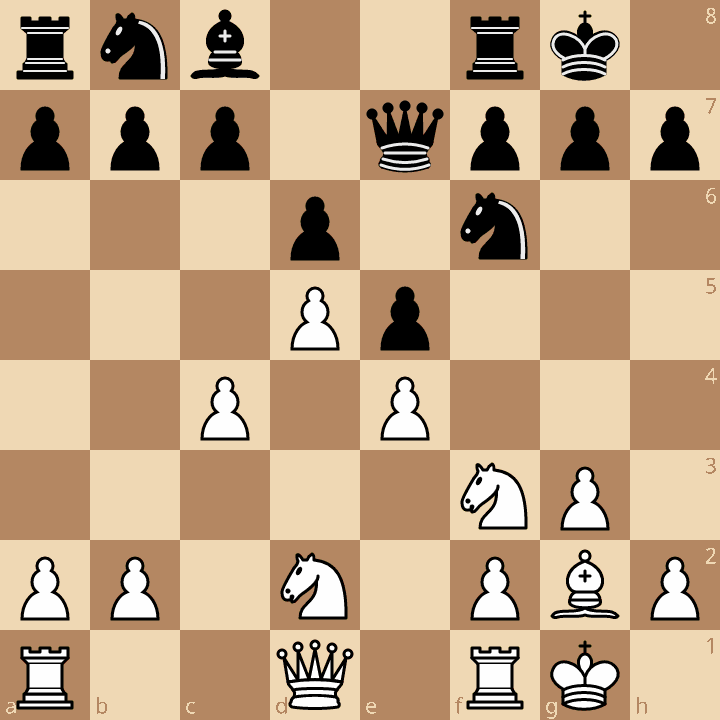
The knight retreats to b8 — a typical Benoni maneuver. The knight will reroute via d7 to c5 or f6-g4, targeting White's weaknesses. Despite looking passive, this is the standard plan used by Tal, Seirawan, Jussupow, and modern GMs like Gukesh. Black's plan: ..Nbd7, ..Nc5 (targeting e4/a4), kingside expansion with ..f5.
Alternative Moves
Key Takeaways
- 3...Bb4+ check disrupts White and gains tempo — the defining idea
- 4...Qe7 maintains the pin and supports the ...e5 plan
- Exchange the bishop on d2 only after developing Nc6 first
- ...e5 is the key thematic break, challenging White's center
- After d5, reroute the knight via Nb8-d7-c5 (Benoni-style)
Now play it through
Step through every move on a real board, try the wrong ones, and ask Knighty why they fail.
Summary
Ready to Practice?
Take this lesson with you
Free account requiredWith every variation — opens in Lichess & ChessBase