
Modern Benoni Defense
An ambitious defense where Black creates asymmetry with ...c5 against d4, leading to dynamic pawn structures and counterplay.
Try Interactive LessonIntroduction
Lesson Content
The Queen's Pawn opening — White claims the center and opens diagonals for the queen and kingside bishop. The most popular first move in chess after 1. e4. Black's main responses: - 1. ..d5 — Queen's Gambit and Slav setups - 1. ..Nf6 — Indian Defenses (King's Indian, Nimzo-Indian, etc.) - 1. ..f5 — Dutch Defense
Black develops the knight and controls e4, preventing White from building the ideal e4+d4 center easily. This is the gateway to all Indian Defense systems. Black delays committing a pawn structure, staying flexible to choose between King's Indian, Nimzo-Indian, Queen's Indian, and more.
Alternative Moves
White reinforces control of d5 and grabs more space. Combined with d4, the two pawns dominate the center. Now Black's response determines the opening system: - 2. ..e6 — Nimzo-Indian (after 3. Nc3 Bb4) or Queen's Indian - 2. ..g6 — King's Indian or Grunfeld - 2. ..c5 — Benoni structures - 2. ..e5 — Budapest Gambit
The Benoni move! Black immediately challenges White's d4 pawn from the side rather than the center. This is a fundamentally different approach from ..d5 or ..e6 — Black fights for asymmetry and counterplay. White must now decide how to handle the tension. The critical choice is 3. d5, pushing the pawn forward and accepting the Benoni pawn structure.
Alternative Moves
White pushes the pawn forward rather than exchanging, gaining space but committing to a fixed pawn structure. The d5 pawn becomes a long-term target for Black while giving White a spatial advantage. This is the defining moment of the Benoni — the asymmetrical pawn chain d5/e4 vs c5/d6 creates permanent strategic tension.
The Modern Benoni move — Black immediately challenges the d5 pawn with ..e6, intending to open the e-file after the exchange. This is more dynamic than the Old Benoni (..d6 without ..e6), as it creates immediate central tension. After the exchange on d5, Black will have an open e-file and a queenside pawn majority (a7/b7/c5 vs White's a2/b2).
Alternative Moves
White develops the knight to its natural square, defending d5 and preparing to recapture with the c-pawn after the exchange. This is overwhelmingly the most popular choice. White could also play 4. Nf3, but Nc3 is more direct, supporting both d5 and a future e4.
Black captures on d5, opening the e-file and creating the characteristic Benoni pawn structure. This is the critical exchange that defines the opening — after White recaptures, Black will have a queenside pawn majority and an open e-file for the rook. The downside: White gets a strong central pawn on d5 and the e4 advance will give extra space.
Alternative Moves
White recaptures with the c-pawn, maintaining the central space advantage with the d5 pawn. The pawn on d5 divides the board and restricts Black's pieces, especially the light-squared bishop. White's plan is clear: build a strong center with e4, develop pieces behind the pawn chain, and use the extra space.
Black supports the c5 pawn and prepares the kingside fianchetto with ..g6 and ..Bg7. The pawn on d6 also prevents White from playing e5, which would gain even more space. This is the key structural move — Black's pawn chain c5/d6 faces White's d5/e4, creating a permanent Benoni structure.
Alternative Moves
White builds the ideal pawn duo on d5 and e4, claiming massive central space. This is the King's Pawn Line — the most direct approach in the Modern Benoni. White now has a clear space advantage and will develop pieces behind the pawn chain. Black must play actively or face a slow positional squeeze.
Black prepares the powerful bishop fianchetto to g7. The bishop on g7 will be Black's best piece — it pressures the long diagonal (a1-h8), supports the ..b5 pawn break, and controls key central squares. The fianchetto is essential in the Benoni: the bishop on g7 makes White's queenside expansion harder and supports kingside counterplay.
Alternative Moves
White develops the knight to its natural square, leading to the Classical Variation of the Benoni. The knight controls e5 and d4, and prepares kingside castling. White's main alternatives here lead to different systems: - 7. f4 — the Pawn Storm Variation, aggressive but weakens the e3 square - 7. f3 — the Sämisch-like setup, solid but slow - 7. h3 — preventing ..Bg4 pins
The bishop takes its powerful post on the long diagonal. From g7, it pressures d4 and b2, supports the c5 pawn, and can become devastating if the center opens. This is Black's key piece in the Benoni. The bishop also supports a future ..f5 break, which can blast open the center when White's pieces are on the queenside.
Alternative Moves
White develops the bishop to a modest but solid square, preparing to castle. Be2 is the Traditional Variation — a classical approach that doesn't commit to any aggressive plan yet. Alternatives give the position different characters: - 8. h3 — the New York Variation, preventing ..Bg4 - 8. Bg5 — the Averbakh-Grivas Attack, pinning the Nf6 - 8. Bd3 — more aggressive, aiming at the kingside
Black castles to safety, connecting the rooks and preparing to use the e-file. The king is secure on g8 behind the fianchettoed bishop, and the f8-rook will soon go to e8 to pressure the e-file. Castling also activates the rook — in the Benoni, the e-file and f-file are Black's primary avenues for counterplay.
Alternative Moves
White also castles, completing kingside development. Both kings are now safe, and the middlegame battle begins. White will typically aim for queenside expansion with a4/b4 or central play with f3/Nc4. This position defines the Classical Main Line of the Modern Benoni (ECO A73).
Black places the rook on the open e-file, targeting the e4 pawn. This is the most important rook lift in the Benoni — the e4 pawn is a long-term target, and the rook on e8 also supports a future ..f5 or ..e5 pawn break. The Czerniak Defense (A76) — this setup has been used by Caruana, Ivanchuk, and Svidler at the highest level.
Alternative Moves
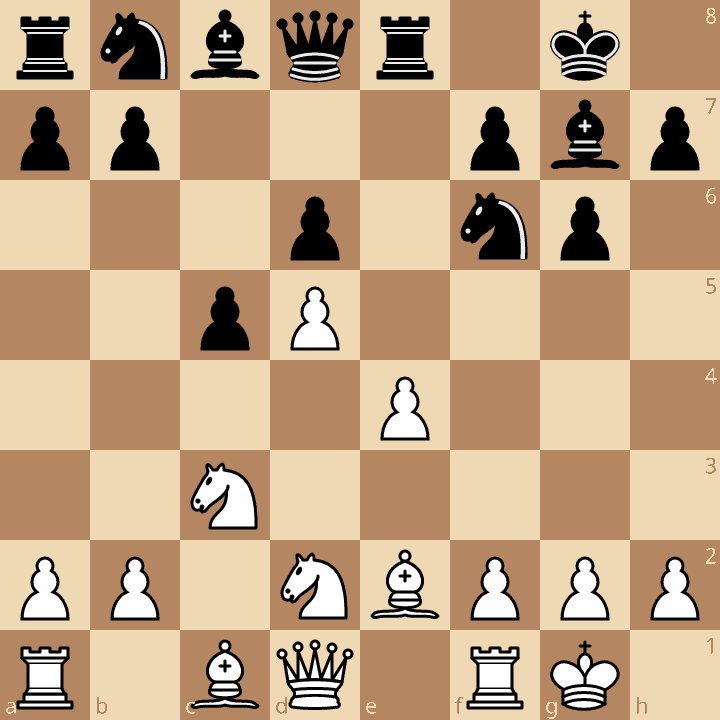
White reroutes the knight from f3, heading for c4 where it will pressure d6 and support a potential b4 break. The knight also unblocks the f-pawn for a possible f3 or f4 advance. This is the Tal Line (ECO A77) — the most critical test of the Benoni. From here Black typically plays ..Na6-c7 or ..Nbd7, preparing the thematic ..b5 pawn break.
Key Takeaways
- **...c5 and ...e6** create the Benoni structure — queenside pawn majority vs White's central space
- **The g7-bishop** is Black's best piece, controlling the long diagonal and supporting pawn breaks
- **Re8** pressures e4 and prepares the ...f5 or ...b5 breakthroughs
- **...b5** is Black's key pawn break on the queenside, undermining White's center
- Black must play actively — passive defense allows White to convert the space advantage
Now play it through
Step through every move on a real board, try the wrong ones, and ask Knighty why they fail.
Summary
Ready to Practice?
Take this lesson with you
Free account requiredWith every variation — opens in Lichess & ChessBase