
Dutch Defense - Classical Variation
A solid Dutch setup where Black develops the bishop to e7, castles kingside, and fights for the e4 square with a central ...d5 break.
Try Interactive LessonIntroduction
Lesson Content
The Queen's Pawn opening — White claims the center with the d-pawn, which is immediately defended by the queen. This tends to lead to more strategic, closed positions compared to 1. e4. Black's main responses: - 1. ..d5 — Queen's Gambit and Slav setups - 1. ..Nf6 — Indian Defenses (King's Indian, Nimzo-Indian, etc.) - 1. ..f5 — Dutch Defense
The Dutch Defense! Black immediately claims control of the e4 square and signals aggressive kingside intentions. The f5 pawn prevents White from building the ideal e4+d4 center. The trade-off is a slightly weakened king position, but Black compensates with active piece play and a clear plan: dominate e4, develop solidly, and attack on the kingside.
Alternative Moves
White grabs queenside space and controls the d5 square. Combined with d4, these two pawns dominate the center. White also prepares to fianchetto the bishop to g2, where it will pressure the long diagonal. Alternatives for White: - 2. Bg5 — the aggressive Hopton Attack - 2. Nc3 — preparing e4 - 2. g3 — immediate fianchetto
Black develops the knight to its most natural square, reinforcing control of e4. The knight on f6 also defends h5 and prepares kingside castling. This is more flexible than 2. ..e6 — Black waits to see White's setup before committing the pawn structure.
Alternative Moves
White prepares to fianchetto the bishop on g2. From g2, the bishop will exert powerful pressure along the long diagonal (a8-h1), targeting Black's queenside and especially the d5 square. This is the most popular setup against the Dutch, leading to rich positional play.
Black supports a future ..d5 push and opens the diagonal for the dark-squared bishop. This is the defining move of the Classical Dutch — Black will place the bishop on e7 rather than d6 (Stonewall) or g7 (Leningrad). The e6 pawn also bolsters the f5 pawn's control of d5 and e4.
Alternative Moves
White completes the fianchetto. The bishop on g2 is a powerful piece — it pressures the long diagonal and will become especially strong if Black's center becomes overextended. This bishop often becomes White's most important piece in the Dutch, working with the c4 pawn to control d5.
The Classical bishop placement — solid and flexible. Unlike ..Bd6 (Stonewall), the bishop on e7 doesn't block the d-pawn. Unlike ..Bg7 (Leningrad), it keeps the f-file clear for the rook. The bishop supports kingside castling and can later relocate to f6 to contest the long diagonal, or stay on e7 to support a ..d5 push.
Alternative Moves
White develops the knight to its natural square, controlling e5 and d4. The knight prepares to support a future Ne5 maneuver, which is one of White's key ideas in the Dutch. White keeps options open — Nc3 and O-O can follow in either order.
Black castles kingside, securing the king and activating the f8-rook. The rook will naturally support the f5 pawn and can become active on the f-file if it opens. Castling early is important in the Dutch since the f5 push already weakened the kingside slightly — the king is safer tucked away behind the g7 and h7 pawns.
Alternative Moves
White also castles, completing mutual kingside development. Both kings are safe and the real strategic battle begins. White's plans include Nc3, b3+Bb2 (pressuring the long diagonal), and potentially Ne5 to challenge Black's control of e4.
The central break! Black establishes the characteristic Classical Dutch pawn structure with pawns on d5, e6, and f5. This pawn chain firmly controls e4, creating a perfect outpost for the knight. This is Black's most important move — the d5 pawn locks the center and signals that Black's play will be on the kingside, while White will expand on the queenside.
Alternative Moves
White develops the last minor piece, putting pressure on d5 and e4. The knight on c3 is well-placed — it supports a future e4 push (if Black ever allows it) and eyes the important d5 and e4 squares. Alternatives: - 7. b3 — the immediate fianchetto plan - 7. Qc2 — multi-purpose, eyeing c6 and e4
Black reinforces the d5 pawn, creating the classic Stonewall pawn chain (c6-d5-e6-f5). This structure is rock-solid — it's very difficult for White to break through in the center. The c6 pawn also prevents any Nb5 ideas and prepares potential queenside play with ..Qe8 and ..Qh5 on the kingside.
Alternative Moves
White places the queen on c2 — a multi-purpose move. The queen eyes e4 (hoping Black's knight goes there so it can be challenged), supports a potential e4 pawn push, and gets off the d-file in case a rook comes to d1. This is the most popular plan at the grandmaster level, often combined with b3 and Bb2.
Black develops the last minor piece, preparing the key maneuver ..Ne4. The knight on d7 supports e4 and can also reroute to f6 if needed, or to b6 to pressure c4. The knight on d7 doesn't block the dark-squared bishop since it's already developed to e7.
Alternative Moves
White prepares the queenside fianchetto with Bb2. The bishop on b2 will aim at the long diagonal, putting pressure on e5, f6, and ultimately the Black king. This is White's primary plan — control the long diagonal and expand on the queenside with a4-a5.
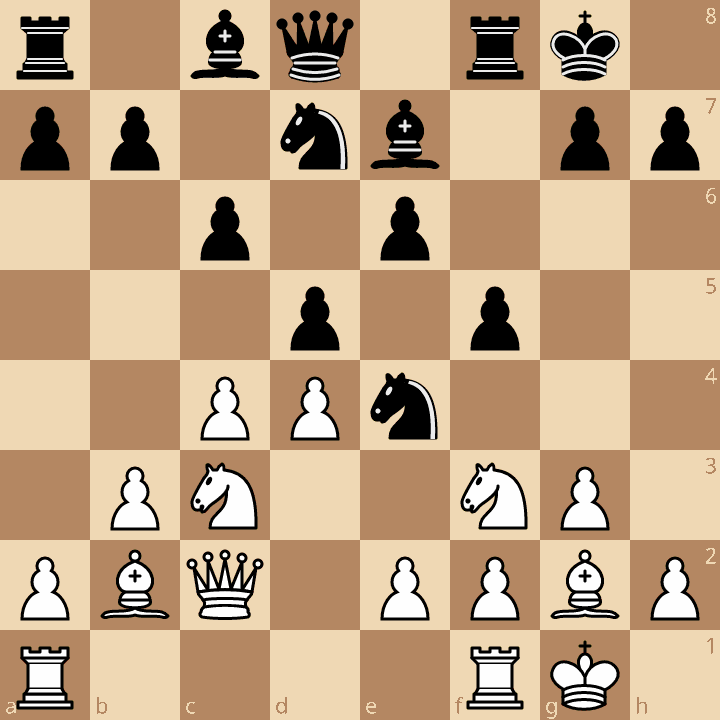
The dream square! The knight occupies the magnificent e4 outpost — the central theme of the Classical Dutch. Supported by the f5 pawn and the Nd7, this knight is extremely difficult to dislodge. From e4, the knight controls d2, f2, d6, f6, c3, and g3 — exerting pressure in all directions. This is Black's primary strategic achievement in the opening.
Alternative Moves
White completes the fianchetto, placing the bishop on the long diagonal. The Bb2 exerts pressure on e5 and f6, and White may consider challenging Black's Ne4 with Nd2 or f3 at some point. The position is well-balanced — Black has the powerful Ne4 outpost, while White controls the long diagonal and has queenside space.
Key Takeaways
- The f5 pawn controls e4 — the foundation of Black's entire strategy
- Be7 is the Classical choice: solid, flexible, and keeps the f-file clear
- The ...d5 break creates the powerful c6-d5-e6-f5 pawn chain
- Ne4 is the dream outpost — supported by f5 and hard to challenge
- White's plan is Bg2+Bb2 on the long diagonal with queenside expansion
Now play it through
Step through every move on a real board, try the wrong ones, and ask Knighty why they fail.
Summary
Ready to Practice?
Take this lesson with you
Free account requiredWith every variation — opens in Lichess & ChessBase