
Dutch Defense - Stonewall Variation
Build an impenetrable pawn wall on c6-d5-e6-f5 and use the e4 outpost to launch a kingside attack.
Try Interactive LessonIntroduction
Lesson Content
The Queen's Pawn opening — White claims the center with the d-pawn, which is immediately defended by the queen. This tends to lead to more strategic, closed positions compared to 1. e4. Black's main responses: - 1. ..d5 — Queen's Gambit and Slav setups - 1. ..Nf6 — Indian Defenses (King's Indian, Nimzo-Indian, etc.) - 1. ..f5 — Dutch Defense
The Dutch Defense! Black immediately stakes a claim on the e4 square and signals aggressive kingside intentions. Unlike 1. ..d5 or 1. ..Nf6, this move is a bold statement — Black wants to attack. The f5 pawn controls e4, preventing White from building the ideal e4+d4 center. The trade-off is a slightly weakened king position, which Black compensates with active piece play.
Alternative Moves
White grabs more central space with two pawns aiming at d5. Combined with d4, White has a broad pawn center. This is the most principled response, preparing to develop the kingside bishop via fianchetto.
Black develops the knight to its most natural square, reinforcing control of e4. The knight also prepares to support the upcoming ..d5 pawn push. Developing before committing the pawn structure keeps maximum flexibility.
Alternative Moves
White prepares to fianchetto the bishop on g2, where it will control the long a8-h1 diagonal. The bishop on g2 pressures Black's d5 square and the queenside, making it the ideal placement against the Stonewall formation.
Black prepares the crucial ..d5 push to complete the Stonewall pawn chain. The e6 pawn will form part of the "stone wall" — the rigid c6-d5-e6-f5 structure that gives this variation its name. The cost: the light-squared bishop is now hemmed in behind its own pawns, a strategic problem Black must address later.
Alternative Moves
White completes the fianchetto. The bishop on g2 is a powerful long-range piece, pressuring the d5 square through the center. Against the Stonewall, this bishop becomes a key strategic asset for White.
The Stonewall is established! Black now has pawns on d5, e6, and f5 — three of the four "wall" pawns. This rigid central structure gives Black a permanent grip on the e4 square, the crown jewel of the Stonewall. The d5 pawn also blocks the Bg2's influence on the long diagonal, neutralizing one of White's key pieces.
Alternative Moves
White develops the knight naturally, controlling e5 and preparing castling. The knight on f3 also supports a future Ne5 maneuver to challenge Black's central grip.
The final wall pawn! Black completes the Stonewall with pawns on c6-d5-e6-f5. The c6 pawn reinforces d5, making the center rock-solid. This four-pawn chain is extremely difficult for White to undermine. The Stonewall is now fully established — Black can focus on piece development and the kingside attack.
Alternative Moves
White castles to safety and connects the rooks. With the fianchettoed bishop and castled king, White's kingside is well-organized. White will look for ways to undermine the Stonewall from the queenside or exploit the e5 square.
The Modern Stonewall! The bishop goes to d6 rather than the passive e7 square. On d6, the bishop eyes the kingside along the b8-h2 diagonal, supporting a potential ..Qe7 and ..Ng4-h2 attacking plan. This active bishop placement is what distinguishes the Modern Stonewall from older, more passive treatments. The bishop may even sacrifice on h2 in some attacking lines!
Alternative Moves
White prepares to fianchetto the second bishop. With Bb2, White will have both bishops aiming at the center, creating long-range pressure. The b3 pawn also supports the c4 pawn.
A flexible, multipurpose queen move. The queen on e7 supports the Bd6 (preventing Bxd6 trades), prepares castling, and reserves the option of swinging to the kingside via Qf7 or Qh4 later. Importantly, the queen frees d8 for a potential rook, and the e7 square connects Black's major pieces.
Alternative Moves
White completes the double fianchetto, a common setup against the Stonewall. Both bishops now rake across the board. The Bb2 pressures the e5 square and the long diagonal toward g7.
The knight develops to d7, preparing the crucial ..Ne4 jump. From d7, the knight can reach e4 (the Stonewall's dream square) or support ..e5 pawn breaks in some positions. This is a key developing move that keeps Black's position flexible while preparing the central knight outpost.
Alternative Moves
White develops the knight to d2, keeping options flexible. The knight may go to f3 (if the other knight moves) or support a future e3-e4 break. White methodically prepares to challenge Black's center.
Black castles to safety. With the Stonewall structure firmly established and pieces developing, it's time to secure the king. The rook on f8 will also support the f5 pawn and potential ..f4 pawn break later.
Alternative Moves
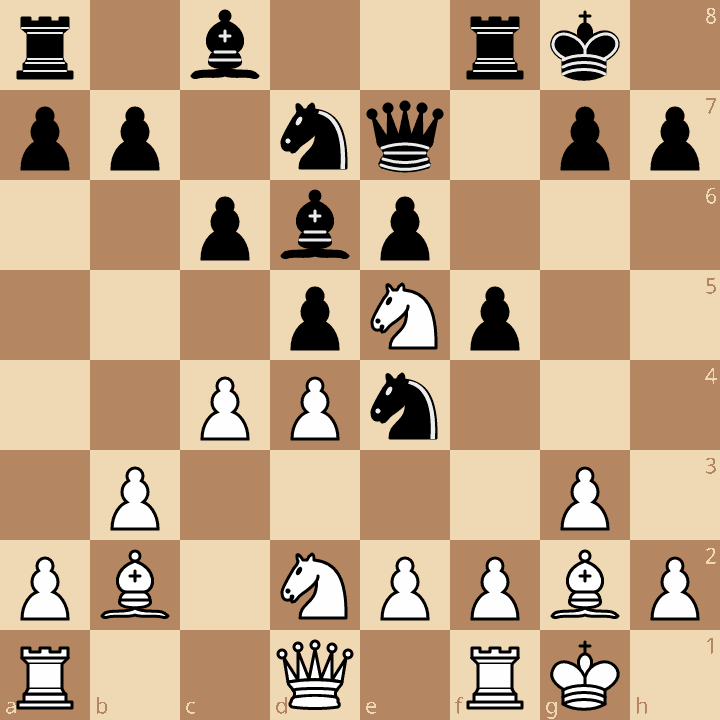
White occupies the e5 outpost, mirroring Black's strategy. The knight on e5 is well-placed — it pressures d7 and f7, and can't easily be kicked by pawns (Black's e-pawn is on e6).
The crown jewel of the Stonewall! The knight lands on e4, the square Black has been building toward since move one. Supported by the f5 pawn, this knight is nearly impossible to dislodge. The Ne4 controls critical squares (d2, f2, g3, c3) and can combine with ..Bd6 to create kingside threats. This is the Stonewall's main strategic achievement — a dominant, unshakable knight in the heart of enemy territory.
Alternative Moves
Key Takeaways
- The c6-d5-e6-f5 pawn chain is the Stonewall — rigid but incredibly strong
- The e4 square is the strategic prize, supported permanently by the f5 pawn
- Bd6 (Modern) is far more active than the old Be7 placement
- Qe7 is a flexible multipurpose move — supports Bd6 and prepares castling
- Castle before attacking — then use Ne4, Bd6, and f4 break for kingside play
Now play it through
Step through every move on a real board, try the wrong ones, and ask Knighty why they fail.
Summary
Ready to Practice?
Take this lesson with you
Free account requiredWith every variation — opens in Lichess & ChessBase