
Albin Counter-Gambit - Fianchetto Line
Sacrifice a pawn to create a powerful passed d-pawn, then maneuver knights to recapture and seize the initiative
Try Interactive LessonIntroduction
Lesson Content
The Queen's Pawn opening — White claims the center with the d-pawn, which is immediately defended by the queen. This tends to lead to more strategic, closed positions compared to 1. e4. Black's main responses: - 1. ..d5 — Queen's Gambit and Slav setups - 1. ..Nf6 — Indian Defenses (King's Indian, Nimzo-Indian, etc.) - 1. ..f5 — Dutch Defense
Black matches White in the center, leading to the Queen's Pawn Game. The symmetrical center typically results in strategic maneuvering rather than immediate tactical battles. White's most popular continuation is 2. c4 — the Queen's Gambit.
Alternative Moves
The Queen's Gambit — White offers a pawn to lure Black's d5 pawn away from the center. It's not a true gambit since Black can't hold the pawn long-term. Black's main choices: - 2. ..e6 — Queen's Gambit Declined, solid and classical - 2. ..c6 — Slav Defense, supporting d5 while keeping the bishop free - 2. ..dxc4 — Queen's Gambit Accepted, giving up the center temporarily
The Albin Counter-Gambit! Instead of defending d5, Black counter-attacks by pushing e5. This is a bold pawn sacrifice — Black gives up the e-pawn to create a powerful passed pawn on d4 after the exchange. The idea is to seize the initiative rather than accept a passive position. This is one of the sharpest responses to the Queen's Gambit, turning the tables on White's central ambitions.
Alternative Moves
White accepts the gambit pawn. This is the most principled response — refusing with 3. e3 or 3. Nc3 allows Black to maintain the tension favorably. Alternatives: - 3. cxd5 — avoids the gambit but lets Black recapture with good play - 3. e3 — passive, Black equalizes easily
The key move of the Albin Counter-Gambit! Black pushes the d-pawn to d4, creating a dangerous passed pawn in the heart of White's position. This pawn cramps White's development — the knight on b1 and bishop on c1 are both restricted by it. Black's plan is simple: maintain the d4 pawn while developing pieces actively and recapturing the e5 pawn with knights.
Alternative Moves
White develops the knight to its most natural square, guarding against the d4 pawn's advance and preparing to deal with it. The knight also eyes e5, supporting the extra pawn. Alternatives: - 4. e3 — a terrible blunder that falls into the famous Lasker Trap (4. ..Bb4+ 5. Bd2 dxe3! 6. Bxb4?? exf2+ 7. Ke2 fxg1=N+!) - 4. e4 — gives Black a strong outpost on d4
Black develops the knight to its best square, adding protection to the d4 pawn and attacking the e5 pawn. The knight on c6 also prepares to maneuver a second knight to help recapture on e5. With both the d4 pawn and pieces aiming at e5, Black builds up pressure despite being a pawn down.
Alternative Moves
White prepares to fianchetto the bishop to g2 — this is the strongest approach against the Albin. The bishop on g2 will control the long diagonal, pressuring Black's queenside and restraining the d4 pawn from a distance. Alternatives: - 5. Nbd2 — the Modern/Alapin line, also playable - 5. a3 — prevents Bb4+ but doesn't develop
Black develops the knight to e7 rather than the more natural f6 square. The reason is subtle but important: from e7, the knight will reroute to g6, from where it can capture on e5. If the knight went to f6, it would block the f-pawn and be kicked by e5-e6 in some lines. The Nge7-g6-e5 maneuver is the signature plan of the Albin Counter-Gambit.
Alternative Moves
White completes the fianchetto. The bishop on g2 is a powerful piece — it controls the long diagonal, puts pressure on Black's queenside, and helps restrain the d4 pawn. White plans to castle quickly and then work on undermining the d4 pawn.
The knight continues its planned journey to g6, now directly attacking the e5 pawn. From g6, the knight can capture on e5, winning back the gambit pawn. This is the critical moment — Black's entire opening strategy hinges on recovering this pawn while maintaining the d4 asset. The knight on g6 also has a useful function defending the kingside.
Alternative Moves
White castles to safety, connecting the rooks. With the bishop on g2 and kingside secure, White is well-placed to fight for the center. The rook on f1 can later support the f-pawn if needed.
Black captures the e5 pawn, completing the knight maneuver that began with 5. ..Nge7! The gambit pawn is recovered and Black still has the passed d4 pawn. Now if White trades knights, Black recaptures and has an excellent centralized knight. This is the payoff of the Albin Counter-Gambit — material is restored with the d4 pawn as a lasting advantage.
Alternative Moves
White trades knights, forced practically since leaving the knight on f3 allows Black too much central control. After Black recaptures, the position clarifies. Alternatives: - 8. Qa4+ — check, but after ..Bd7 Black develops naturally
Black recaptures with the remaining knight, placing it on the dominant e5 outpost. The knight on e5 is wonderfully centralized — it attacks f3, d3, c4, and controls key central squares. Combined with the passed d4 pawn, Black has excellent compensation for the opening gambit. Black's position is active and promising despite the slight material equality.
Alternative Moves
White plays Qa4+ to force Black to weaken the queenside or block with a piece. This is a practical move — White probes Black's setup while developing the queen to an active square. Alternatives: - 9. Na3 — develops the knight but Qa4+ is more testing, forcing Black to commit
Black blocks the check with c6, which also serves an important strategic purpose: it reinforces the d5 square and prepares to develop the bishop. While c6 looks passive, it solidifies Black's center and doesn't weaken the position. The knight on e5 remains dominant and the d4 pawn is still a powerful asset.
Alternative Moves
White targets the d4 pawn with the rook. The passed pawn is Black's greatest asset but also a target — White will try to blockade and eventually win it. Alternatives: - 10. Nd2 — develops but Rd1 directly pressures Black's key pawn
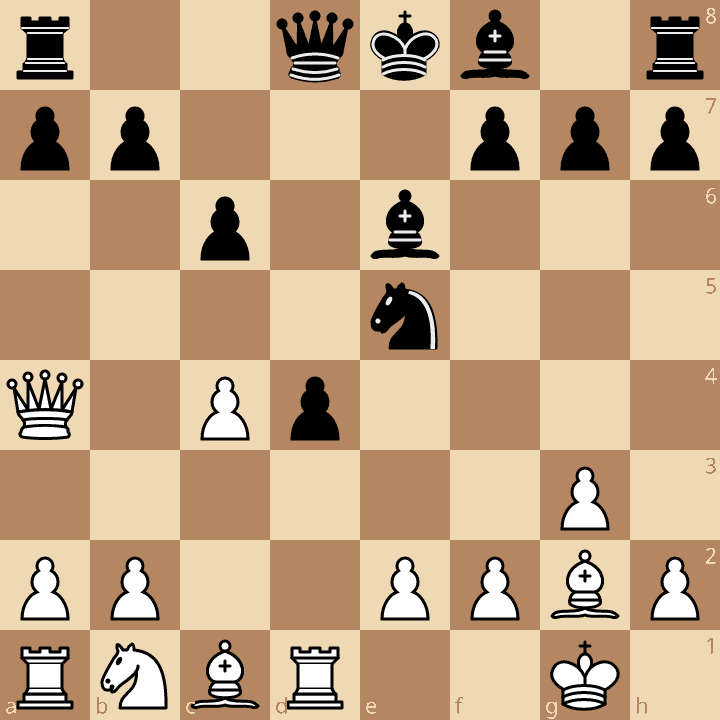
Black develops the bishop to e6, defending the d5 square and preparing to develop the dark-squared bishop. The bishop on e6 also eyes the c4 pawn, adding counterplay. With the knight on e5, bishop on e6, and the passed d4 pawn, Black has a harmonious position with clear plans. Black has successfully navigated the Albin Counter-Gambit — the gambit pawn is recovered and Black's pieces are active and well-coordinated.
Alternative Moves
Key Takeaways
- 2...e5 and 3...d4 — sacrifice a pawn to create a powerful passed pawn that cramps White
- The Nge7-Ng6-Ngxe5 knight maneuver is the signature plan to recapture the gambit pawn
- Never play 4.e3?? as White — it falls into the famous Lasker Trap with dxe3 and fxg1=N+
- After recovering the pawn, the centralized Ne5 + passed d4 pawn give Black excellent compensation
- Be6 completes development while defending the center and eyeing c4 for counterplay
Now play it through
Step through every move on a real board, try the wrong ones, and ask Knighty why they fail.
Summary
Ready to Practice?
Take this lesson with you
Free account requiredWith every variation — opens in Lichess & ChessBase