
Italian Game - Evans Gambit
White sacrifices a pawn for rapid development and a powerful center attack.
Try Interactive LessonIntroduction
Lesson Content
The King's Pawn opening — White claims the center and opens diagonals for the queen and kingside bishop. The most popular first move in chess. Black's main responses: - 1. ..e5 — Open Game, matching White's center - 1. ..c5 — Sicilian Defense, fighting for d4 asymmetrically - 1. ..e6 — French Defense, preparing ..d5 - 1. ..c6 — Caro-Kann, also preparing ..d5
Black mirrors White's central claim, establishing a symmetrical pawn center. This leads to the Open Games — the oldest and most classical family of openings. The e5 pawn controls d4 and f4, limiting White's expansion options.
White develops the knight to its most natural square, attacking the e5 pawn immediately. The knight also controls d4 and prepares kingside castling. This is the most common second move, leading to a vast tree of openings including the Italian, Ruy Lopez, and Scotch.
Black defends the e5 pawn with the most natural developing move. The knight on c6 also controls the important d4 and e5 squares. From here White's third move defines the opening: - 3. Bc4 — Italian Game - 3. Bb5 — Ruy Lopez - 3. d4 — Scotch Game - 3. Nc3 — Four Knights / Vienna hybrid
The bishop develops to c4, aiming at Black's vulnerable f7 square — the weakest point in the starting position since only the king defends it. This is the defining move of the Italian Game. White's alternatives here lead to entirely different openings: - 3. Bb5 — the Ruy Lopez, pressuring the Nc6 defender - 3. d4 — the Scotch Game, immediately challenging the center - 3. Nc3 — the Three/Four Knights, delaying the decision
Black develops the bishop to its most active diagonal, mirroring White's pressure on the center. The Giuoco Piano ("Quiet Game") begins — though the name is deceptive, as sharp play often follows. The bishop on c5 eyes the f2 square and supports a future ..d5 break.
The Evans Gambit! White offers a pawn to deflect Black's bishop from the a7-g1 diagonal, gaining time to build an ideal pawn center with c3 and d4. This is one of the oldest and most aggressive gambits in chess. Black's main responses: - 4. ..Bxb4 — accepting the gambit (most common) - 4. ..Bb6 — declining, keeping the bishop active - 4. ..d5 — the Hein Countergambit, striking at the center immediately
Alternative Moves
Black accepts the gambit, winning a pawn. The bishop has been lured away from c5, and now White will use the tempo to build a dominating center. Declining with 4. ..Bb6 is playable but allows White easy development. Black must now decide where to retreat the bishop after White's c3.
Alternative Moves
White prepares the ideal pawn center with d4. The c3 pawn also attacks the bishop, forcing it to move again. This is the key follow-up — White has invested a pawn and now demands the full return in development and center control.
Alternative Moves
The main line retreat — the bishop stays on the a5-e1 diagonal where it pressures the c3 pawn and eyes White's king position. This leads to the sharpest play. Black's alternatives: - 5. ..Be7 — the Anderssen Variation, solid but passive - 5. ..Bd6 — the Stone-Ware Variation, blocking the d-pawn - 5. ..Bc5 — the McDonnell Defense, returning to the original square
The central break! White establishes the ideal e4+d4 pawn center — the whole point of the gambit. The position opens up, and White's lead in development becomes critical. Black must now deal with the central tension.
Alternative Moves
Black captures, accepting the central challenge. The position opens further, which generally favors the better-developed side — White. Black could also play 6. ..d6 (the Bronstein Defense), keeping the center closed.
Alternative Moves
White castles into safety while the position is wide open — a hallmark of gambit play. The rook immediately eyes the f-file and the center. White doesn't bother recapturing on d4 yet, preferring rapid development. Black is a full pawn up but significantly behind in development.
Alternative Moves
The Mieses Defense — Black develops the knight to e7 rather than f6, keeping the option to recapture on d5 with the knight. The knight on e7 also avoids blocking the f-pawn, which may be needed for ..f6 to support the center.
Alternative Moves
White recaptures, establishing the powerful d4+e4 center. Despite being a pawn down, White has a massive lead in development: the bishop on c4 targets f7, the rook controls the f-file, and the d4 pawn cramps Black's position.
Black strikes back at the center! This is the critical counter — challenging White's e4 pawn and opening lines for Black's pieces. Without ..d5, Black would be suffocated by White's central dominance.
White captures, opening the e-file for the rook and clearing the center. The d5 pawn will be recaptured by Black's knight, which centralizes powerfully — but White's development advantage keeps the initiative.
Black recaptures with the knight, centralizing it on the powerful d5 outpost. The knight controls key squares and threatens to coordinate with the bishop pair. Material is nearly equal now.
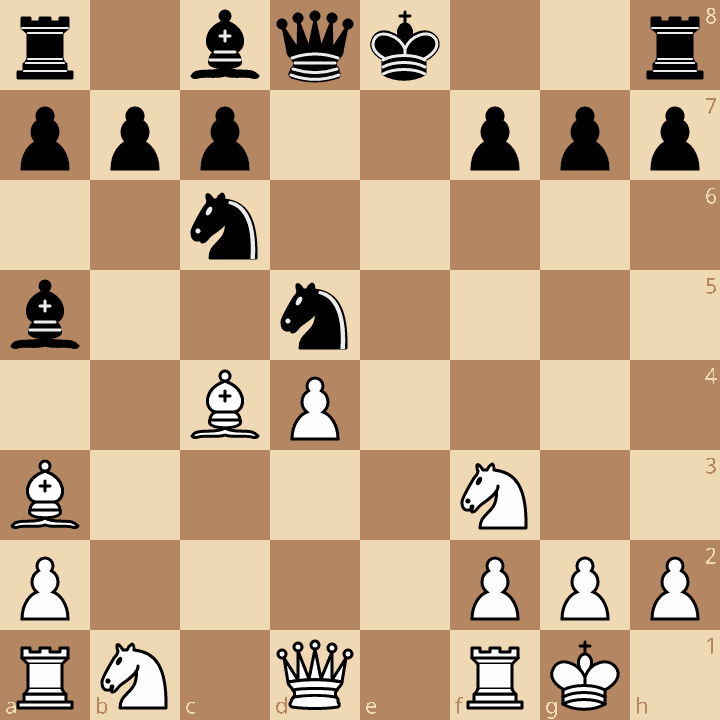
The bishop springs to life on a3, preventing Black from castling kingside! This is the payoff of the Evans Gambit — White's pieces are active, the center is open, and Black's king is stuck in the middle. White has full compensation for the sacrificed pawn.
Alternative Moves
Key Takeaways
- 4.b4 sacrifices a pawn for tempo and central control
- c3 + d4 builds the ideal pawn center — the gambit's strategic goal
- Rapid development and open lines compensate for the material deficit
- Ba3 prevents castling — the key positional payoff
- In gambits, time (development) is worth more than material
Now play it through
Step through every move on a real board, try the wrong ones, and ask Knighty why they fail.
Summary
Ready to Practice?
Take this lesson with you
Free account requiredWith every variation — opens in Lichess & ChessBase