
Italian Game - Giuoco Piano Main Line
Learn the classical Italian Game with central pawn play and piece activity
Try Interactive LessonIntroduction
Lesson Content
Start by controlling the center with your king pawn.
e4 — The King's Pawn opening — White claims the center and opens diagonals for the queen and kingside bishop. The most popular first move in chess. Black's main responses: - 1. ..e5 — Open Game, matching White's center - 1. ..c5 — Sicilian Defense, fighting for d4 asymmetrically - 1. ..e6 — French Defense, preparing ..d5 - 1. ..c6 — Caro-Kann, also preparing ..d5
Alternative Moves
Black mirrors White's central claim, establishing a symmetrical pawn center. This leads to the Open Games — the oldest and most classical family of openings. The e5 pawn controls d4 and f4, limiting White's expansion options.
Develop a piece that attacks the e5 pawn.
♘︎f3 — White develops the knight to its most natural square, attacking the e5 pawn immediately. The knight also controls d4 and prepares kingside castling. This is the most common second move, leading to a vast tree of openings including the Italian, ♖︎uy Lopez, and Scotch.
Alternative Moves
Black defends the e5 pawn with the most natural developing move. The knight on c6 also controls the important d4 and e5 squares. From here White's third move defines the opening: - 3. ♗︎c4 — Italian Game - 3. ♗︎b5 — Ruy Lopez - 3. d4 — Scotch Game - 3. ♘︎c3 — Three Knights Game (Four Knights after 3. ..♘︎f6)
Develop your bishop to target the f7 square.
♗︎c4 — The bishop develops to c4, aiming at Black's vulnerable f7 square — the weakest point in the starting position since only the king defends it. This is the defining move of the Italian Game. White's alternatives here lead to entirely different openings: - 3. ♗︎b5 — the Ruy Lopez, pressuring the ♘︎c6 defender - 3. d4 — the Scotch Game, immediately challenging the center - 3. ♘︎c3 — the Three/Four Knights, delaying the decision
Alternative Moves
Black develops the bishop to its most active diagonal, mirroring White's pressure on the center. The Giuoco Piano ("Quiet Game") begins — though the name is deceptive, as sharp play often follows. The bishop on c5 eyes the f2 square and supports a future ..d5 break.
Alternative Moves
Prepare to push d4 by supporting it first.
c3 — Preparing the ideal pawn center with d4 — this is the signature idea of the Giuoco Piano main line. White wants pawns on e4 and d4 to completely dominate the center. White's alternatives set different tempos: - 4. d3 — the Giuoco Pianissimo, a quieter positional approach - 4. O-O — flexible, delaying the central advance - 4. b4 — the Evans Gambit, a sharp pawn sacrifice for rapid development
Alternative Moves
Black develops the knight to f6, counterattacking the e4 pawn with tempo. This is the most natural developing move, preparing to castle kingside. The knight on f6 also controls d5 and supports a future ..d5 central break — Black's primary equalizing strategy in the Italian Game.
Push the pawn you prepared to create a strong center.
The central break! After preparing with c3, White pushes d4 to establish the ideal pawn center. This attacks Black's bishop on c5 and opens the position for active piece play. The d4 push is the whole point of the c3 setup — delaying it further would waste the tempo invested.
Alternative Moves
Black captures, opening the position and creating the half-open e-file. This trade is virtually forced — retreating the bishop with ..♗︎b6 allows White too strong a center after maintaining d4. The character of the game shifts from positional maneuvering to tactical play.
Recapture to maintain your central pawn presence.
cxd4 — Recapturing with the c-pawn builds a broad center that can later become an isolated d-pawn (IQP), but it half-opens the c-file and gives White active piece play. This is a classic trade-off — structural weakness for dynamic activity. The IQP position is one of the most important pawn structures to understand. White's pieces become very active along the open diagonals and files.
Alternative Moves
Black gives check with the bishop, disrupting White's coordination. This gains a tempo and forces White to decide how to block — a key moment in the opening. The check is strong because it prevents White from smoothly completing development with moves like ♘︎c3 or O-O.
Block the check while developing a piece.
♗︎d2 — Blocking with the bishop develops a piece and prepares to trade off Black's active ♗︎b4. This is the most principled response — it avoids the awkward ♘︎c3 block and preserves castling rights unlike ♔︎f1. After the inevitable bishop exchange, White will have smoothly completed development.
Alternative Moves
Black trades the bishops, simplifying the position. While this removes Black's active piece, it also eliminates White's dark-squared bishop. The trade helps White by clearing the way for smooth development — the recapture will bring another piece into play.
Recapture while developing your knight.
♘︎bxd2 — Recapturing with the b1-knight develops another piece toward the center. White now has both knights developed, the bishop active on c4, and is ready to castle. Developing the knight with the recapture is more efficient than ♕︎xd2 — following the principle of *knights before queens* in the opening.
Alternative Moves
Black counter-attacks the center with the thematic ..d5 break! This is Black's primary equalizing resource in the Italian Game — challenging White's central dominance and opening lines for the pieces. The d5 push also activates Black's light-squared bishop and creates central tension that White must resolve.
Capture the pawn to open lines for your pieces.
exd5 — Capturing opens the e-file completely, which will benefit White's rook after castling. The position transitions into a tactical middlegame centered around the IQP on d4. White's isolated d-pawn is a potential endgame weakness, but in the middlegame it provides open lines and active piece play — a fair trade.
Alternative Moves
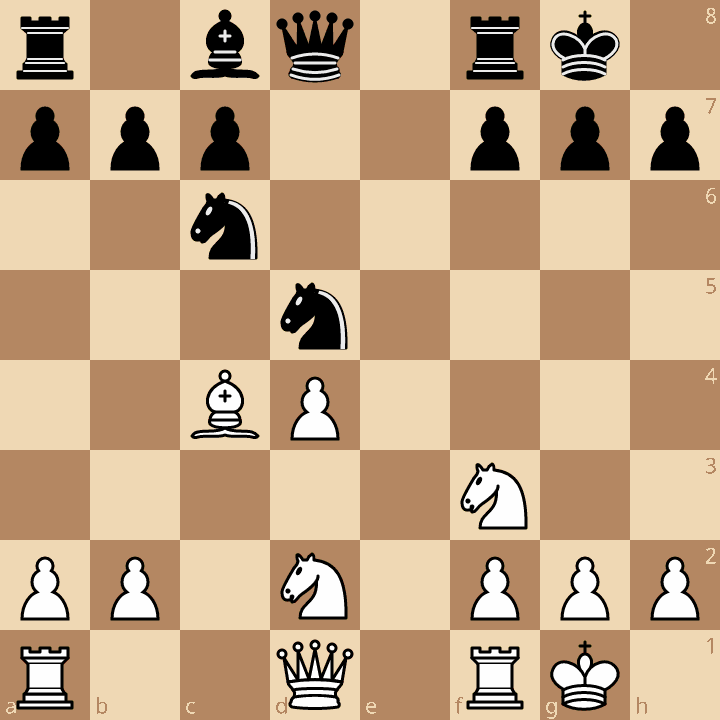
Black recaptures with the knight, placing it powerfully in the center on d5. The knight controls key squares (b4, c3, e3, f4) and is very difficult to dislodge. This centralized knight is one of Black's key assets, partly compensating for White's more active piece placement.
Secure your king by castling.
O-O — Castle to safety! The king tucks away on g1 while the rook comes to f1, ready for the open e-file. With this move, White completes classical development. From here, White's typical plans include ♘︎f3-e5, ♕︎b3 targeting b7 and d5, or doubling rooks on the e-file.
Alternative Moves
Black also castles, completing mutual development. The position is roughly balanced — White has the IQP and slightly more active pieces, while Black has a solid structure and the strong ♘︎d5. The real battle begins now: White seeks dynamic play before the IQP becomes a liability in an endgame.
Key Takeaways
- ♗︎c4 aims at f7—Black's weakest square
- c3 + d4 builds the ideal pawn center
- The isolated d-pawn gives White open lines and piece activity
- Black's ...d5 break is the key counter-attacking resource
- Piece activity often compensates for structural weaknesses
Now play it through
Step through every move on a real board, try the wrong ones, and ask Knighty why they fail.
Related Lessons
Summary
Ready to Practice?
Next in this opening family
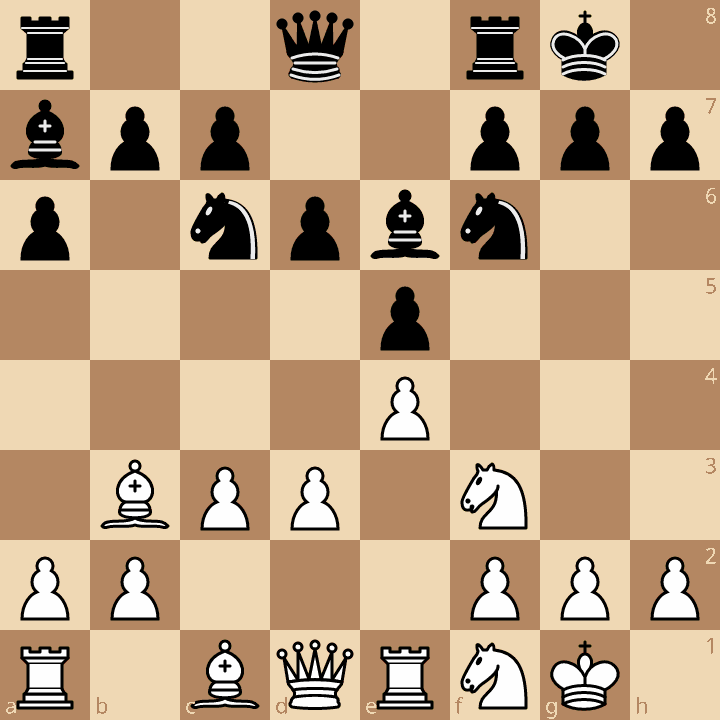
Giuoco Pianissimo
Take this lesson with you
Free account requiredWith every variation — opens in Lichess & ChessBase