
Old Indian Defense
A solid defense against 1.d4 where Black builds a compact e5/d6 pawn center and prepares a later ...c6 and ...d5 break.
Try Interactive LessonIntroduction
Lesson Content
The Queen's Pawn opening — White claims the center with the d-pawn, which is immediately defended by the queen. This tends to lead to more strategic, closed positions compared to 1. e4. Black's main responses: - 1. ..d5 — Queen's Gambit and Slav setups - 1. ..Nf6 — Indian Defenses (King's Indian, Nimzo-Indian, etc.) - 1. ..f5 — Dutch Defense
Black develops the knight and controls e4, preventing White from building the ideal e4+d4 center easily. This is the gateway to all Indian Defense systems. Black delays committing a pawn structure, staying flexible to choose between King's Indian, Nimzo-Indian, Queen's Indian, Old Indian, and more.
Alternative Moves
White reinforces control of d5 and grabs more space. Combined with d4, the two pawns dominate the center. Now Black's response determines the opening system: - 2. ..e6 — Nimzo-Indian (after 3. Nc3 Bb4) or Queen's Indian - 2. ..g6 — King's Indian or Grunfeld - 2. ..d6 — Old Indian Defense - 2. ..e5 — Budapest Gambit
The defining move of the Old Indian Defense. Instead of challenging the center with ..d5 or fianchettoing with ..g6, Black supports a future ..e5 advance. The d6 pawn creates a compact structure that is hard to break down. The Old Indian is classified under ECO codes A53-A55 and has a long history dating back to the 19th century.
Alternative Moves
White develops the knight to its natural square, supporting e4 and reinforcing control of d5. This is the most principled continuation. White's alternatives: - 3. Nf3 — also common, can transpose after Nc3 - 3. e4 — aggressive, leading to a more immediate central confrontation
Black strikes at the center! The e5 pawn challenges White's d4 and creates a firm foothold in the center. Together with d6, Black has a compact pawn duo that controls key central squares. This is the heart of the Old Indian — Black accepts a slightly cramped position but builds a solid, resilient structure.
Alternative Moves
White develops the second knight, adding pressure to the e5 and d4 squares. The knight on f3 also prepares kingside castling. White keeps the central tension — the d4 pawn attacks e5, forcing Black to decide how to maintain the center.
Black reinforces the e5 pawn with the knight rather than capturing on d4. This is a key Old Indian idea — maintaining the pawn on e5 gives Black a solid center and avoids opening the position for White's better-developed pieces. The knight on d7 also supports a future ..c6 and ..d5 break when the time is right.
Alternative Moves
White prepares to fianchetto the bishop on g2, aiming it at the long diagonal toward Black's queenside. The bishop on g2 will put pressure on d5 and support a potential e4 advance. This is the most common setup against the Old Indian. White builds slowly but with strong long-term pressure.
Black develops the bishop to e7 — the classical Old Indian square. Unlike the King's Indian (..Bg7), the bishop on e7 keeps the kingside solid and supports a future ..Bf8 retreat if needed to reposition. The Be7 setup is less aggressive than ..Bg7 but more flexible — Black can later consider ..Bf8-g7 or ..Bf8-d6 depending on how White plays.
Alternative Moves
White completes the fianchetto. The bishop on g2 is a powerful piece, exerting long-range pressure along the h1-a8 diagonal. It targets the d5 square and indirectly pressures Black's queenside. The Bg2 + Nc3 + d4 + c4 setup gives White a significant space advantage, which is the price Black pays for solidity.
Black castles to safety, completing kingside development. The king is now secure and the rook connects with the rest of the position. With the king safe, Black can focus on the strategic plan: ..c6 to prepare the thematic ..d5 central break.
White also castles, completing development. Both sides have castled kingside, and the middlegame battle is about to begin. White's plan is to play e4, seizing more central space. Black must prepare counterplay before White's space advantage becomes overwhelming.
The key preparatory move! Black supports a future ..d5 break, which is the main strategic goal in the Old Indian. The c6 pawn also takes away the b5 and d5 squares from White's pieces. Timing is critical — Black plays ..c6 before White can consolidate with e4, though White usually plays e4 anyway. The ..d5 break will come later when conditions are right.
Alternative Moves
White seizes more central space with the ideal e4+d4 pawn duo. This is the position White was aiming for — a broad center that restricts Black's pieces. However, the e4 advance also has a downside: the d4 pawn is now less well-supported, and Black can target it with the ..d5 break.
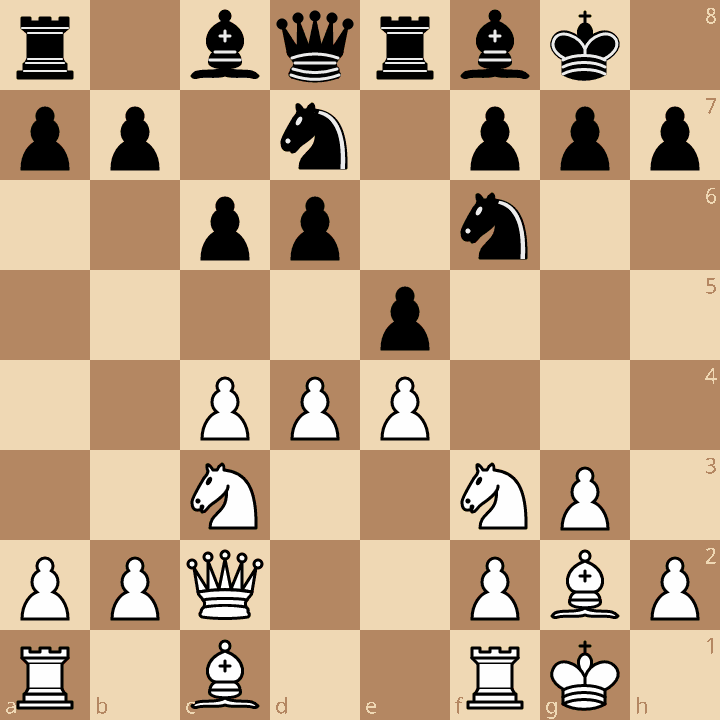
Black places the rook on the half-open e-file, reinforcing the e5 pawn and preparing tactical possibilities along the e-file. The rook may also support a later ..exd4 exchange followed by ..d5. This is a typical Old Indian maneuver — the rook on e8 adds a layer of support to Black's central pawn structure.
Alternative Moves
White moves the queen off the d-file (avoiding potential ..d5 discoveries) and connects the rooks. The queen on c2 also supports e4 and eyes the kingside along the c2-h7 diagonal. This is a flexible move that prepares various plans: Be3, Rd1, or b3 with a slow buildup.
A sophisticated retreat! The bishop returns to f8 to reposition — it can later go to g7 (supporting ..d5), d6 (attacking the kingside), or stay on f8 to keep the position flexible. This maneuver (Be7-f8) is a hallmark of the Old Indian. The bishop on e7 has done its job (allowed castling), and now Black optimizes piece placement for the middlegame battle.
Alternative Moves
Key Takeaways
- The d6 + e5 pawn duo gives Black a solid, hard-to-break center
- Nbd7 reinforces e5 and keeps the c-pawn free for ...c6
- ...c6 prepares the critical ...d5 central break — Black's main counterplay
- The bishop maneuver Be7-f8 is a key Old Indian idea to reposition the piece
- Accept a slight space disadvantage for solidity — the ...d5 break equalizes
Now play it through
Step through every move on a real board, try the wrong ones, and ask Knighty why they fail.
Summary
Ready to Practice?
Take this lesson with you
Free account requiredWith every variation — opens in Lichess & ChessBase