
Scholar's Mate - How to Punish
Learn how to defend against the Scholar's Mate and punish White's premature queen development
Try Interactive LessonIntroduction
Lesson Content
The King's Pawn opening — White claims the center and opens diagonals for the queen and kingside bishop. The most popular first move in chess.
Black mirrors White's central claim, establishing a symmetrical pawn center. This leads to the Open Games — the oldest and most classical family of openings. The e5 pawn controls d4 and f4, limiting White's expansion options.
The Bishop's Opening — White develops the bishop to target the f7 square, the weakest point in Black's starting position. On its own this is a reasonable opening, but it becomes suspicious when followed by an early Qh5. In normal play, White would continue with 2. Nf3 (Italian Game, Ruy Lopez) instead.
Alternative Moves
Black develops the knight to its most natural square, defending the e5 pawn. This is the best response regardless of White's next move — whether it's a normal continuation or the Scholar's Mate attempt.
Alternative Moves
The Scholar's Mate attempt! White threatens Qxf7# — checkmate in one move. This looks scary but is actually a mistake. Moving the queen this early violates a key opening principle: don't bring the queen out too early, because it will become a target for Black's developing pieces. Also known as the Parham Attack (ECO C20).
Alternative Moves
The key defensive move! Black attacks the queen while simultaneously defending f7. The queen has no good square — she must retreat, wasting another tempo. Warning: The natural-looking 3. ..Nf6?? is a terrible blunder — it blocks the f7 square's defense, allowing 4. Qxf7# checkmate! Always play g6 first.
Alternative Moves
White retreats the queen to f3, still eyeing f7 through the Bc4-f7 diagonal. But this is the queen's third move in 4 turns — a massive waste of time. Black has developed two pieces while White has moved the queen twice and the bishop once.
Alternative Moves
Black develops the second knight to its ideal square. The knight controls d5 and e4, and prepares kingside castling. Black now has two developed pieces to White's one (the Bc4 — the queen on f3 is a liability, not a developed piece).
Alternative Moves
White develops the knight to e2 instead of the more natural f3 square — because the queen is blocking it! This is a concrete downside of the early queen move: the knight is forced to a less active square.
Alternative Moves
The bishop fianchettoes to g7, completing Black's kingside development. On the long diagonal, the bishop exerts powerful pressure on the center (d4, e5) and will be a strong piece for the rest of the game. Black is now ready to castle.
Alternative Moves
White plays d3 to support the e4 pawn and open a diagonal for the dark-squared bishop. A solid but modest move — White's position is cramped because the queen on f3 restricts natural development.
Black solidifies the center, supporting the e5 pawn and preparing to develop the light-squared bishop. The pawn on d6 also takes away the c5 and e5 squares from White's knight. Black's position is already preferable: better development, more harmonious pieces, and ready to castle.
Alternative Moves
White finally develops the queenside knight. Both knights are developed now, but notice that Ne2 is on an awkward square compared to its natural Nf3 post — all because the queen got in the way.
Black castles to safety, connecting the rooks. Black has completed kingside development beautifully: knights on c6 and f6, bishop on g7, king safely castled. White's king is still in the center.
Alternative Moves
White castles a full move behind Black. The development gap is clear: Black's pieces are harmoniously placed, while White's queen on f3 and knight on e2 are both on suboptimal squares.
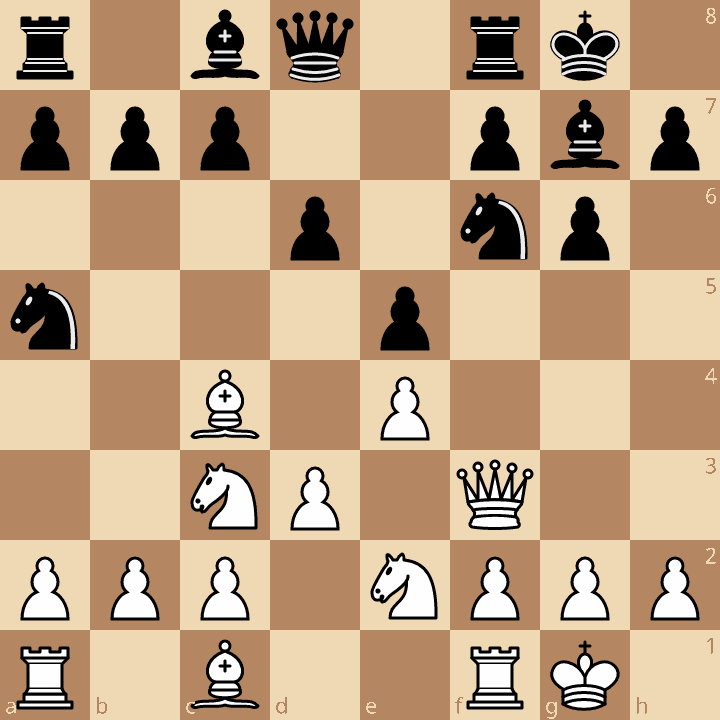
The knight jumps to a5, targeting the bishop on c4 — the very piece that started the Scholar's Mate attempt! White must retreat or trade, and after ..Nxc4, Black eliminates White's most active piece. This is poetic justice: the bishop that aimed at f7 is now being chased away by the very development advantage Black gained from punishing the early queen.
Alternative Moves
Key Takeaways
- Never panic when you see Qh5 — play g6 to attack the queen and defend f7
- 3...Nf6?? loses instantly to Qxf7# — always remember this trap
- White's early queen is a liability — it blocks Nf3 and wastes tempi
- Develop naturally (Nc6, Nf6, Bg7, O-O) while White struggles with the misplaced queen
- After castling, Na5 targets the Bc4 and completes the punishment
Now play it through
Step through every move on a real board, try the wrong ones, and ask Knighty why they fail.
Summary
Ready to Practice?
Take this lesson with you
Free account requiredWith every variation — opens in Lichess & ChessBase