
Center Game
White sacrifices a tempo by recapturing with the queen to open the position early and aim for rapid development.
Try Interactive LessonIntroduction
Lesson Content
Start by controlling the center with your king pawn.
e4 — The King's Pawn opening — White claims the center and opens diagonals for the queen and kingside bishop. The most popular first move in chess. Black's main responses: - 1. ..e5 — Open Game, matching White's center - 1. ..c5 — Sicilian Defense, fighting for d4 asymmetrically - 1. ..e6 — French Defense, preparing ..d5 - 1. ..c6 — Caro-Kann, also preparing ..d5
Black mirrors White's central claim, establishing a symmetrical pawn center. This leads to the Open Games — the oldest and most classical family of openings. The e5 pawn controls d4 and f4, limiting White's expansion options.
Strike at the center immediately — this defines the Center Game.
The Center Game begins! White immediately challenges Black's e5 pawn by striking in the center with d4. This is more direct than 2. ♘︎f3 — White wants to open the position right away. After 2. ..exd4, White will recapture with the queen rather than a knight, which is the defining characteristic of the Center Game.
Alternative Moves
Black captures the d4 pawn — the most natural and best response. Declining with 2. ..d6 gives White a comfortable space advantage after 3. ♘︎c3. Now White faces a critical decision: recapture with the queen (Center Game) or with the knight (Scotch Game).
Alternative Moves
Recapture with the queen to stay in the Center Game.
♕︎xd4 — The defining move of the Center Game — White recaptures with the queen, placing it actively in the center. The queen controls d5, e5, c5, and a4 from here. The drawback is obvious: developing the queen early violates a classical principle, and Black will gain tempo by attacking it with ..♘︎c6. But White aims to compensate with rapid piece development.
Alternative Moves
Black develops with tempo, attacking the queen and forcing it to move again. This is the main reason the Center Game is considered slightly dubious at the highest level — White loses time. The knight on c6 develops naturally, defends e5 (if needed later), and controls d4.
Retreat the queen to a square where it stays active and supports e4.
♕︎e3 — The Paulsen Attack — the queen retreats to e3, where it stays active and flexible. From e3, the queen supports both e4 and a future kingside attack, while keeping the half-open d-file for a rook. White's alternatives: - 4. ♕︎a4 — eyes the c6-knight along the a4-e8 diagonal, at least as strong - 4. ♕︎d1 — too passive, wastes the whole idea - 4. ♕︎c4 — also playable but less harmonious
Alternative Moves
Black continues rapid development, attacking the e4 pawn and preparing to castle kingside. The knight on f6 is Black's best piece — it controls d5, e4, and g4. This position is the Berger Variation of the Center Game, a well-known tabiya.
Defend e4 while developing a piece.
White defends the e4 pawn while developing the knight to its best square. ♘︎c3 also controls d5 and prepares to complete development quickly. With both knights developed, White is ready to get the bishops out and castle — the key is catching up in development after the early queen excursion.
Alternative Moves
Black pins the ♘︎c3 to the king on e1 — an absolute pin along the b4-c3-e1 diagonal. The knight cannot move at all, which means e4 is only defended by the queen. This is a typical Nimzo-Indian-style motif: the bishop applies pressure from b4 and White must address the pin before completing development.
Break the pin while developing your bishop.
♗︎d2 — White breaks the pin with a natural developing move. The bishop on d2 defends c3 and connects the queenside, preparing O-O-O. This is the most practical choice. The position is heading for opposite-side castling — the hallmark of the Center Game — where both sides will attack the enemy king.
Alternative Moves
Black castles to safety — a natural and strong move. The king is secure on g8, and the rook will soon be active on the e-file, targeting White's e4 pawn. Black has completed more development than White at this point, but White is about to catch up with queenside castling.
Castle on the opposite side to set up an attacking position.
O-O-O — Queenside castling! This is the key idea of the Center Game — opposite-side castling creates a dynamic, attacking game. Both kings are on different flanks, so pawn storms don't weaken your own king. The rook immediately lands on d1, eyeing the half-open d-file. White is now ready to develop the remaining pieces aggressively.
Alternative Moves
Black places the rook on the half-open e-file, creating direct pressure against e4. The rook also X-rays the queen on e3, which could become uncomfortable. This is a key defensive and counterattacking idea — Black uses the half-open file before White can fully organize an attack.
Develop your bishop to target the f7 weak point.
♗︎c4 — The bishop develops to its most active diagonal, targeting f7 — the classic weak point in Black's position. Combined with the queen on e3 and rook on d1, White is building a dangerous attacking formation. White's pieces are now rapidly coming together. The bishop on c4 also supports a future ♘︎g5 lunge.
Alternative Moves
Black solidifies the position with ..d6, opening the diagonal for the c8-bishop and reinforcing the center. The pawn on d6 also covers the c5 and e5 squares. Black is well-developed and solid, but must stay alert to White's attacking potential on the kingside.
Complete your development with the last knight.
♘︎f3 — The last minor piece enters the game — White now has full development completed. The knight on f3 controls e5 and g5, both important attacking squares. White's position is harmonious: pieces aim at the kingside, the rook controls the d-file, and the queen supports everything from e3.
Black develops the last minor piece, challenging White's strong ♗︎c4. Trading bishops would ease Black's defensive burden by removing one of White's attacking pieces. The bishop on e6 also eyes the a2 pawn and helps control the d5 square — a sensible, practical decision.
Trade bishops to change the character of the position.
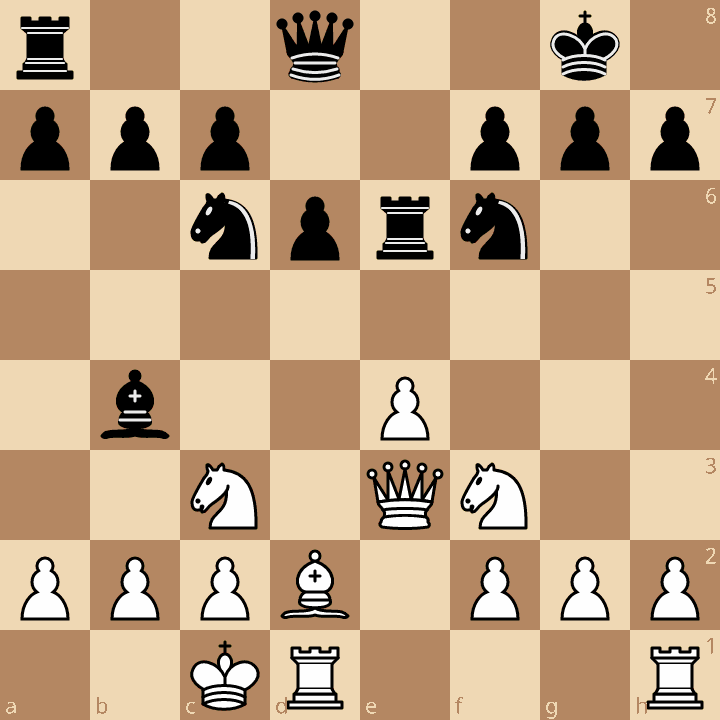
♗︎xe6 — White exchanges bishops. While normally you'd want to keep attacking pieces, this trade forces Black to weaken the pawn structure with ..fxe6 or use the rook to recapture. After 10. ..♖︎xe6, Black's rook is actively placed on the e-file, eyeing e4. The position is roughly balanced — a typical Center Game middlegame.
Alternative Moves
Black recaptures with the rook, keeping the pawn structure intact. The rook is actively placed on e6, defending the kingside laterally while staying on an open file. The position is dynamically balanced. White has an active formation with opposite-side castling, while Black has solid development and a flexible pawn structure. The middlegame battle begins!
Alternative Moves
Key Takeaways
- The Center Game opens the position immediately with 2.d4 — more direct than 2.♘︎f3
- 3.♕︎xd4 loses a tempo to ...♘︎c6 but White compensates with rapid piece development
- 4.♕︎e3 (Paulsen Attack) keeps the queen active and supports e4
- Opposite-side castling (O-O-O) is the key strategic idea — both sides attack the enemy king
- White's plan: develop quickly, castle queenside, and launch a kingside attack with pieces
Now play it through
Step through every move on a real board, try the wrong ones, and ask Knighty why they fail.
Related Lessons
Summary
Ready to Practice?
Next in this opening family
Danish Gambit
Take this lesson with you
Free account requiredWith every variation — opens in Lichess & ChessBase