
Bishop's Opening
A flexible 1.e4 system where White develops the bishop to c4 before committing the knight, targeting f7 and preparing a slow central build-up.
Try Interactive LessonIntroduction
Lesson Content
The King's Pawn opening — White claims the center and opens diagonals for the queen and kingside bishop. The most popular first move in chess. Black's main responses: - 1. ..e5 — Open Game, matching White's center - 1. ..c5 — Sicilian Defense, fighting for d4 asymmetrically - 1. ..e6 — French Defense, preparing ..d5 - 1. ..c6 — Caro-Kann, also preparing ..d5
Black mirrors White's central claim, establishing a symmetrical pawn center. This leads to the Open Games — the oldest and most classical family of openings. The e5 pawn controls d4 and f4, limiting White's expansion options.
The Bishop's Opening! White develops the bishop to c4, aiming at f7 — the weakest point in Black's starting position (only defended by the king). By developing the bishop before the knight, White avoids the Petrov Defense and retains flexibility. White's alternatives: - 2. Nf3 — the most common, leading to Italian, Ruy Lopez, or Scotch - 2. d4 — the Center Game, immediately opening the position - 2. Nc3 — the Vienna Game, another flexible approach
Alternative Moves
The Berlin Defense of the Bishop's Opening — Black develops the knight, counterattacking the e4 pawn. This is the most popular response, putting immediate pressure on White's center. Other options include 2. ..Nc6 (defending e5) and 2. ..Bc5 (mirroring White's development).
White supports the e4 pawn solidly with d3 rather than the more ambitious d4. This is the modern approach — keeping the center flexible and avoiding early exchanges. The d3 pawn also opens the diagonal for the dark-squared bishop. White's plan is to later prepare d4 with c3 and Nbd2, building up gradually.
Alternative Moves
Black develops the bishop to its most active diagonal, mirroring White's Bc4. The bishop on c5 eyes the f2 square and supports a future ..d5 break. This is a natural developing move that leads to Italian-like structures.
White develops the knight to its best square, attacking the e5 pawn and preparing kingside castling. Combined with Bc4 and d3, this completes the minor piece development on the kingside.
Alternative Moves
Black castles kingside to safety. The king is now protected and the rook can potentially support the e-file or f-file later.
White follows suit, tucking the king to safety and connecting the rooks. Both sides have castled — now the middlegame maneuvering begins.
Black reinforces the e5 pawn and opens a retreat square for the bishop. The pawn on d6 also prevents White from playing d4 easily, since after dxe5 dxe5, Black's pawn structure remains solid.
The key preparatory move! White supports a future d4 advance. The plan is c3 → Nbd2 → d4, building the ideal pawn center. This is the signature strategic idea in the Bishop's Opening setup.
Alternative Moves
Black retreats the bishop from the center anticipating White's d4 push. On b6, the bishop remains on the a7–g1 diagonal and still puts pressure on f2.
White develops the last minor piece, reinforcing the center and preparing the d4 break. The knight on d2 supports both e4 and a future d4 push. It can also reroute to c4 or f1–g3 later.
Alternative Moves
Black solidifies the center by supporting a future ..d5 break. The c6 pawn also prevents any Nb5 ideas and gives Black queenside stability.
White retreats the bishop to b3, keeping it on the powerful a2–g8 diagonal while moving it out of range of a future ..d5 attack. From b3, the bishop continues to eye the f7 square and remains well placed for the middlegame.
Alternative Moves
Black places the rook on the semi-open e-file, adding support to the e5 pawn and preparing for potential central tension when White plays d4.
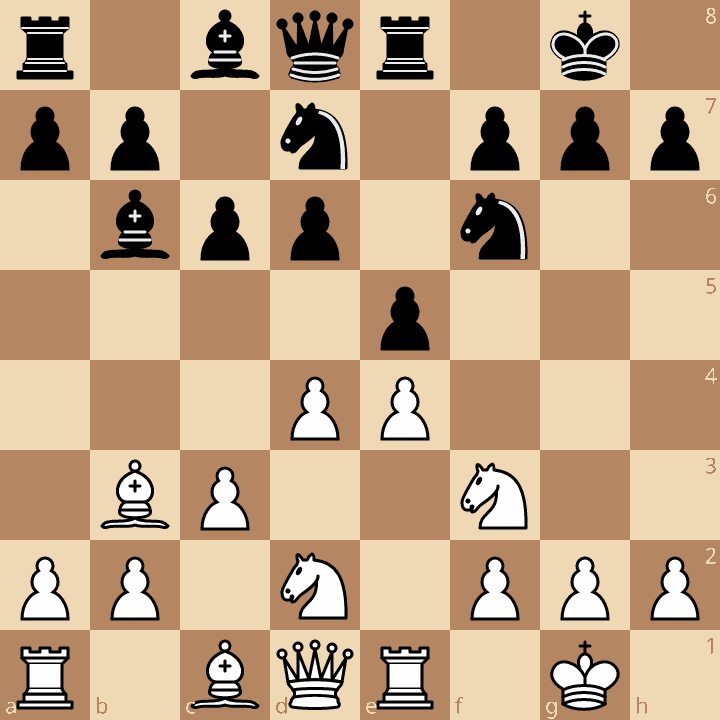
White mirrors Black's rook placement, claiming the e-file. The rook on e1 supports the e4 pawn and will become very active once the center opens after d4.
Alternative Moves
Black develops the queenside knight, adding support to e5 and keeping the position flexible. The knight can later go to f8–g6 or stay on d7 to support central play.
The thematic central break! After careful preparation with c3, Nbd2, Bb3, and Re1, White finally strikes in the center. This challenges Black's e5 pawn and opens lines for White's well-placed pieces. The moment White has been building toward since move 6.
Alternative Moves
Key Takeaways
- 2.Bc4 targets f7 and avoids the Petrov Defense — more flexible than 2.Nf3
- d3 supports e4 without committing to an early d4
- c3 + Nbd2 prepares the thematic d4 central break
- Bb3 keeps the bishop on the strong a2–g8 diagonal
- Complete development (O-O, Re1) before executing the central break
Now play it through
Step through every move on a real board, try the wrong ones, and ask Knighty why they fail.
Summary
Ready to Practice?
Take this lesson with you
Free account requiredWith every variation — opens in Lichess & ChessBase