
Sicilian Defense - Alapin Variation
White avoids the complex Open Sicilian with 2.c3, preparing an ideal pawn center with d4. A practical, low-theory weapon favored by Carlsen.
Try Interactive LessonIntroduction
Lesson Content
The King's Pawn opening — White claims the center and opens diagonals for the queen and kingside bishop. The most popular first move in chess. Black's main responses: - 1. ..e5 — Open Game, matching White's center - 1. ..c5 — Sicilian Defense, fighting for d4 asymmetrically - 1. ..e6 — French Defense, preparing ..d5 - 1. ..c6 — Caro-Kann, also preparing ..d5
The Sicilian Defense — Black's most popular and ambitious reply to 1. e4. Rather than matching White in the center with ..e5, Black fights for the d4 square asymmetrically. The Sicilian leads to unbalanced positions where both sides have chances. White typically gets a kingside attack; Black gets queenside counterplay and the c-file.
The Alapin Variation! White prepares d4 with pawn support instead of entering the complex Open Sicilian with 2. Nf3. After d4, White will achieve the ideal e4+d4 pawn center. This is a practical choice: White avoids thousands of moves of Sicilian theory while getting a clear plan. Carlsen has used the Alapin extensively against top GMs including Nepomniachtchi, Giri, and Ding Liren.
Alternative Moves
Black develops the knight and attacks the e4 pawn directly. This is the most popular response, forcing White to make a concrete decision about the center. Black's main alternative is 2. ..d5, immediately challenging the center. Both are sound.
Alternative Moves
White pushes the e-pawn forward, gaining space and attacking the knight. This is the most principled response — White grabs territory in the center and forces Black to retreat. The e5 pawn cramps Black's position and controls the d6 and f6 squares, limiting Black's piece development.
Alternative Moves
The knight retreats to d5, the only good square. From d5, the knight is centralized and eyes c3 and e3. Black will look to challenge White's center with ..d6 or ..e6.
White strikes in the center — this is what c3 prepared! The ideal e5+d4 pawn center gives White significant space advantage. Black is practically forced to exchange on d4, leading to an isolated d-pawn (IQP) structure.
Alternative Moves
Black captures the d4 pawn. Declining with ..e6 or ..Nc6 allows White too strong a center. After the exchange, the position transforms into an IQP structure once White recaptures.
Alternative Moves
White develops the knight before recapturing on d4. The knight goes to its best square, controlling d4 and e5, and preparing kingside castling. White can recapture with cxd4 next move. This is the most popular move order, favored by masters including Aronian and Nakamura. The immediate 5. cxd4 is also common.
Alternative Moves
Black develops the knight to its natural square, adding pressure to the d4 pawn and the e5 pawn. The knight also prepares ..d6 to challenge White's space advantage. Black's alternatives are 5. ..e6 (more solid) and 5. ..d6 (more direct challenge to e5).
Alternative Moves
White recaptures, establishing the IQP (isolated d-pawn) on d4. The isolated pawn controls e5 and c5, giving White space and piece activity. The tradeoff: the d4 pawn has no neighboring pawns to support it, so it can become a target in the endgame. This IQP structure is one of the most important in chess — understanding it is key to playing the Alapin well.
Alternative Moves
Black challenges the e5 pawn — the key break. After the exchange on e5, the position opens up and Black gets free piece play. This is the most natural way to fight White's space advantage.
Alternative Moves
The bishop develops to its most active diagonal, targeting the Nd5 and eyeing the f7 square. From c4, the bishop supports the d4 pawn indirectly and can shift to b5 or b3 depending on Black's response. This is the overwhelming favorite in master play — Carlsen, Nakamura, MVL, and Aronian all play this automatically.
Alternative Moves
The knight retreats to b6, hitting the Bc4 and preparing to reroute. The knight on b6 also eyes d5 — the ideal blockade square for the IQP — and supports the ..a5-a4 push in some lines.
Alternative Moves
The bishop retreats to b5, pinning the Nc6 against the king. This is the most popular continuation — the bishop remains active on the a4-e8 diagonal while creating tactical pressure. White threatens Bxc6+ in some lines, doubling Black's pawns. The bishop also clears the c4 square for a potential rook lift via Rc1-c4 in some plans.
Alternative Moves
Black captures the e5 pawn, opening the position. This is the right moment — after the exchange, the isolated d-pawn becomes the central theme. Black aims to blockade it on d5 with a knight, while White seeks to push it or use the open lines for attack.
Alternative Moves
White recaptures with the knight, placing it powerfully on e5. The knight on e5 is a monster — it controls d7, f7, c6, and d3. This is the peak of White's piece activity in the IQP structure.
Black develops the bishop and challenges the Ne5. The bishop on d7 also breaks the pin on the Nc6 and connects to the Bb5. After the upcoming exchanges, the position simplifies toward equality.
White exchanges on d7, simplifying the position. This is the most popular choice — White trades the active knight but removes Black's bishop pair and forces the queen to an awkward recapture. The alternative 10. Bxc6 is also sound, giving Black doubled pawns but the bishop pair.
Alternative Moves
Black recaptures with the queen — the only move. The queen on d7 is reasonably placed, eyeing the d4 pawn and ready to shift to c6 or a4 for counterplay.
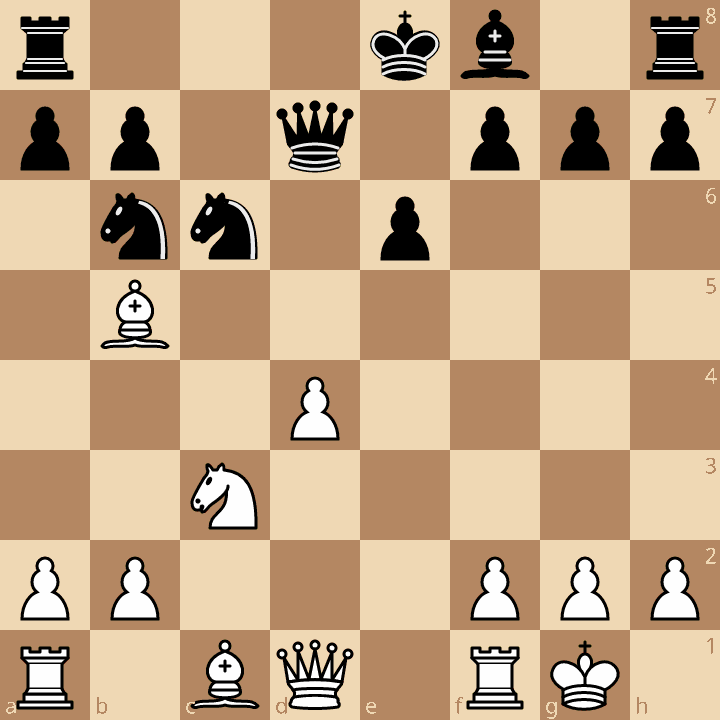
White develops the last minor piece, supporting the d4 pawn and controlling d5 and e4. The knight on c3 is well-placed in the IQP structure — it defends d5 invasion attempts and can jump to e4 or b5. White's plan: complete development with O-O and Be3, then use the active pieces to compensate for the isolated pawn.
Alternative Moves
Black prepares to develop the bishop to e7 or d6 and castle. The e6 pawn also reinforces d5 — the ideal blockade square for the isolated d4 pawn. Black will aim for a knight on d5 to lock down the IQP.
Alternative Moves
White castles kingside, completing development. The king is safe and the rook eyes the e-file. White's position is harmonious: the IQP on d4 gives space and active pieces, while Black must carefully blockade the pawn and equalize. Typical plans from here: Be3 to support d4, Rc1 to contest the c-file, and Qf3 or Qg4 for attacking chances.
Key Takeaways
- 2.c3 prepares d4 — avoiding the massive Open Sicilian theory
- The resulting IQP structure gives White active pieces and space
- Bc4 then Bb5 is the standard bishop maneuver — developing with purpose
- Nxe5 creates a powerful centralized knight before simplification
- In the IQP middlegame, White's activity compensates for the pawn weakness
Now play it through
Step through every move on a real board, try the wrong ones, and ask Knighty why they fail.
Summary
Ready to Practice?
Take this lesson with you
Free account requiredWith every variation — opens in Lichess & ChessBase