
Sicilian Accelerated Dragon
A flexible Sicilian where Black fianchettoes early to enable the powerful ...d5 break in one move.
Try Interactive LessonIntroduction
Lesson Content
The King's Pawn opening — White claims the center and opens diagonals for the queen and kingside bishop. The most popular first move in chess. Black's main responses: - 1. ..e5 — Open Game, matching White's center - 1. ..c5 — Sicilian Defense, fighting for d4 asymmetrically - 1. ..e6 — French Defense, preparing ..d5 - 1. ..c6 — Caro-Kann, also preparing ..d5
Fight for the d4 square with your c-pawn.
c5 — The Sicilian Defense: Black's most popular and ambitious reply to 1. e4. Rather than matching White in the center with ..e5, Black fights for the d4 square asymmetrically. The Sicilian leads to unbalanced positions where both sides have chances. White typically gets a kingside attack; Black gets queenside counterplay and the c-file.
Alternative Moves
The Open Sicilian begins. White develops naturally and prepares d4, which will open the position. This is the most principled approach against the Sicilian. Black's main responses determine the specific variation: - 2. ..d6 — Najdorf, Dragon, Classical - 2. ..♘︎c6 — Sveshnikov, Kalashnikov, Accelerated Dragon - 2. ..e6 — Kan, Taimanov, Scheveningen
Develop your knight to control the center.
♘︎c6 — Black develops the knight to its most natural square, preparing to recapture on d4. The knight on c6 controls the critical d4 and e5 squares. This move order keeps maximum flexibility — Black hasn't committed to ..d6 yet, which is the whole point of the Accelerated Dragon.
Alternative Moves
White strikes at the center with the thematic d4 push. This is virtually the only way to fight for an advantage in the Open Sicilian — White offers a pawn trade to open the position and accelerate development. Black should capture, half-opening the c-file for future counterplay.
Capture to half-open the c-file for your rook.
cxd4 — Black captures, half-opening the c-file which will become a long-term asset. The half-open c-file gives Black's rook natural counterplay against White's queenside. This trade is standard in the Open Sicilian — Black trades a flank pawn for a center pawn, creating the asymmetric structure that defines the Sicilian.
White recaptures with the knight, centralizing it powerfully on d4. The knight controls key squares (b5, c6, e6, f5) and can later jump to various outposts. From here, Black's next move defines the variation — and this is where the Accelerated Dragon diverges from the regular Dragon.
Prepare the bishop fianchetto — this is the Accelerated Dragon!
g6 — The Accelerated Dragon! Black prepares to fianchetto the bishop on g7 without first playing ..d6. This is the key distinction from the regular Dragon (where ..d6 comes first). By delaying ..d6, Black preserves the option to push ..d5 in one move — a powerful central break that's impossible in the regular Dragon. The downside is that White can try the Maroczy Bind with c4, clamping down on d5.
Alternative Moves
White develops the knight to c3, supporting e4 and controlling d5. This is the natural developing move, but it allows Black to continue with the fianchetto plan. White's main alternative is 5. c4 — the Maroczy Bind, which directly prevents ..d5 by controlling that square with pawns. The Maroczy Bind leads to a slower, more strategic game.
Complete the fianchetto — your bishop belongs on the long diagonal.
Black completes the fianchetto, placing the bishop on the powerful long diagonal (a1-h8). The ♗︎g7 is the Accelerated Dragon's prize piece — it exerts pressure on the center and queenside, particularly the d4 square. The bishop also contributes to king safety after castling, forming a solid defensive structure around the Black king.
White develops the dark-squared bishop to e3, supporting the ♘︎d4 and preparing to develop the kingside. The bishop also supports potential queenside play. This is the most popular continuation. White's plan typically involves ♗︎c4 or ♗︎e2, followed by castling and central pressure.
Develop your knight and attack the e4 pawn.
♘︎f6 — Black develops the knight to f6, attacking the e4 pawn and preparing to castle kingside. The knight also controls d5 — a critical square in this opening. With both knights developed and the bishop fianchettoed, Black is almost ready to castle and then execute the ..d5 break at the right moment.
White places the bishop on c4, targeting the f7 square and indirectly discouraging ..d5. The bishop on c4 is aggressive — it supports ♘︎d5 ideas and prepares for a potential kingside attack. This is the strongest move here, creating more concrete threats than the quieter 7. ♗︎e2.
Get your king to safety before breaking in the center.
O-O — Black castles kingside, securing the king behind the fianchetto structure. The rook also moves to f8, potentially supporting a future ..f5 push or ..d5 break. Castling is essential before launching any central action — the king needs to be safe before opening the position.
White retreats the bishop to b3, keeping it on the a2-g8 diagonal and maintaining pressure on f7. The retreat also avoids ..d5 hitting the bishop with tempo. From b3, the bishop continues to influence the center and supports ideas like f3 and ♕︎d2 for a potential kingside attack.
Strike at the center — this is the move you delayed ...d6 for!
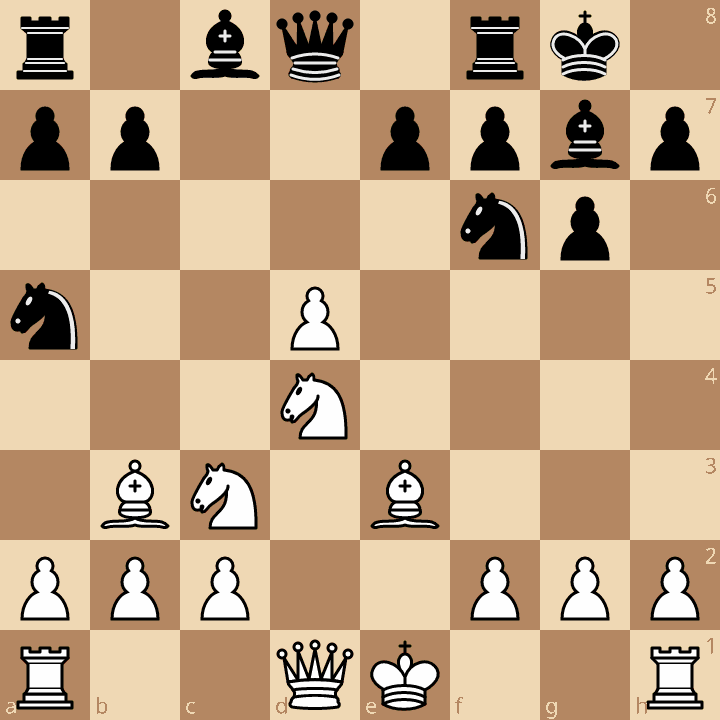
The thematic central break — the whole point of the Accelerated Dragon! Black strikes at the center with ..d5 in a single move, something impossible in the regular Dragon where ..d6 has already been played. This break challenges White's center directly and opens lines for Black's pieces, especially the ♗︎g7 on the long diagonal. The position becomes sharp and dynamic.
Alternative Moves
White captures, opening the position. This is the most natural response — declining the capture with e5 would block the center but leave the e5 pawn vulnerable. After exd5, Black has an important decision about how to recapture and create counterplay.
Attack the bishop to win back the d5 pawn with tempo.
♘︎a5 — Black attacks the ♗︎b3 with the knight, gaining tempo while the d5 pawn remains a target. White must deal with the threat to the bishop before consolidating. After the inevitable exchange on b3, Black will recapture the d5 pawn with the ♘︎f6, reaching a comfortable position with active pieces and no weaknesses. The ♗︎g7 will rake down the long diagonal once the center opens.
Alternative Moves
Key Takeaways
- Play ...g6 before ...d6 to keep the ...d5 break option open
- The ♗︎g7 is the key piece — it dominates the long diagonal
- ...d5 in one move is the whole point of the Accelerated move order
- Watch out for the Maroczy Bind (c4) — White's main way to prevent ...d5
- Castle before breaking in the center — king safety first
Now play it through
Step through every move on a real board, try the wrong ones, and ask Knighty why they fail.
Related Lessons
Summary
Ready to Practice?
Next in this opening family
Sicilian Sveshnikov
Take this lesson with you
Free account requiredWith every variation — opens in Lichess & ChessBase