
Connected Passed Pawns vs Rook
Learn when two connected passed pawns can overpower a rook — one of the most important pawn endgame principles.
Try Interactive LessonIntroduction
Lesson Content
Advance the more dangerous pawn first — it threatens to promote immediately!
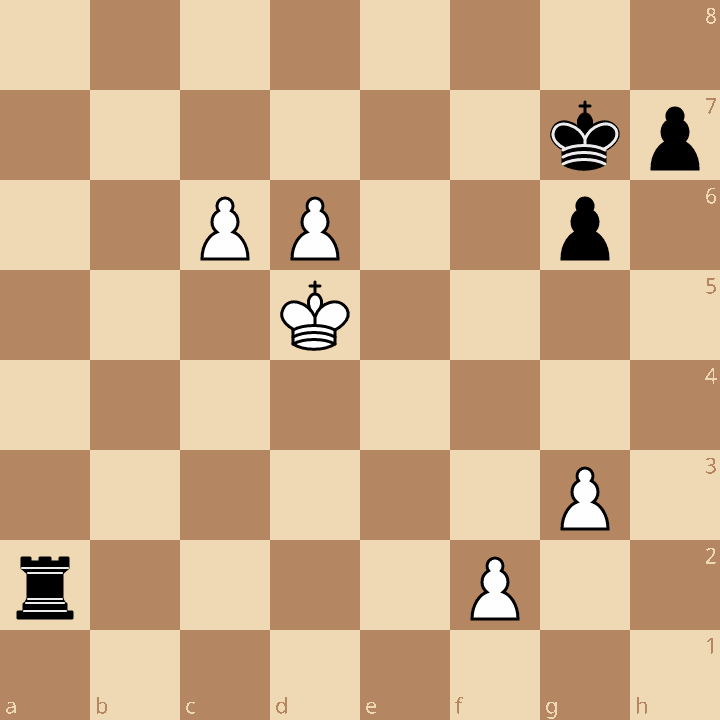
Push the more advanced threat first! The d-pawn storms to d7, just one square from promotion. This forces Black to react immediately — the pawn threatens d8=♕︎. The beauty of connected passed pawns is that even if Black deals with this pawn, the c6 pawn is ready to follow. Notice the chain of protection: the c6 pawn guards d7, and the king on d5 guards c6. This is why connected passed pawns are so powerful — they form a self-reinforcing chain.
Alternative Moves
Black brings the king toward the pawns, trying to set up a blockade. ♔︎f7 heads toward e8/d8 to block the d-pawn's promotion square. But White has a devastating response — pushing the second pawn to create two simultaneous promotion threats.
Bring the second pawn up too — two pawns on the 7th rank are unstoppable!
c7 — ♗︎oth pawns on the 7th rank! This is the critical position that demonstrates the power of connected passed pawns. Black now faces an impossible problem: the rook and king cannot cover both c8 and d8 simultaneously. If the rook goes to c8, White plays d8=♕︎. If the rook goes to d8, White plays c8=♕︎. The pawns have outrun the rook's ability to defend — a single piece simply cannot blockade two connected passed pawns on the 7th rank.
Alternative Moves
Black tries a desperate check with the rook. This is the only practical attempt — if the rook goes to d8 or c8 to blockade, one pawn promotes immediately. So Black resorts to harassing the White king with checks, hoping to delay promotion.
Move the king to c6 — let the pawns shield you from checks!
♔︎c6 — The king shelters behind the pawns! By stepping to c6, the king hides behind the c7 and d7 pawns, which shield it from rook checks from above. The pawns are not just promotion threats — they also protect the king. This is another advantage of connected passed pawns: they create a pawn shelter for the king while simultaneously threatening to promote.
Alternative Moves
The rook retreats to d1, hoping to later come back and interfere. But with both pawns on the 7th rank and the king on c6 supporting them, there is no way to prevent at least one promotion. Black is simply out of useful moves.
Promote the c-pawn — the rook cannot stop both pawns!
The first pawn promotes! White chooses c8=♕︎ because the d7 pawn still threatens d8=♕︎, maintaining a second promotion threat. Black's rook on d1 is too far away to prevent this. The connected passed pawns have done their job — at least one must promote, and here both will. Notice that d8=♕︎ works just as well (the engine even prefers it slightly); after c8=♕︎ the d-pawn stays ready for d8=♕︎+ on the next move.
Alternative Moves
Black's king steps to f6, trying to stay out of the new queen's range. But with a queen on c8 and the d7 pawn about to become a second queen, the position is hopeless.
Promote with check — two queens on the board!
d8=♕︎+ — The second pawn promotes with check! Both connected passed pawns have become queens. Black's rook can capture on d8, but White simply recaptures. The rook — which seemed so powerful at the start — was completely overwhelmed by the two pawns marching together.
The rook captures the checking queen. But this just walks into White's recapture.
Recapture the rook — queen plus pawns wins easily.
♕︎xd8+ — White recaptures with check. The final position tells the whole story: White has a queen and two pawns against Black's king and two pawns. What started as pawns vs a rook ended with a decisive material advantage. The connected passed pawns completely overwhelmed the rook because it could not cover two promotion squares at once.
Key Takeaways
- Two connected passed pawns on the 6th rank are often stronger than a rook — they create two threats the rook cannot both cover
- Push both pawns to the 7th rank together — the rook can only blockade one promotion square at a time
- Connected passed pawns protect each other as they advance, unlike isolated pawns which need piece support
- The king can shelter behind advanced connected passed pawns, using them as a shield against rook checks
- When defending against connected passed pawns, try to blockade them BEFORE they reach the 6th rank — once they reach the 7th, it is usually too late
Now play it through
Step through every move on a real board, try the wrong ones, and ask Knighty why they fail.
Related Lessons
Summary
Ready to Practice?
Next in this course
Two Pawns vs One
Take this lesson with you
Free account requiredWith every variation — opens in Lichess & ChessBase