
Elephant Trap
A devastating queen trap in the Queen's Gambit Declined. Learn how to punish White's greedy 6.Nxd5 with a stunning bishop check.
Try Interactive LessonIntroduction
Lesson Content
The Queen's Pawn opening — White claims the center with the d-pawn, which is immediately defended by the queen. This tends to lead to more strategic, closed positions compared to 1. e4. Black's main responses: - 1. ..d5 — Queen's Gambit and Slav setups - 1. ..Nf6 — Indian Defenses (King's Indian, Nimzo-Indian, etc.) - 1. ..f5 — Dutch Defense
Black matches White in the center, leading to the Queen's Pawn Game. The symmetrical center typically results in strategic maneuvering rather than immediate tactical battles. White's most popular continuation is 2. c4 — the Queen's Gambit.
The Queen's Gambit — White offers a pawn to lure Black's d5 pawn away from the center. It's not a true gambit since Black can't hold the pawn long-term. Black's main choices: - 2. ..e6 — Queen's Gambit Declined, solid and classical - 2. ..c6 — Slav Defense, supporting d5 while keeping the bishop free - 2. ..dxc4 — Queen's Gambit Accepted, giving up the center temporarily
The Queen's Gambit Declined — Black reinforces d5 solidly. The downside is the same as in the French: the light-squared bishop is blocked behind the e6 pawn. This is one of the most classical and well-respected opening systems in chess.
White develops the knight to its natural square, adding pressure to d5 and preparing e4. The Nc3 knight is a central pillar of White's QGD setup. From here White typically continues with Bg5, Nf3, or e3.
Black develops the knight to its best square, defending d5 and fighting for e4. A natural and principled developing move in the Queen's Gambit Declined. Black's setup is solid — the next question is where to place the remaining pieces.
White pins the Nf6 against the queen. This is the classical approach in the QGD — the bishop pressures d5 indirectly by targeting its defender. If Black plays ..Be7, the pin is resolved but White maintains strategic pressure. This position is classified as ECO D51.
Setting the Elephant Trap! The knight develops to d7, seemingly a passive square — but it conceals a deadly tactical idea. If White carelessly captures on d5 with the knight, Black has a stunning refutation. The Nbd7 move also supports Nf6, adds a defender to e5 and c5, and prepares to recapture on d5 with a knight.
Alternative Moves
White captures on d5, releasing the central tension. This is a normal move — the Exchange Variation of the QGD. The idea is to simplify the center and rely on a slight space advantage. By itself this is perfectly fine, but it creates the conditions for the Elephant Trap if White follows up carelessly.
Black recaptures with the e-pawn, maintaining a pawn on d5. The center is now symmetrical with pawns on d4 and d5. The e-file is half-open. The trap is now set — the d5 pawn looks tempting to White's Nc3, but capturing it is a catastrophic mistake.
The blunder! White captures the d5 pawn with the knight, thinking it wins a free pawn since the Nf6 is pinned by the Bg5 (if ..Nxd5, then Bxd8 wins the queen). But White has overlooked a devastating intermediate move. The correct moves were 6. e3 or 6. Nf3, continuing normal development.
Alternative Moves
Spring the trap! Black captures the knight despite the apparent pin. White will now play Bxd8 to capture the queen, thinking they're winning material. But Black has a crushing intermediate check coming. The key insight: the "pin" is an illusion — Black doesn't need the queen!
White captures the queen, seemingly winning massive material. But this is the moment of truth — Black's devastating reply turns the tables completely. White's bishop on d8 will be recaptured later by the king.
The Elephant Trap springs! The bishop delivers check from b4, and White's queen is the only piece that can block on d2. After the forced queen trade, Black will recapture the bishop on d8 with the king — ending up a full piece ahead. This is the power of intermediate checks — they disrupt the expected sequence of captures.
White's only legal way to block the check while maintaining any material. The queen interposes on d2, but it's doomed to be captured. Other options are even worse: 8. Ke2 loses the right to castle and keeps the queen trapped, 8. Kd2 allows further tactics.
Alternative Moves
Capture the queen! Black takes the queen with check, forcing White's king to recapture. The queen trade is complete — both sides have lost their queens, but Black's king will now recapture the bishop on d8, leaving Black a full piece ahead. The material count after the dust settles: Black has two knights and a bishop vs White's one knight and one bishop.
White recaptures the bishop, but the damage is done. White's king has lost castling rights and sits exposed in the center. The king must now waste time returning to safety.
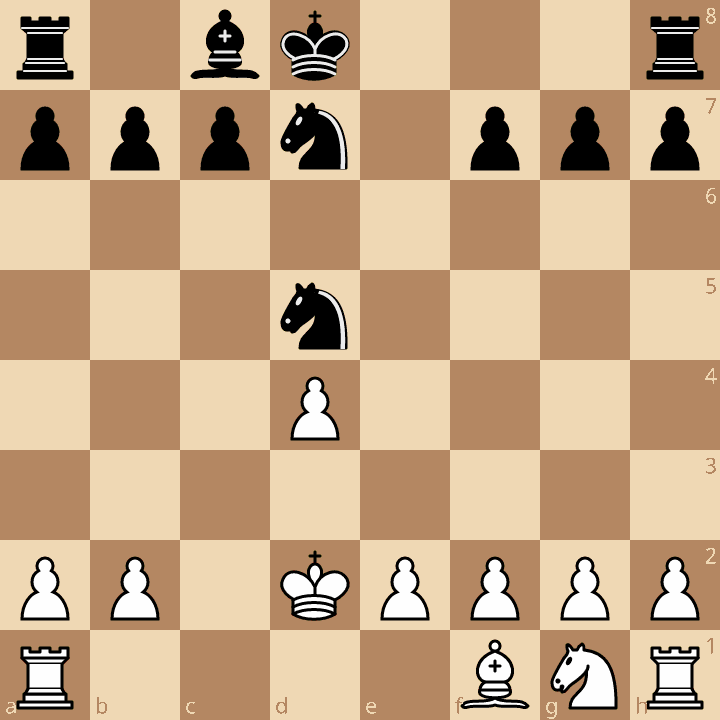
Recapture the bishop! Black takes the bishop on d8 with the king, completing the trap. The final count: Black is a full piece ahead (two knights and a bishop vs one knight and one bishop). Both kings have lost castling rights, but Black's material advantage is decisive. The Elephant Trap is complete — White fell into the pit!
Key Takeaways
- 4...Nbd7 sets the Elephant Trap by adding a second knight to recapture on d5
- 6.Nxd5?? is the blunder — the pin on Nf6 is an illusion
- 7...Bb4+ is the key intermediate check that wins the queen
- Intermediate checks can completely change the outcome of a capture sequence
- Always check for in-between moves before assuming a pin is real
Now play it through
Step through every move on a real board, try the wrong ones, and ask Knighty why they fail.
Summary
Ready to Practice?
Take this lesson with you
Free account requiredWith every variation — opens in Lichess & ChessBase