
Queen's Indian Defense
A hypermodern defense controlling the center from a distance with the fianchettoed bishop on b7.
Try Interactive LessonIntroduction
Lesson Content
The Queen's Pawn opening — White claims the center with the d-pawn, which is immediately defended by the queen. This tends to lead to more strategic, closed positions compared to 1. e4. Black's main responses: - 1. ..d5 — Queen's Gambit and Slav setups - 1. ..Nf6 — Indian Defenses (King's Indian, Nimzo-Indian, etc.) - 1. ..f5 — Dutch Defense
Black develops the knight and controls e4, preventing White from building the ideal e4+d4 center easily. This is the gateway to all Indian Defense systems. Black delays committing a pawn structure, staying flexible to choose between King's Indian, Nimzo-Indian, Queen's Indian, and more.
White reinforces control of d5 and grabs more space. Combined with d4, the two pawns dominate the center. Now Black's response determines the opening system: - 2. ..e6 — Nimzo-Indian (after 3. Nc3 Bb4) or Queen's Indian - 2. ..g6 — King's Indian or Grunfeld - 2. ..c5 — Benoni structures - 2. ..e5 — Budapest Gambit
Black prepares ..d5 or ..Bb4 (Nimzo-Indian). This is a flexible move that keeps many options open. If White plays 3. Nc3, Black can pin with ..Bb4 (Nimzo-Indian); if 3. Nf3, Black can play ..b6 (Queen's Indian) or ..d5 (QGD transposition).
White develops the knight but avoids 3. Nc3, sidestepping the Nimzo-Indian (3. ..Bb4). This is called the Anti-Nimzo-Indian — White keeps the option to fianchetto with g3 or play e3 systems. Black's main responses: - 3. ..b6 — Queen's Indian Defense, fianchettoing the bishop - 3. ..d5 — transposing to the Queen's Gambit Declined - 3. ..Bb4+ — Bogo-Indian Defense
Alternative Moves
The Queen's Indian Defense! Black prepares to fianchetto the bishop to b7, where it will exert powerful pressure on the a8–h1 diagonal — especially targeting the e4 square. This is the defining move of the QID. Since White avoided 3. Nc3, Black shifts from the Nimzo-Indian plan to controlling the center with pieces rather than pawns.
Alternative Moves
White prepares to fianchetto their own bishop to g2, creating a mirror fianchetto structure. The Bg2 will contest the long diagonal and support e4. This is the Fianchetto Variation — White's most popular and classical response. White's alternatives: - 4. a3 — Petrosian Variation, preventing ..Bb4+ and preparing Nc3 - 4. Nc3 — Kasparov Variation, sharper and more ambitious - 4. e3 — Spassky System, quiet and solid
Alternative Moves
The bishop takes its designated post on the long diagonal. From b7 it controls e4, making it very difficult for White to achieve the ideal e4 pawn push. The Bb7 also supports potential ..d5 breaks and eyes the white kingside.
Alternative Moves
White completes the fianchetto. The Bg2 is a powerful piece — it controls the long diagonal, defends the king after castling, and supports a future e4 push. Both bishops now contest the a8–h1 diagonal.
Black develops the bishop to a modest but solid square. Be7 prepares castling and keeps the position flexible — the bishop may later go to f6 to pressure the center or stay on e7 in a solid setup. This is the Traditional Variation, favored by Karpov and Carlsen for its reliability.
Alternative Moves
White castles to safety, connecting the rooks and preparing to fight for the center. The king is well-protected behind the fianchettoed bishop.
Black castles to safety. Both sides have completed their kingside development. The strategic battle now centers on whether White can achieve e4 and whether Black can organize counterplay with ..c5 or ..d5.
White develops the last minor piece, supporting the e4 push. Now Black must decide how to handle the threat of e4, which would give White a dominant center.
Alternative Moves
The key move of the Classical QID! The knight jumps to e4, occupying the square that Black's Bb7 has been fighting to control. By planting a knight on e4, Black prevents White from ever playing e4 themselves and forces a resolution of the central tension. This centralizing maneuver is the payoff of Black's entire opening strategy.
Alternative Moves
White sidesteps the knight and prepares to recapture on c3 with the queen, maintaining the pawn structure. The queen on c2 also eyes the e4 square and keeps options open.
Alternative Moves
Black captures the knight, forcing White to recapture. The exchange removes White's Nc3, which was supporting e4. After Qxc3, White's queen is somewhat exposed on c3.
White recaptures with the queen, keeping the pawn structure intact. The queen is active on c3 but slightly exposed. White will now plan Bf4 or b3 with a slow buildup.
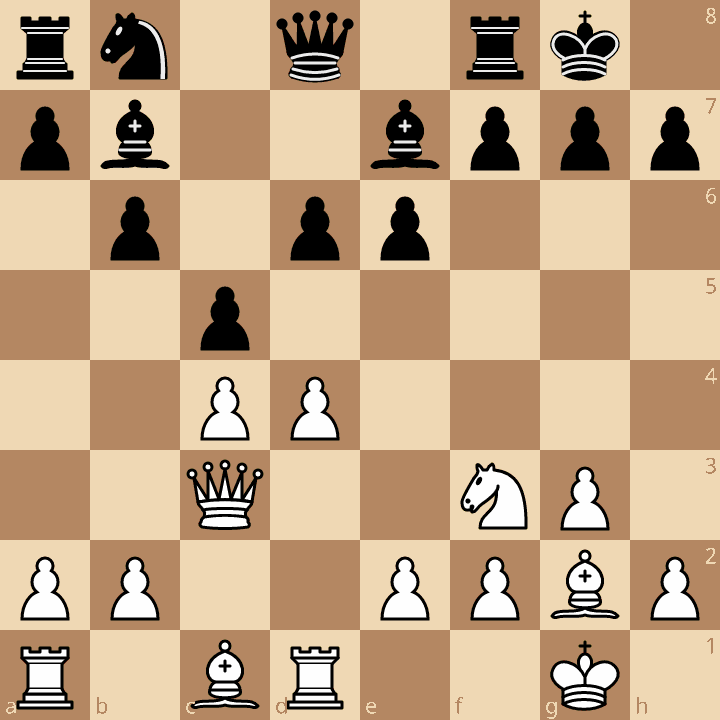
The thematic Queen's Indian pawn break! Black challenges White's d4 pawn, fighting for central space. This move activates the Bb7 further (the diagonal opens up) and prepares to establish counterplay on the queenside. Karpov played this position masterfully throughout his career.
Alternative Moves
White places the rook behind the d-pawn, supporting the center and preparing for the central tension to resolve. The rook eyes the d-file, which may open after a future dxc5 or ..cxd4 exchange.
Black solidifies the pawn structure, supporting c5 and preparing ..Nd7 to reroute the knight. The position is balanced and strategic — Black has a flexible, solid setup with the powerful Bb7 and will look for counterplay with ..Nd7, ..Bf6, or ..a5.
Key Takeaways
- The Bb7 controls the long diagonal and prevents White from playing e4
- 3...b6 is Black's answer when White avoids the Nimzo-Indian with 3.Nf3
- The ...Ne4 jump is the key move — occupying the square Black's bishop fights for
- After the knight exchange, ...c5 challenges the center at the right moment
- The QID leads to strategic, balanced positions — Karpov's weapon of choice
Now play it through
Step through every move on a real board, try the wrong ones, and ask Knighty why they fail.
Summary
Ready to Practice?
Take this lesson with you
Free account requiredWith every variation — opens in Lichess & ChessBase