
Catalan Opening - Open Variation
Fianchetto the bishop for long-term pressure on the long diagonal
Try Interactive LessonIntroduction
Lesson Content
The Queen's Pawn opening — White claims the center with the d-pawn, which is immediately defended by the queen. This tends to lead to more strategic, closed positions compared to 1. e4. Black's main responses: - 1. ..d5 — Queen's Gambit and Slav setups - 1. ..Nf6 — Indian Defenses (King's Indian, Nimzo-Indian, etc.) - 1. ..f5 — Dutch Defense
Alternative Moves
Black develops the knight and controls e4, preventing White from building the ideal e4+d4 center easily. This is the gateway to all Indian Defense systems. Black delays committing a pawn structure, staying flexible to choose between King's Indian, Nimzo-Indian, Queen's Indian, and more.
White reinforces control of d5 and grabs more space. Combined with d4, the two pawns dominate the center. Now Black's response determines the opening system: - 2. ..e6 — Nimzo-Indian (after 3. Nc3 Bb4) or Queen's Indian - 2. ..g6 — King's Indian or Grunfeld - 2. ..c5 — Benoni structures
Alternative Moves
Black prepares ..d5 or ..Bb4 (Nimzo-Indian). This is a flexible move that keeps many options open. If White plays 3. Nc3, Black can pin with ..Bb4; if 3. Nf3, Black can play ..b6 (Queen's Indian) or ..d5 (QGD transposition).
The defining move of the Catalan Opening — White prepares to fianchetto the bishop to g2, where it will exert long-term pressure on the entire long diagonal (a8-h1). Unlike the standard QGD (3. Nc3), the Catalan aims for positional pressure rather than direct central clashes. White's alternatives lead to different systems: - 3. Nc3 — mainline QGD/Nimzo-Indian - 3. Nf3 — Queen's Indian/Bogo-Indian territory
Alternative Moves
Black stakes a claim in the center with the d-pawn. Now the c4 pawn creates tension against d5, and Black must decide how to handle it — maintain, exchange, or sacrifice the center.
The Catalan bishop takes its post on the long diagonal. From g2 it pressures d5, controls b7, and x-rays the entire a8-h1 diagonal. This bishop often becomes White's strongest piece, influencing the game for many moves.
Alternative Moves
The Open Catalan — Black captures the c4 pawn, conceding the center temporarily. Black's plan is to hold the extra pawn with ..a6 and ..b5, creating a queenside pawn chain. White gets long-term positional compensation through the powerful Bg2.
White develops naturally rather than rushing to win back the c4 pawn. The Bg2's long-diagonal pressure provides lasting compensation. In the Catalan, patience is rewarded — the positional advantages accumulate gradually.
Alternative Moves
Black prepares ..b5 to defend the extra c4 pawn with a pawn chain. This is the standard plan in the Open Catalan — if Black can consolidate with ..b5, the extra pawn becomes meaningful.
White prioritizes king safety and development over material recovery. Castling completes kingside development and connects the rooks. The Catalan philosophy: positional compensation outlasts a temporary pawn deficit.
Alternative Moves
Black develops the knight and adds pressure to the d4 pawn. With the knight on c6 and the extra c4 pawn, Black has a solid position, though White's Bg2 provides long-term compensation.
White solidifies the d4 pawn and prepares to recapture on c4 via Nbd2. The modest e3 fits the Catalan style — patient, positional chess rather than aggressive central expansion.
Alternative Moves
Black develops the bishop to d7, supporting a future ..b5 and connecting the queenside pieces. The bishop doesn't have a more active square yet — c6 would block the knight.
A flexible queen move that eyes both the c4 pawn and the e-file. The queen on e2 prepares Rd1 and keeps options open for recapturing on c4 with either piece.
Alternative Moves
Black executes the plan — the b5 pawn chain defends c4 and gains queenside space. This is the critical moment of the Open Catalan: Black has successfully held the pawn, and White must now work to undermine the structure.
The key break! White undermines the b5 pawn that defends c4. After axb5 ..axb5, the a-file opens for White's rook, creating long-term pressure. This is a classic Catalan technique — exploiting weaknesses created by Black's pawn grab.
Alternative Moves
Black activates the rook on the b-file, anticipating the pawn exchange. The rook on b8 will put pressure on White's b2 pawn after the a-file opens.
White captures, opening the a-file. The rook on a1 gains an open file, and Black's queenside pawns become potentially weak. White's Bg2 combined with open lines creates strong long-term compensation.
Alternative Moves
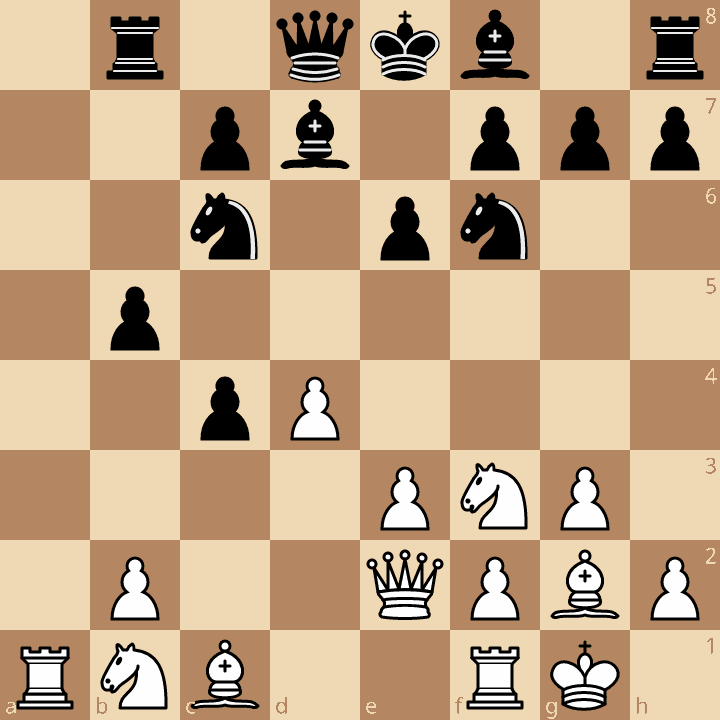
Black recaptures, and the a-file is now fully open. Both sides have achieved their goals — Black held the pawn temporarily, and White has open lines and the powerful Bg2. The position remains dynamically balanced.
Key Takeaways
- g3 + Bg2 is the Catalan trademark—long diagonal pressure
- White often sacrifices c4 temporarily for positional play
- The Bg2 targets d5 and b7—key queenside pressure
- a4 undermines Black's b5-c4 pawn chain
- Positional compensation over material is the Catalan theme
Now play it through
Step through every move on a real board, try the wrong ones, and ask Knighty why they fail.
Summary
Ready to Practice?
Take this lesson with you
Free account requiredWith every variation — opens in Lichess & ChessBase