
Caro-Kann Two Knights Attack
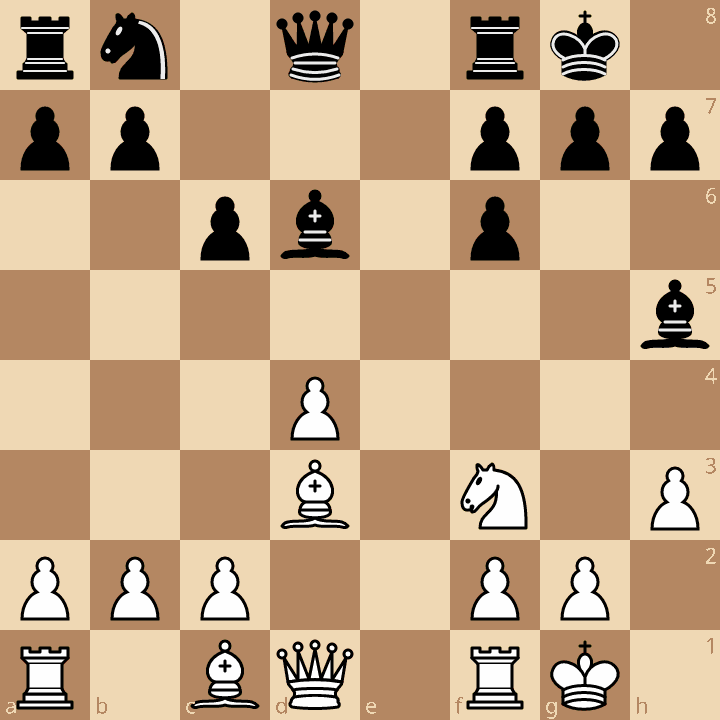
White develops both knights aggressively before exchanging on f6, creating a structural imbalance where doubled pawns meet the bishop pair.
Try Interactive LessonIntroduction
Lesson Content
The King's Pawn opening — White claims the center and opens diagonals for the queen and kingside bishop. The most popular first move in chess. Black's main responses: - 1. ..e5 — Open Game, matching White's center - 1. ..c5 — Sicilian Defense, fighting for d4 asymmetrically - 1. ..e6 — French Defense, preparing ..d5 - 1. ..c6 — Caro-Kann, also preparing ..d5
The Caro-Kann Defense — like the French, Black prepares ..d5, but via c6 instead of e6. The key advantage: the light-squared bishop stays unblocked. The Caro-Kann is considered one of the most solid defenses to 1. e4, favored by players who want a reliable, low-risk structure.
White develops the knight toward the center instead of the usual 2. d4. This is the first step of the Two Knights system — White aims to develop both knights rapidly and only then decide on the pawn structure. White's alternatives lead to the main Caro-Kann lines: - 2. d4 — the classical approach, allowing 2. ..d5 3. Nc3/Nd2/e5/exd5 - 2. d3 — the King's Indian Attack setup
Alternative Moves
Black carries out the plan prepared by ..c6, challenging the e4 pawn. The c6 pawn supports d5 while leaving the light-squared bishop free to develop — the trademark advantage of the Caro-Kann over the French.
The Two Knights Attack! White develops the second knight, putting additional pressure on e4's defense of d5. Both knights now bear down on the center, and White is ready to recapture on e4 with the knight if Black exchanges. This is more aggressive than 3. d4, which would transpose into normal Caro-Kann lines. The two-knight setup aims to reach a favorable structure after an early exchange.
Alternative Moves
Black captures the e4 pawn, the most principled response. Taking now is practically forced — maintaining the tension with ..Nf6 allows White to favorably resolve it, and ..Bg4 is the main alternative leading to the sharp Mindeno Variation. After this capture, White gets the powerful knight recapture on e4.
Alternative Moves
Recapturing with the knight places it on a dominant central square. The knight on e4 controls key squares (d6, f6, c5, g5) and creates immediate tactical pressure — particularly the threat of Nd6+ in some lines. This is White's whole idea behind the Two Knights setup — a powerfully centralized knight that Black must address.
Black develops the knight and challenges the powerful Ne4. This is the most natural response — developing a piece while forcing White to decide the knight's fate. Black's alternatives: - 4. ..Bf5 — developing the bishop first, but 5. Ng3 Bg6 6. h4 gives White a kingside initiative - 4. ..Bg4 — pinning the Nf3, but 5. h3 gives White the bishop pair
White exchanges the centralized knight, doubling Black's f-pawns. This is the defining strategic idea of the Two Knights line — White trades a well-placed piece for a lasting structural advantage. The doubled f-pawns weaken Black's kingside and make it harder to create a passed pawn. In return, Black gets the bishop pair and an open e-file.
Alternative Moves
Black recaptures toward the center, the strongly preferred choice. Taking with the e-pawn opens the e-file for the rook and keeps the pawn structure as compact as possible. The doubled f-pawns control e5 and g5, which isn't all bad. The alternative 5. ..gxf6 is much worse — it shatters the kingside and gives White a clear advantage after 6. d4.
Now White claims the center with d4, establishing a strong pawn presence. The d4 pawn controls c5 and e5, restricting Black's pieces. White has a classical center with excellent development prospects. The combination of a clean pawn structure and central control gives White a comfortable game — the strategic fruit of the Two Knights exchange.
Alternative Moves
Black develops the bishop to d6, the most active square available. From d6, the bishop controls the a3-f8 and b8-h2 diagonals, and supports a future ..f5 pawn break to free the doubled pawns. This is Black's best piece — the bishop pair is the main compensation for the structural damage.
White develops the bishop to d3, eyeing the kingside — particularly the h7 square, which could become vulnerable after Black castles. The bishop on d3 also supports a future e4 square if White ever wants to reroute pieces. Both bishops are now developed, and White is ready to castle.
Alternative Moves
Black castles kingside, getting the king to safety and connecting the rooks. The rook on f8 will naturally slide to e8, using the open e-file — Black's main source of counterplay in this structure.
White castles, completing development. Both sides have castled and the middlegame begins. White's plan revolves around exploiting the cleaner pawn structure — targeting the doubled f-pawns and maintaining central control. Typical ideas include Re1 to contest the e-file, c3 to solidify the center, and Be3 or Bf4 to develop the last minor piece.
Black activates the light-squared bishop — the Caro-Kann's signature piece. Unlike in the French Defense, this bishop was never blocked by ..e6 and now develops aggressively, pinning the Nf3 against the queen. This is Black's most effective piece and compensates significantly for the doubled pawns.
Challenging the bishop — it must decide whether to capture on f3 or retreat. This is a useful move that also creates luft for the king and takes the g4 square away from Black's pieces permanently. After the bishop retreats to h5, White can follow up with g4 to gain more space on the kingside and potentially trap the bishop.
Alternative Moves
The bishop retreats to h5, maintaining pressure on the f3 knight. From here it stays active but is slightly vulnerable — White can later play g4 to push it further back to g6, where it becomes passive. Black's plan is to use the open e-file (Re8), develop the knight (Nd7), and seek counterplay before the bishop gets sidelined.
Key Takeaways
- 2.Nc3 and 3.Nf3 put immediate pressure on d5 — the Two Knights setup
- Nxf6+ doubles Black's pawns, creating a lasting structural edge
- Black recaptures with ...exf6 (not ...gxf6) to keep the structure intact
- Black's compensation: the bishop pair and open e-file for counterplay
- White aims to exploit the pawn structure; Black activates the bishops
Now play it through
Step through every move on a real board, try the wrong ones, and ask Knighty why they fail.
Summary
Ready to Practice?
Take this lesson with you
Free account requiredWith every variation — opens in Lichess & ChessBase