
Caro-Kann Defense - Advance Variation
Learn how Black handles the Advance Caro-Kann with the bishop-first setup and kingside expansion
Try Interactive LessonIntroduction
Lesson Content
The King's Pawn opening — White claims the center and opens diagonals for the queen and kingside bishop. The most popular first move in chess. Black's main responses: - 1. ..e5 — Open Game, matching White's center - 1. ..c5 — Sicilian Defense, fighting for d4 asymmetrically - 1. ..e6 — French Defense, preparing ..d5 - 1. ..c6 — Caro-Kann, also preparing ..d5
Prepare ...d5 while keeping your light-squared bishop free.
The Caro-Kann Defense — like the French, Black prepares ..d5, but via c6 instead of e6. The key advantage: the light-squared bishop stays unblocked. The Caro-Kann is considered one of the most solid defenses to 1. e4, favored by players who want a reliable, low-risk structure.
White builds the full pawn center. After 2. ..d5, White must decide how to handle the tension: - 3. ♘︎c3 or 3. ♘︎d2 — maintain the tension - 3. e5 — Advance Variation, gaining space - 3. exd5 cxd5 — Exchange, leading to symmetrical pawn structure
Strike at the center.
Black challenges the e4 pawn as planned. Unlike the French (1. ..e6 2. ..d5), the c6 pawn supports d5 while leaving the light-squared bishop free to develop actively.
The Advance Variation — White pushes the pawn to e5, gaining space and restricting Black's kingside knight from its natural f6 square. The pawn chain d4-e5 gives White a territorial advantage but also creates a fixed target. Black's strategy revolves around attacking this chain at its base (d4) with a future ..c5 break.
Develop your bishop outside the pawn chain before it gets locked in.
♗︎f5 — The defining move of the Advance Caro-Kann — Black develops the light-squared bishop before playing ..e6. This is the whole point of 1. ..c6 over 1. ..e6 (French): the bishop escapes to an active diagonal instead of being trapped behind its own pawns. The bishop on f5 controls key squares and will need a safe retreat later (typically to h7 or g6).
Alternative Moves
The Short Variation — named after Nigel Short. White develops naturally, preparing to castle kingside and build a solid position. This is the most popular approach at the highest level. White's alternatives define different systems: - 4. ♘︎d2 — more flexible, heading for ♘︎b3 - 4. h4 — the Tal Variation, aggressive kingside play - 4. ♘︎c3 — the Van der Wiel Attack
Alternative Moves
Support d5 and complete your pawn structure.
Black solidifies the d5 pawn and prepares to develop the kingside. The pawn on e6 locks in the light-squared bishop, but since it's already developed to f5, this is no problem — a key advantage of the Caro-Kann move order.
White develops the bishop modestly to e2, preparing to castle. The bishop is less aggressive here than on d3 (where it would attack f5), but ♗︎e2 is the most flexible choice — it doesn't commit to a particular plan yet and avoids a bishop trade on d3.
Develop your knight to support the ...c5 break.
♘︎d7 — Black develops the knight to d7 rather than the blocked f6 square. From d7, the knight supports the ..c5 pawn break and can later reroute via f8 to g6. This is the most popular continuation, played by Mamedyarov, Carlsen, and many others. The alternative 5. ..c5 is the direct pawn break, also very playable but a different character.
Alternative Moves
White castles kingside, getting the king to safety. A natural and strong move.
Start the knight maneuver toward g6.
The knight heads for e7 with a clear destination: g6, where it eyes the f4 and e5 squares. The ♘︎e7-g6 maneuver is one of the most important plans in the Advance Caro-Kann.
Alternative Moves
White develops the knight to d2, heading for b3 where it supports d4 and may target the c5 break. The knight on d2 avoids blocking the c-pawn, keeping c3 available for pawn support.
Alternative Moves
Prepare ...g5 and secure your bishop.
h6 — A multi-purpose move: prevents ♘︎g5 (which would harass the ♗︎f5), prepares ..g5 kingside expansion, and secures a retreat square on h7 for the bishop. This is the most popular continuation at the GM level.
Alternative Moves
The knight arrives on b3, bolstering the d4 pawn and eyeing c5. From b3, the knight also has the option of going to a5 to pressure the queenside. This is the most natural follow-up to ♘︎bd2.
Seize kingside space and prevent White from playing f4.
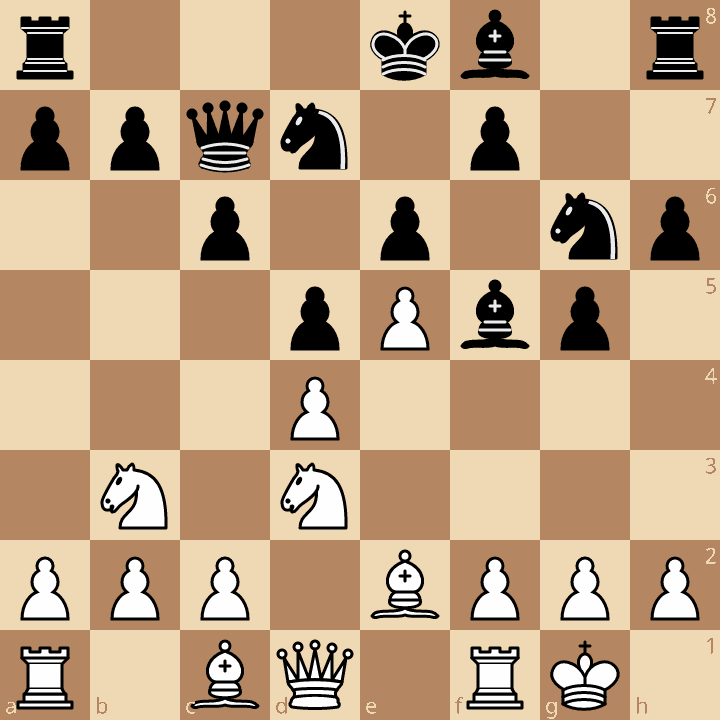
The modern main line — Black seizes kingside space with a bold pawn advance! This move prevents f4 (which would challenge Black's bishop and break through), gains space for the pieces, and prepares ..♗︎g7 or ..♘︎g6 with a solid kingside setup. Played extensively by Firouzja, Aronian, and Caruana at the top level. The kingside looks exposed but Black's pawn structure is surprisingly resilient.
Alternative Moves
White reroutes the knight from f3 to d3 (via e1), where it will support a potential f4 break and cover key central squares. The knight on f3 had limited prospects after ..g5 blocked f4.
Alternative Moves
Put pressure on the e5 pawn with your queen.
♕︎c7 — The queen targets the e5 pawn, adding pressure to White's pawn chain. From c7, the queen also supports the ..c5 break and connects Black's pieces. This is overwhelmingly the most played move.
The knight completes its journey to d3 — an ideal square supporting e5, covering f4, and eyeing c5. White's position is solid but somewhat passive; the challenge is finding active play.
Complete the knight maneuver to its ideal square.
♘︎g6 — The knight arrives at its ideal square! From g6, the knight puts pressure on both e5 and f4. The ♘︎e7-g6 maneuver is complete — Black has a solid, harmonious position with clear plans: ..c5 to challenge the center, and potential ..♘︎f4 in some lines.
Alternative Moves
Key Takeaways
- Develop the bishop to f5 before ...e6 — this is the whole point of 1...c6 over 1...e6
- The ♘︎e7-g6 maneuver is Black's key piece setup, pressuring e5 and f4
- ...g5 prevents White's f4 break and seizes kingside space
- ...c5 is the thematic pawn break, attacking the base of White's d4-e5 chain
- Black's position is solid and resilient despite the space disadvantage
Now play it through
Step through every move on a real board, try the wrong ones, and ask Knighty why they fail.
Related Lessons
Summary
Ready to Practice?
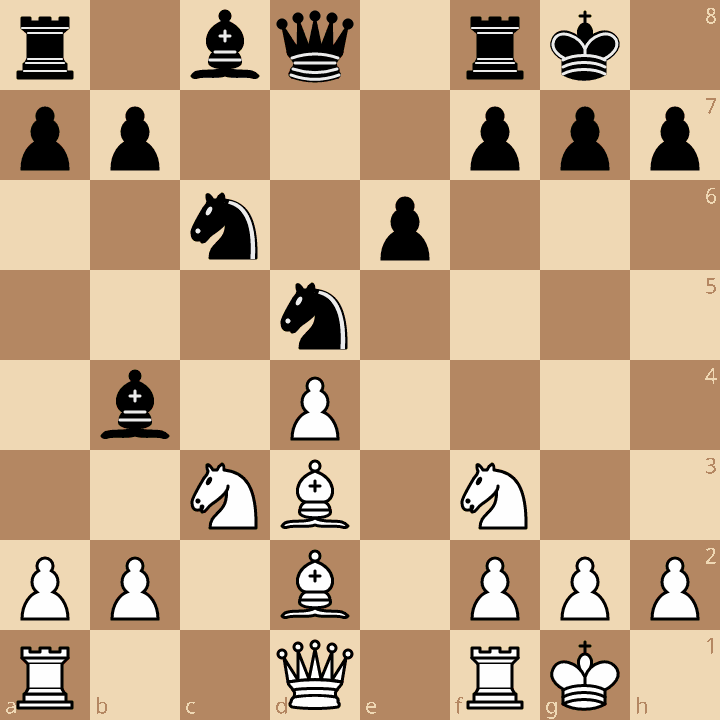
Next in this opening family
Caro-Kann - Panov-Botvinnik Attack
Take this lesson with you
Free account requiredWith every variation — opens in Lichess & ChessBase