
Caro-Kann - Panov-Botvinnik Attack
Transform the solid Caro-Kann into a dynamic IQP battle with 4.c4
Try Interactive LessonIntroduction
Lesson Content
Start by controlling the center with your king pawn.
e4 — The King's Pawn opening — White claims the center and opens diagonals for the queen and kingside bishop. The most popular first move in chess. Black's main responses: - 1. ..e5 — Open Game, matching White's center - 1. ..c5 — Sicilian Defense, fighting for d4 asymmetrically - 1. ..e6 — French Defense, preparing ..d5 - 1. ..c6 — Caro-Kann, also preparing ..d5
The Caro-Kann Defense — like the French, Black prepares ..d5, but via c6 instead of e6. The key advantage: the light-squared bishop stays unblocked. The Caro-Kann is considered one of the most solid defenses to 1. e4, favored by players who want a reliable, low-risk structure.
Claim the full center.
d4 — White builds the full pawn center. After 2. ..d5, White must decide how to handle the tension: - 3. ♘︎c3 or 3. ♘︎d2 — maintain the tension - 3. e5 — Advance Variation, gaining space - 3. exd5 cxd5 — Exchange, leading to symmetrical pawn structure
Black challenges the e4 pawn as planned. Unlike the French (1. ..e6 2. ..d5), the c6 pawn supports d5 while leaving the light-squared bishop free to develop actively.
Exchange pawns to prepare the Panov-Botvinnik plan.
White exchanges pawns, entering the Caro-Kann Exchange Variation. This simplifies the center but White has a concrete plan: follow up with c4 to attack the d5 pawn and reach an isolated queen pawn (IQP) position. 3. e5 (Advance) is at least as strong, but 3. exd5 is the gateway to the dynamic Panov-Botvinnik Attack.
Alternative Moves
Black recaptures with the c-pawn, the only sensible recapture. The d5 pawn is now unsupported by other pawns — a critical detail White will exploit with c4.
Attack the d5 pawn with your c-pawn — the Panov move!
c4 — The Panov-Botvinnik Attack! White immediately targets the d5 pawn with a second pawn, threatening to win it or reach an isolated d-pawn (IQP) position after a future cxd5. This transforms the quiet Caro-Kann Exchange into a dynamic struggle resembling the Queen's Gambit Declined. White gets open lines and active pieces; Black gets a solid but potentially passive position.
Alternative Moves
Black develops the knight to its most natural square, defending d5 and preparing kingside castling. This is overwhelmingly the most popular response in master play.
Alternative Moves
Develop your knight to increase pressure on d5.
♘︎c3 — White develops the knight to its ideal square, adding a second attacker to the d5 pawn. Combined with c4, the pressure on d5 is becoming serious — Black must decide how to handle the tension.
Alternative Moves
Black reinforces the d5 pawn with the e-pawn. This is the most popular choice, leading to the main line. The downside: the light-squared bishop is now blocked behind the pawn chain, similar to the French Defense.
Alternative Moves
Develop your second knight and prepare castling.
♘︎f3 — White completes kingside development, controlling e5 and d4 while preparing to castle. Both knights are now developed to their optimal squares.
Alternative Moves
The main line! Black pins the ♘︎c3 to the king, preventing it from capturing on d5. This creates a Nimzo-Indian-like structure within the Caro-Kann — the ♗︎b4 pin is Black's most active option. Black's alternatives: - 6. ..♗︎e7 — solid but passive, used by Karpov - 6. ..♘︎c6 — develops but allows cxd5 with tempo
Alternative Moves
Capture to create the isolated pawn position you prepared for.
cxd5 — White resolves the central tension now. After ..♘︎xd5, White's d4 pawn becomes isolated (IQP) — the defining structural feature of the Panov-Botvinnik. White trades pawn structure for active pieces and open lines.
Alternative Moves
Black recaptures with the knight, centralizing it powerfully on d5. The knight is a superb blockader of White's isolated d4 pawn — a long-term weakness, but White compensates with active piece play.
Alternative Moves
Develop your bishop and address the pin on Nc3.
♗︎d2 — White develops the bishop while offering to trade off Black's active ♗︎b4. If Black trades on c3, White recaptures with the bishop, maintaining piece coordination. The bishop on d2 also supports a future a3 if needed.
Alternative Moves
Black completes knight development, adding pressure on d4 and controlling key central squares. The knight on c6 also supports the ♗︎b4 and prepares castling.
Develop your bishop to aim at the kingside.
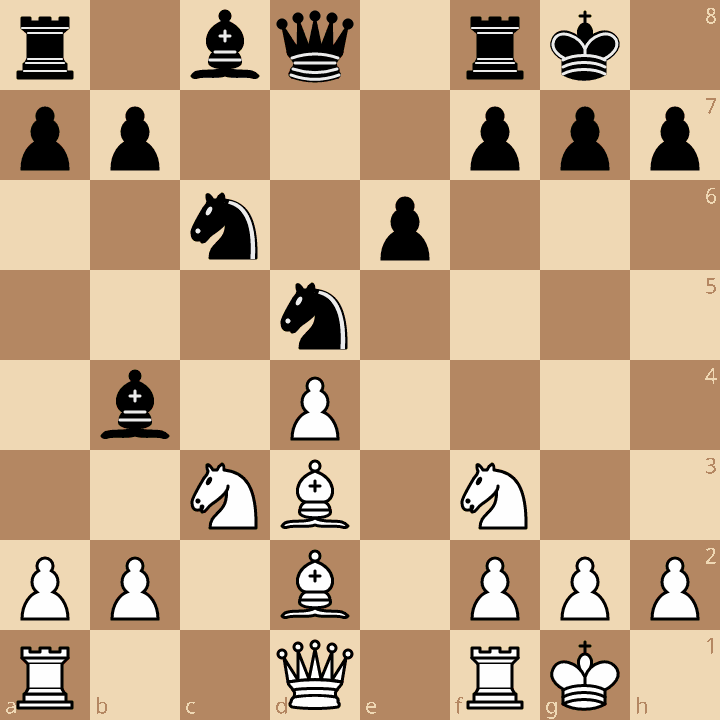
♗︎d3 — White develops the last minor piece to an excellent diagonal, eyeing the kingside — particularly h7. The bishop on d3 is a classic attacking piece in IQP positions, supporting potential kingside attacks.
Black castles to safety, connecting the rooks. The king is now secure and a rook can later use the half-open d-file.
Castle to complete your development.
O-O — White castles, completing development. All pieces are active: ♗︎d3 eyes h7, ♘︎f3 controls e5, ♘︎c3 pressures d5, and ♗︎d2 is ready to reposition. Despite the isolated d4 pawn, White's piece activity provides full compensation.
Key Takeaways
- 4.c4 is the Panov move — it attacks d5 and leads to an IQP position after the trade
- The resulting position resembles a Queen's Gambit Declined with an isolated d-pawn
- ♗︎d3 aimed at h7 is the key attacking piece in the IQP middlegame
- Black's ♗︎b4 pin (Nimzo-Indian style) is the main defensive resource
- White trades structural purity for piece activity and open lines
Now play it through
Step through every move on a real board, try the wrong ones, and ask Knighty why they fail.
Related Lessons
Summary
Ready to Practice?
Next in this opening family
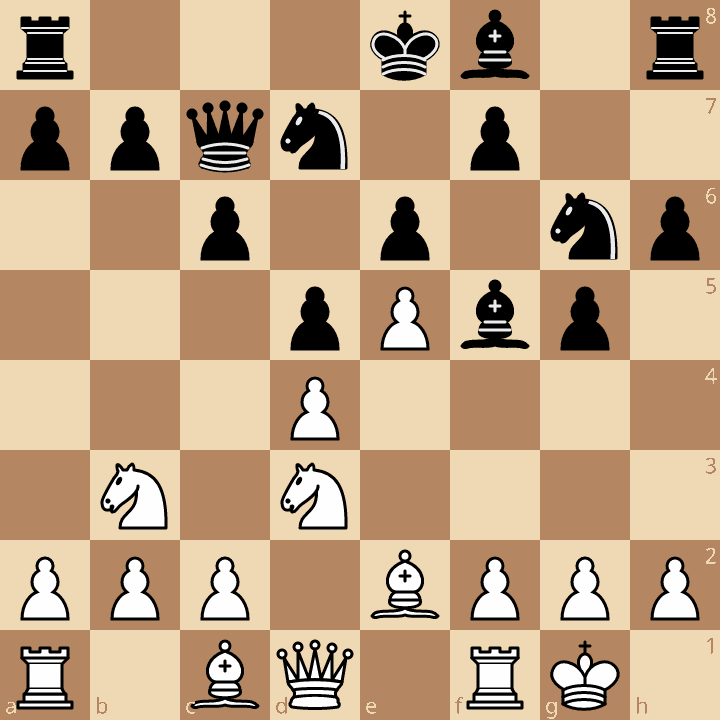
Caro-Kann Defense - Advance Variation
Take this lesson with you
Free account requiredWith every variation — opens in Lichess & ChessBase