
Nimzo-Indian Defense - Rubinstein Variation
Play the solid Rubinstein system, trade into an IQP middlegame, and target White's isolated d-pawn
Try Interactive LessonIntroduction
Lesson Content
The Queen's Pawn opening — White claims the center with the d-pawn, which is immediately defended by the queen. This tends to lead to more strategic, closed positions compared to 1. e4. Black's main responses: - 1. ..d5 — Queen's Gambit and Slav setups - 1. ..Nf6 — Indian Defenses (King's Indian, Nimzo-Indian, etc.) - 1. ..f5 — Dutch Defense
Black develops the knight and controls e4, preventing White from building the ideal e4+d4 center easily. This is the gateway to all Indian Defense systems. Black delays committing a pawn structure, staying flexible to choose between King's Indian, Nimzo-Indian, Queen's Indian, and more.
White reinforces control of d5 and grabs more space. Combined with d4, the two pawns dominate the center. Now Black's response determines the opening system: - 2. ..e6 — Nimzo-Indian (after 3. Nc3 Bb4) or Queen's Indian - 2. ..g6 — King's Indian or Grunfeld - 2. ..c5 — Benoni structures - 2. ..e5 — Budapest Gambit
Black prepares ..d5 or ..Bb4 (Nimzo-Indian). This is a flexible move that keeps many options open. If White plays 3. Nc3, Black can pin with ..Bb4 (Nimzo-Indian); if 3. Nf3, Black can play ..b6 (Queen's Indian) or ..d5 (QGD transposition).
White develops the knight to its natural square, supporting e4. Now Black faces a critical choice: - 3. ..Bb4 — Nimzo-Indian Defense, pinning the knight - 3. ..d5 — Queen's Gambit Declined transposition - 3. ..c5 — Benoni structures
The Nimzo-Indian Defense — Black pins the Nc3, preventing e4 and creating immediate strategic tension. The Nimzo is considered one of the best defenses against 1. d4, used extensively by Kasparov, Kramnik, and Carlsen. Black may double White's pawns with ..Bxc3, creating a long-term structural imbalance.
The Rubinstein Variation — the most popular response to the Nimzo-Indian with over 36,000 master games. White supports d4 and prepares to develop the bishop to d3. The trade-off: e3 temporarily blocks the dark-squared bishop, but White gets solid, harmonious development. White's main fourth-move alternatives: - 4. Qc2 — Classical, prevents doubled c-pawns - 4. f3 — Kmoch, preparing a big center with e4 - 4. Nf3 — Three Knights, flexible development
Alternative Moves
Black castles immediately, securing the king before committing to a central pawn structure. This is the most popular and flexible approach — Black keeps options for ..d5, ..c5, ..d6, and even ..b6 setups.
Alternative Moves
White develops the bishop to its ideal diagonal, targeting h7 and supporting a future e4 push. The bishop on d3 is a key piece in the Rubinstein — it controls central light squares and can participate in kingside attacks.
Alternative Moves
Black occupies the center, challenging White's c4 pawn directly. This is the most classical response, establishing central tension. The position now heads toward the critical moment: will Black capture on c4 to create an IQP, or keep the tension?
Alternative Moves
White completes kingside development, preparing to castle. The knight on f3 supports d4 and controls e5. White's setup (Bd3 + Nf3 + O-O) is the standard Rubinstein configuration.
The thematic central counter-attack! Black strikes at the d4 pawn, creating tension across the center. This double pressure on d4 (from ..c5 and ..d5) is the key strategic idea in the Nimzo-Indian. After the upcoming exchanges, an isolated queen's pawn (IQP) will appear on d4 — the defining feature of this variation.
Alternative Moves
White castles, completing development before the central exchanges begin. The king is safe and the rook eyes the center. White is ready for the upcoming pawn trades.
Black captures on c4, deflecting the bishop from d3 and beginning the sequence that creates the IQP. After Bxc4 and ..cxd4, exd4, White will have an isolated d4 pawn — a double-edged structure that gives White piece activity but Black long-term targets.
Alternative Moves
White recaptures, placing the bishop on a strong diagonal (a2-g8). The bishop now targets f7 and supports the d4 pawn. White's pieces are actively placed — the classic IQP compensation.
Black captures the d4 pawn, completing the exchange sequence. After exd4, White has an isolated d-pawn on d4 — it cannot be supported by neighboring pawns. This is the strategic heart of the Rubinstein: Black aims to blockade and pressure d4, while White uses the open e- and c-files and active pieces.
White recaptures with the e-pawn, creating the isolated queen's pawn (IQP) on d4. The d4 pawn controls c5 and e5 — important squares — but has no pawn neighbors to defend it. White must use piece activity to compensate for this long-term weakness.
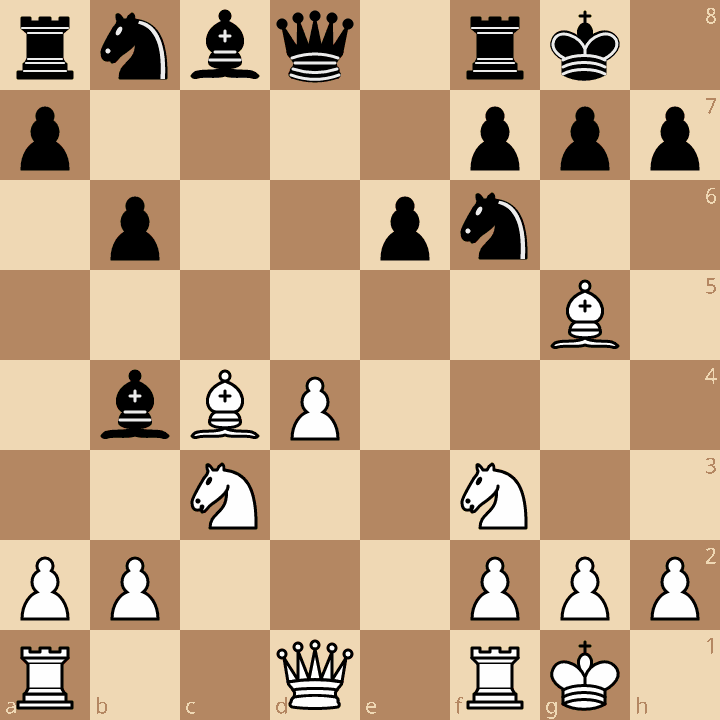
The Karpov Variation — Black prepares to fianchetto the bishop to b7, aiming it at the d4 pawn and the long diagonal. The bishop on b7 will exert pressure on d5, e4, and indirectly on d4. This is the most positional approach, favored by Karpov and Kramnik.
Alternative Moves
White develops the last minor piece aggressively, pinning the Nf6 against the queen. This is the most popular choice, creating tactical pressure and preparing Bxf6 to weaken Black's kingside. The pin also discourages ..Nbd7 since d7 is needed for the queen's retreat.
Alternative Moves
Key Takeaways
- 4.e3 is the Rubinstein — White develops solidly but blocks the dark-squared bishop
- Castle first (4...O-O), then commit to ...d5 and ...c5 to challenge the center
- The exchange sequence ...dxc4, Bxc4, ...cxd4, exd4 creates the IQP on d4
- The IQP gives White piece activity but Black targets it long-term via ...Bb7 and ...Nc6
- The Karpov Variation (9...b6) is the most positional approach, aiming for the long diagonal
Now play it through
Step through every move on a real board, try the wrong ones, and ask Knighty why they fail.
Summary
Ready to Practice?
Take this lesson with you
Free account requiredWith every variation — opens in Lichess & ChessBase