
Queen's Gambit Declined - Main Line
Decline the gambit, develop solidly, and execute Capablanca's famous freeing maneuver with ...♘︎d5
Try Interactive LessonIntroduction
Lesson Content
The Queen's Pawn opening — White claims the center with the d-pawn, which is immediately defended by the queen. This tends to lead to more strategic, closed positions compared to 1. e4. Black's main responses: - 1. ..d5 — Queen's Gambit and Slav setups - 1. ..♘︎f6 — Indian Defenses (King's Indian, Nimzo-Indian, etc.) - 1. ..f5 — Dutch Defense
Mirror White and claim your share of the center.
d5 — Black matches White in the center, leading to the Queen's Pawn Game. The symmetrical center typically results in strategic maneuvering rather than immediate tactical battles. White's most popular continuation is 2. c4 — the Queen's Gambit.
The Queen's Gambit — White offers a pawn to lure Black's d5 pawn away from the center. It's not a true gambit since Black can't hold the pawn long-term. Black's main choices: - 2. ..e6 — Queen's Gambit Declined, solid and classical - 2. ..c6 — Slav Defense, supporting d5 while keeping the bishop free - 2. ..dxc4 — Queen's Gambit Accepted, giving up the center temporarily
Reinforce your center pawn.
The Queen's Gambit Declined — Black reinforces d5 solidly. The downside is the same as in the French: the light-squared bishop is blocked behind the e6 pawn. This is one of the most classical and well-respected opening systems in chess.
White develops the knight to its natural square, adding pressure on d5 and supporting a future e4 advance. This is the most common continuation, though 3. ♘︎f3 is also very popular. Now Black should develop the kingside knight: - 3. ..♘︎f6 — the Normal Defense, the most popular and classical - 3. ..♗︎e7 — the Charousek Variation, solid but passive - 3. ..c6 — transposing toward Semi-Slav structures
Alternative Moves
Develop the knight to its natural square and control e4.
♘︎f6 — The Normal Defense — Black develops the knight to its best square, controlling e4 and d5. This is the most natural and popular response, keeping the position flexible. White must now decide how to develop: 4. ♗︎g5 (the Orthodox), 4. ♘︎f3 (Three Knights), or 4. cxd5 (Exchange Variation).
Alternative Moves
The Orthodox QGD begins. White pins the ♘︎f6 against the queen, creating pressure on d5 indirectly — if the knight moves, d5 becomes weaker. This is one of the most classical setups in the QGD. White's main alternatives: - 4. cxd5 — Exchange Variation, simplifying the center - 4. ♘︎f3 — Three Knights, staying flexible - 4. ♗︎f4 — Harrwitz Attack, developing without creating a pin
Alternative Moves
Break the pin and prepare to castle.
♗︎e7 — Black breaks the pin with the most natural developing move. The bishop on e7 is modest but solid — it defends the king and prepares castling. This is the defining move of the Orthodox QGD. Black's alternatives lead to different systems: - 4. ..♘︎bd7 — Knight Defense, less common - 4. ..dxc4 — Vienna Variation, grabbing the pawn - 4. ..♗︎b4 — less standard but playable
Alternative Moves
White solidifies the d4 pawn and prepares to develop the bishop to d3 (the ideal diagonal for controlling the kingside). The pawn on e3 supports d4 and opens the diagonal for ♗︎f1. The usual trade-off — e3 shutting in the dark-squared bishop — doesn't apply: it's already developed to g5.
Alternative Moves
Castle to safety before deciding on your pawn structure.
O-O — Black castles to safety before committing to a specific plan. This is the most flexible approach — Black can still choose between ..♘︎bd7, ..h6, or ..b6 setups. The king is secure on g8, and the rook enters the game on f8.
Alternative Moves
White develops the king's knight. The knight controls e5 and d4, and White is now ready to play ♗︎d3 and castle.
Develop the knight — it supports the center and prepares the freeing maneuver.
♘︎bd7 — The Orthodox Defense — Black develops the last minor piece to its most useful square. The knight on d7 supports the ♘︎f6 (in case of ♗︎xf6) and can reroute to e5, c5, or b6. It also prepares the key freeing maneuver ..dxc4 followed by ..♘︎d5. This is the signature move of the Orthodox QGD setup.
Alternative Moves
White places the rook on the c-file, anticipating that Black will play ..dxc4 soon. The rook pressures the c-file and supports a potential c4-c5 advance. This is the most popular move here, chosen by Karpov and Topalov. Alternatives include 7. ♕︎c2 (Rubinstein Attack) and 7. ♗︎d3 (Botvinnik Variation).
Alternative Moves
Shore up the center — prepare for the freeing maneuver.
Black reinforces d5 with the c-pawn, creating a solid pawn chain. This is the tabiya of the Orthodox Defense — the most common and reliable setup. The pawn on c6 also prevents White's pieces from invading via b5 or d5. Black is now ready for the key plan: ..dxc4 followed by ..♘︎d5.
Alternative Moves
White develops the bishop to its ideal square, aiming at the kingside (particularly h7). The bishop on d3 is well-placed for both attack and defense. White's setup is now complete and ready for the middlegame.
Alternative Moves
Capture the c4 pawn to start the freeing maneuver.
dxc4 — The first step of the Capablanca freeing maneuver! Black captures on c4, half-opening the d-file and preparing ..♘︎d5. By exchanging the d-pawn, Black gains freedom for the pieces and prepares to challenge the ♗︎g5. White must recapture with the bishop, and then ..♘︎d5 hits the ♘︎c3 and lets the ♗︎e7 challenge the ♗︎g5.
Alternative Moves
White recaptures with the bishop, which now stands on c4 aiming at the e6 pawn and the f7 square. However, this bishop is now a target for Black's next move — the key idea of the Capablanca System.
Jump to the center — attack the bishop and seize d5!
♘︎d5 — The Capablanca freeing maneuver — the heart of this entire system! The knight jumps to d5 with multiple purposes: it uncovers an attack on the ♗︎g5, centralizes powerfully, and forces White to make a concession. Named after José Raúl Capablanca, who demonstrated this plan's strength in the 1920s. White must now exchange the bishop for the ♗︎e7, which eases Black's cramped position.
Alternative Moves
White exchanges the bishop for the ♗︎e7. This is practically forced — retreating (♗︎h4 or ♗︎f4) allows ..♘︎xc3 with a comfortable game for Black, while keeping the bishop on g5 leaves it exposed to ..f6 ideas. After the trade, the position becomes simpler but Black has solved the key strategic problem: piece activity.
Alternative Moves
Recapture with the queen to keep it active.
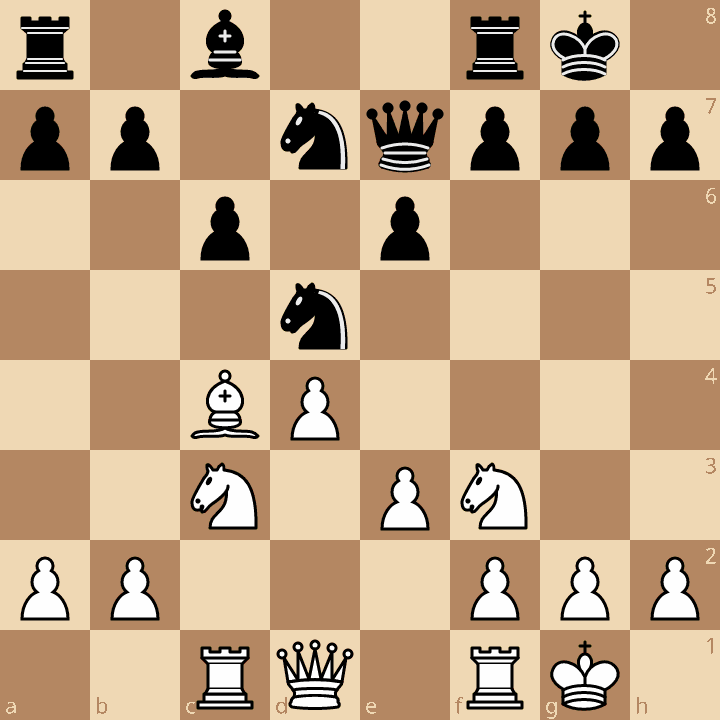
♕︎xe7 — Black recaptures with the queen, which now stands actively on e7. The queen eyes the kingside and can later swing to the queenside. Black has achieved the goal: the bishops are exchanged, the position is simplified, and the knight on d5 is a powerhouse. The resulting positions are balanced — White has a slight space edge, but Black has excellent piece placement.
White castles to safety. The typical continuation is 11. ..♘︎xc3 12. ♖︎xc3 e5, where Black strikes at the center with the thematic pawn break. The position is roughly equal — one of the most deeply studied positions in all of chess theory.
Key Takeaways
- 2...e6 declines the gambit solidly but blocks the light-squared bishop — solving this is the key strategic challenge
- The Orthodox setup (♗︎e7, O-O, ♘︎bd7, c6) is rock-solid and prepares the freeing maneuver
- 9...♘︎d5 is Capablanca's freeing maneuver — it attacks the ♗︎g5, centralizes the knight, and forces favorable exchanges
- After ♗︎xe7 ♕︎xe7, Black has solved the bishop problem and the position is roughly equal
- The typical follow-up is ...♘︎xc3 and ...e5, challenging the center with a pawn break
Now play it through
Step through every move on a real board, try the wrong ones, and ask Knighty why they fail.
Related Lessons
Summary
Ready to Practice?
Next in this opening family
QGD Tartakower Defense
Take this lesson with you
Free account requiredWith every variation — opens in Lichess & ChessBase