
English Opening - Symmetrical Variation
Master the Symmetrical English with mirrored fianchettos and the thematic d4 central break
Try Interactive LessonIntroduction
Lesson Content
Control d5 from the flank.
c4 — The English Opening — White controls d5 from the flank without committing the d-pawn. This is a flexible, positional opening that can transpose into many 1. d4 lines or lead to unique English systems. Black's main options: - 1. ..e5 — Reversed Sicilian - 1. ..♘︎f6 — can transpose to Indian setups - 1. ..c5 — Symmetrical English
Alternative Moves
The Symmetrical English — Black mirrors White's flank approach, creating a symmetrical pawn structure. Both sides control the d4/d5 squares from the wing, leading to a strategic battle over who breaks the symmetry first. Black's other options: - 1. ..e5 — Reversed Sicilian, more aggressive - 1. ..♘︎f6 — Indian Defense transpositions
Develop your knight toward the center.
♘︎f3 — White develops the kingside knight to its most natural square, controlling e5 and d4 while preparing kingside castling. This flexible move keeps all options open.
Alternative Moves
Black develops the queenside knight, mirroring White's setup and controlling d4 and e5. The symmetry continues — both sides develop naturally before committing to a pawn structure.
Complete your knight development.
♘︎c3 — White completes the knight development, reinforcing control over d5. Both knights are now on their ideal squares. White's next decision is how to develop the kingside — with g3 (fianchetto) or e3/e4. White's alternatives: - 3. d4 — the Maroczy Bind approach, immediately challenging the center - 3. g3 — fianchetto first (Botvinnik System)
Alternative Moves
Black prepares to fianchetto the dark-squared bishop on g7, where it will control the long a1-h8 diagonal. This is a hypermodern approach — controlling the center with pieces rather than pawns. Black's alternatives: - 3. ..e5 — grabbing space immediately - 3. ..♘︎f6 — developing first (Four Knights Variation)
Mirror the fianchetto setup.
g3 — White mirrors Black's fianchetto plan! Both sides will place their bishops on the long diagonals, creating the characteristic mirrored fianchetto structure of the Symmetrical English. This is the most thematic approach.
Alternative Moves
Black completes the fianchetto. The bishop on g7 is a powerful piece — it controls the long diagonal and supports a future ..d5 or ..e5 break. It also provides excellent defense for the kingside after castling.
Complete your fianchetto to match Black.
White completes the fianchetto setup. The ♗︎g2 controls the a8-h1 diagonal, pressuring d5 and Black's queenside. Both bishops rake the long diagonals toward the enemy queenside — a hallmark of the Symmetrical English.
Alternative Moves
The Full Symmetry Line (ECO A38) — Black develops the second knight, creating a perfectly symmetrical position. Both sides have identical pawn structures and mirror-image piece placement. Now the question is: who breaks the symmetry first? Black's alternatives: - 5. ..e6 — the Hedgehog approach, more flexible - 5. ..d6 — preparing ..e5 or a KID-like setup - 5. ..e5 — Botvinnik System Reversed
Secure your king before the central break.
O-O — White castles, securing the king. With the fianchettoed bishop protecting the kingside, this is a very safe king position. White is now ready to prepare the central break with d4.
Alternative Moves
Black mirrors with castling. Both kings are now safe behind their fianchettoed bishops. The position is completely symmetrical — but White has the advantage of moving first, which means White gets to break the symmetry with d4.
Break the symmetry with the central push you prepared.
The thematic central break! White strikes in the center, shattering the symmetry. This is the moment the entire English Opening has been building toward. The d4 push is backed by the ♘︎f3 and the queen on d1. This position has been reached in many legendary games, including Fischer vs Spassky (World Championship 1972).
Alternative Moves
Black captures, half-opening the c-file and d-file. The symmetry is finally broken — Black's c5 pawn is gone, and the position becomes dynamic. The half-open files will give both rooks active play.
Recapture to centralize your knight.
♘︎xd4 — White recaptures with the knight, placing it on the powerful central d4 square. From d4, the knight attacks multiple key squares and can't be easily challenged by Black's pawns.
Black exchanges knights, simplifying the position. This is the most popular choice among grandmasters — Black eliminates White's strong centralized knight and hopes to equalize in the resulting position. Black's main alternative: - 8. ..♕︎a5 — more ambitious, keeping the tension but allowing White's knight to remain on d4
Recapture with the queen to centralize.
♕︎xd4 — White recaptures with the queen, centralizing it powerfully. The queen on d4 controls key squares and prepares to relocate — typically to d3, where it supports both the c4 pawn and potential e4 expansion.
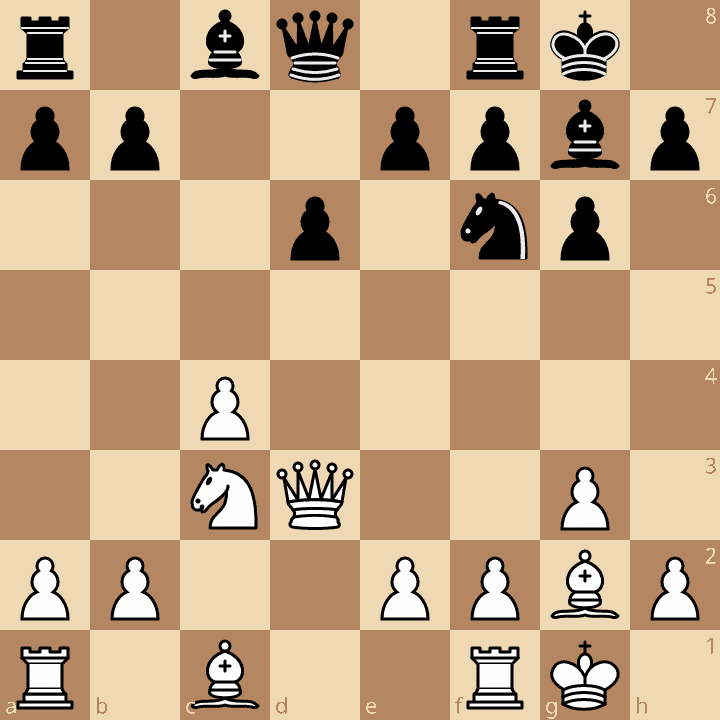
Black plays the practically forced ..d6, controlling e5 and c5 and opening the diagonal for the c8 bishop. The position now settles into a strategic battle where White has a slight space advantage and more active pieces.
Reposition the queen to support your center.
♕︎d3 — The queen retreats to d3, its ideal square. From here it supports the c4 pawn, eyes the kingside, and prepares e4 for further central control. White has a comfortable, slightly better position with clear plans: expand with e4 and b3+♗︎b2, or play on the queenside with ♖︎b1 and b4. This is the starting position for the rich middlegame of the Symmetrical English.
Alternative Moves
Key Takeaways
- The mirrored kingside fianchetto (g3+♗︎g2) is the hallmark of the Symmetrical English
- d4 is the thematic central break — the whole opening prepares for it
- Castle before breaking in the center for maximum safety
- After the trades, ♕︎d3 supports c4 and prepares e4 expansion
- White has a slight but lasting positional edge in the resulting middlegame
Now play it through
Step through every move on a real board, try the wrong ones, and ask Knighty why they fail.
Related Lessons
Summary
Ready to Practice?
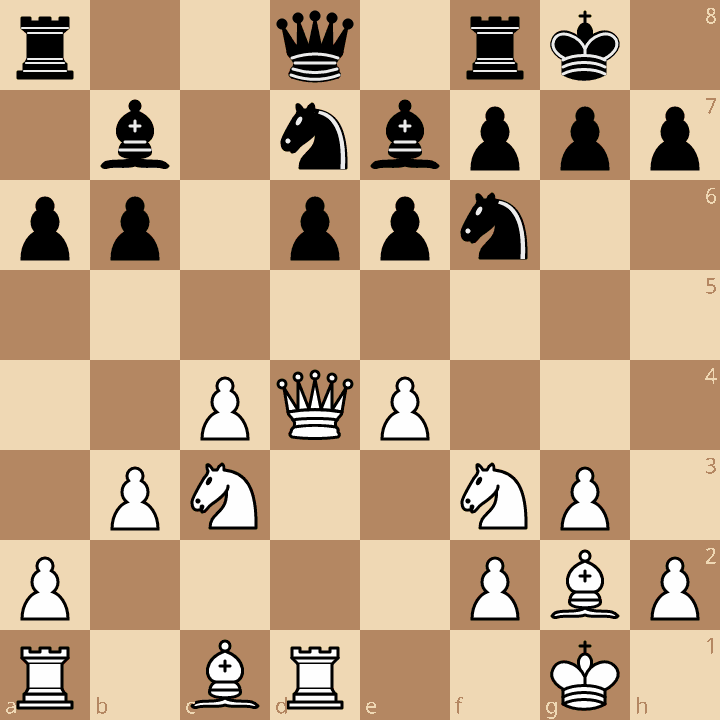
Next in this opening family
Hedgehog System
Take this lesson with you
Free account requiredWith every variation — opens in Lichess & ChessBase