
French Defense - Advance Variation
Gain space and attack Black's kingside structure
Try Interactive LessonIntroduction
Lesson Content
The King's Pawn opening — White claims the center and opens diagonals for the queen and kingside bishop. The most popular first move in chess. Black's main responses: - 1. ..e5 — Open Game, matching White's center - 1. ..c5 — Sicilian Defense, fighting for d4 asymmetrically - 1. ..e6 — French Defense, preparing ..d5 - 1. ..c6 — Caro-Kann, also preparing ..d5
Alternative Moves
The French Defense — Black prepares ..d5 to challenge White's center on the next move. The pawn on e6 supports d5 but blocks the light-squared bishop, which is the main strategic downside of the French. The French leads to rich strategic battles around White's pawn chain.
White builds the ideal pawn center. Now Black will challenge it with 2. ..d5, creating the characteristic French pawn tension. White's third-move choice defines the variation: - 3. Nc3 then 3. ..Bb4 (Winawer) or 3. ..Nf6 (Classical) - 3. e5 — Advance Variation - 3. Nd2 — Tarrasch Variation
Alternative Moves
Black challenges White's e4 pawn head-on. This is the defining move of the French Defense — creating immediate central tension that White must resolve. The battle over the e4-d5 tension will shape the entire game.
The Advance Variation! White gains space and fixes the pawn structure with e5, creating a pawn chain pointing toward Black's kingside. The e5 pawn cramps Black's position, particularly blocking the f6 square for the knight. This is the most aggressive response to the French — White commits to a space advantage while Black will attack the base of the chain.
Alternative Moves
Black immediately attacks the base of White's d4-e5 pawn chain — the fundamental counterplay in the French Defense. By targeting d4, Black aims to undermine the chain and equalize. This follows Nimzowitsch's principle: *attack the base of the pawn chain*. Without this break, Black's position would remain cramped indefinitely.
Supporting d4 to maintain the powerful d4-e5 pawn chain. The chain gives White a significant space advantage, and protecting its base with c3 is essential to White's entire strategy. The pawn structure is now fixed — White will focus on kingside pressure while Black attacks d4 and seeks counterplay on the queenside.
Alternative Moves
Black develops the knight and adds more pressure to the d4 pawn. The Nc6 is natural, joining Black's assault on the base of the pawn chain. With ..c5 and ..Nc6 both targeting d4, Black creates real tension. White must defend carefully while continuing to develop.
Developing the knight to f3, adding a defender to d4 and reinforcing the e5 pawn. The knight also prepares kingside castling. This is the most natural response — developing while supporting the central pawn chain. White builds a solid position before seeking active play.
Alternative Moves
Black brings the queen to b6, piling pressure on d4 and threatening the b2 pawn. The queen is active on this square but somewhat exposed — a trade-off typical of the French Advance. The b2 pawn is actually a trap: if Black takes with ..Qxb2, White gains significant time for development and counterplay.
Solid development preparing castling. White calmly ignores the b2 threat — if Black captures with ..Qxb2, White gains significant time for development and piece activity. Be2 is more flexible than Bd3 here, as it doesn't block the d-file. The bishop can later support a kingside advance.
Alternative Moves
An unusual square for a knight, but necessary — f6 is blocked by White's e5 pawn. From h6, the knight aims to reach the powerful f5 outpost via a later ..Nf5. This is a common maneuver in the French Advance — Black's knight must find an indirect route around the e5 pawn to become active.
Trading the dark-squared bishop for the knight to permanently damage Black's kingside pawn structure. After ..gxh6, Black will have doubled h-pawns — a long-term structural weakness. This is a strategic decision: White gives up the bishop pair but gains concrete targets for a kingside attack.
Alternative Moves
Black must recapture with the g-pawn, creating doubled h-pawns — a permanent structural weakness. The open g-file gives Black's rook some activity, but the damaged pawn structure around the king is a bigger concern. White can target these pawns in the middlegame and endgame.
Castling to safety while connecting the rooks. White's king is secure on the kingside, and the rook can swing to the center or support a future f4 advance. White now has clear targets — Black's doubled h-pawns and the weakened squares around the Black king.
Alternative Moves
Black captures on d4, opening the c-file for queenside counterplay. This exchange releases some tension and gives Black's rooks access to the open file. The timing is right — with White castled, Black can afford to open the position for active piece play.
Recapturing with the c-pawn maintains the d4-e5 pawn chain intact. White keeps the space advantage and the strong outpost on d4. The d4 pawn is now isolated, but the e5 pawn compensates — together they control a massive central block and cramp Black's position.
Alternative Moves
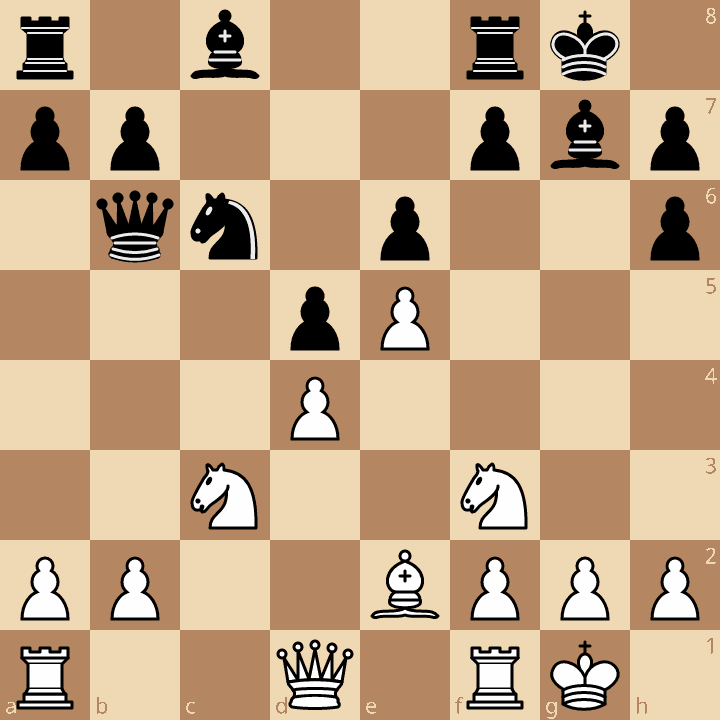
The bishop develops to g7 on the long diagonal, fianchettoed as a result of the damaged pawn structure. From g7, the bishop exerts pressure along the a1-h8 diagonal and eyes the d4 pawn. Despite the structural damage, this bishop can become Black's most powerful piece — especially if the d4 pawn falls.
Developing the final minor piece to its best square. The Nc3 supports the center and controls the critical d5 square, completing White's development. White has a clear positional advantage: more space, targets on Black's kingside, and a solid pawn center. The plan is to exploit Black's structural weaknesses.
Alternative Moves
Black castles, getting the king to relative safety despite the weakened pawn structure. Both sides are fully developed and the middlegame battle begins. White has more space and clear targets on Black's damaged kingside. Black will rely on the Bg7 diagonal pressure and the open c-file for counterplay.
Key Takeaways
- e5 gains space and cramps Black
- c3 supports d4—maintaining the pawn chain is critical
- Black's ...c5 attacks the base of the chain (standard counterplay)
- Bxh6 damages Black's kingside pawn structure
- The doubled h-pawns create long-term weaknesses for Black
Now play it through
Step through every move on a real board, try the wrong ones, and ask Knighty why they fail.
Summary
Ready to Practice?
Take this lesson with you
Free account requiredWith every variation — opens in Lichess & ChessBase