
French Defense - Winawer Variation
The sharpest French Defense line — sacrifice pawns for initiative and queenside counterplay
Try Interactive LessonIntroduction
Lesson Content
The King's Pawn opening — White claims the center and opens diagonals for the queen and kingside bishop. The most popular first move in chess. Black's main responses: - 1. ..e5 — Open Game, matching White's center - 1. ..c5 — Sicilian Defense, fighting for d4 asymmetrically - 1. ..e6 — French Defense, preparing ..d5 - 1. ..c6 — Caro-Kann, also preparing ..d5
The French Defense — Black prepares ..d5 to challenge White's center on the next move. The pawn on e6 supports d5 but blocks the light-squared bishop, which is the main strategic downside of the French. The French leads to rich strategic battles around White's pawn chain.
White builds the ideal pawn center. Now Black will challenge it with 2. ..d5, creating the characteristic French pawn tension. White's third-move choice defines the variation: - 3. Nc3 then 3. ..Bb4 (Winawer) or 3. ..Nf6 (Classical) - 3. e5 — Advance Variation - 3. Nd2 — Tarrasch Variation
Black challenges White's e4 pawn head-on. This is the defining move of the French Defense — creating immediate central tension that White must resolve.
White defends the e4 pawn with the knight. This is the most popular continuation, keeping the central tension alive. Black now faces a critical decision: - 3. ..Bb4 — Winawer Variation, pinning the knight - 3. ..Nf6 — Classical Variation, attacking e4 - 3. ..dxe4 — Rubinstein Variation, releasing tension
Alternative Moves
The Winawer Variation! Black pins the knight that defends e4, creating immediate strategic tension. The key idea: Black is willing to trade the dark-squared bishop for White's knight, accepting weakened dark squares in exchange for damaging White's pawn structure after ..Bxc3+. This is one of the most double-edged openings in chess — both sides take on structural weaknesses for dynamic compensation.
Alternative Moves
White advances, gaining space and establishing the pawn chain e5-d4. This locks the center and creates a clear plan: kingside attack behind the e5 spearhead. The e5 pawn also restricts Black's knight from reaching f6. White's alternatives: - 4. exd5 — Delayed Exchange, less ambitious - 4. Ne2 — Alekhine-Maroczy Gambit
Alternative Moves
The thematic French counter-strike! Black immediately attacks the base of White's pawn chain (d4). This is the most important strategic concept in the French Defense — undermine the center from the base. The c5 break also opens the c-file for future rook activity and creates queenside counterplay.
Alternative Moves
White forces a decision on the bishop. This is the main line — White wants Black to capture on c3, creating doubled pawns but gaining the bishop pair and open lines. The resulting pawn structure (c3+c2 doubled) gives White a queenside majority on paper but weakens the dark squares.
Alternative Moves
Black captures the knight with check, doubling White's c-pawns. This is the fundamental trade of the Winawer: Black gives up the bishop pair and weakens dark squares, but shatters White's queenside structure and gains a tempo. The alternative 5. ..Ba5 retreats the bishop, keeping it but losing time. The exchange is more principled and committal.
Alternative Moves
White recaptures, creating the characteristic doubled c-pawns. White now has the bishop pair and a strong center, but the pawn structure on c2+c3 is a long-term weakness. The open b-file and weakened dark squares around c3 give Black targets.
The knight develops to e7 rather than the usual f6 square (which is blocked by the e5 pawn). From e7, the knight can reroute to g6 or f5 to pressure e5, or go to c6 to attack d4. This is the only good square for this knight. Black's alternatives: - 6. ..Qa5 — Portisch-Hook, targeting a3 and c3 - 6. ..Qc7 — Classical, pressuring e5 immediately
Alternative Moves
White's queen leaps to g4, attacking the g7 pawn. This is the most aggressive continuation — White threatens to grab pawns on the kingside. Black must decide: protect g7 or sacrifice it for counterplay. This move defines the Poisoned Pawn Variation, one of the sharpest lines in all of chess.
Alternative Moves
The Poisoned Pawn Variation! Black defends the e5 pawn indirectly (after Qxe5+ check is possible) while daring White to capture on g7. If White takes the "poisoned" g7 pawn, Black gains massive compensation through rapid development and queenside pressure. This has been one of the most hotly debated theoretical positions for decades, played by Kasparov, Ivanchuk, and Nepomniachtchi.
Alternative Moves
White accepts the challenge and grabs the g7 pawn. This wins material but the queen will spend several tempi collecting pawns while Black develops rapidly. The queen on g7 is temporarily out of play. The alternative 8. Bd3 declines the pawn, keeping a calmer position.
Alternative Moves
Black attacks the queen, gaining a tempo. The rook activates along the g-file while forcing White's queen to retreat. This is the start of Black's compensation — every move gains time against the wandering queen.
White grabs a second pawn — now up two pawns in material. But the queen is far from the action on h7, and Black is about to unleash a wave of central and queenside play. The material is irrelevant if Black's initiative is fast enough.
Black opens the center! By capturing on d4, Black destroys White's pawn center and creates threats against the weak c3 pawn. The queen on c7 now eyes both c3 and e5. White's extra pawns mean nothing if the center collapses. This is the critical moment — Black trades material for initiative.
White develops the knight to e2, defending against the threats along the c-file and preparing to stabilize. The knight can go to f4 (attacking e6) or d4. White needs to coordinate pieces quickly before Black's initiative becomes overwhelming.
Alternative Moves
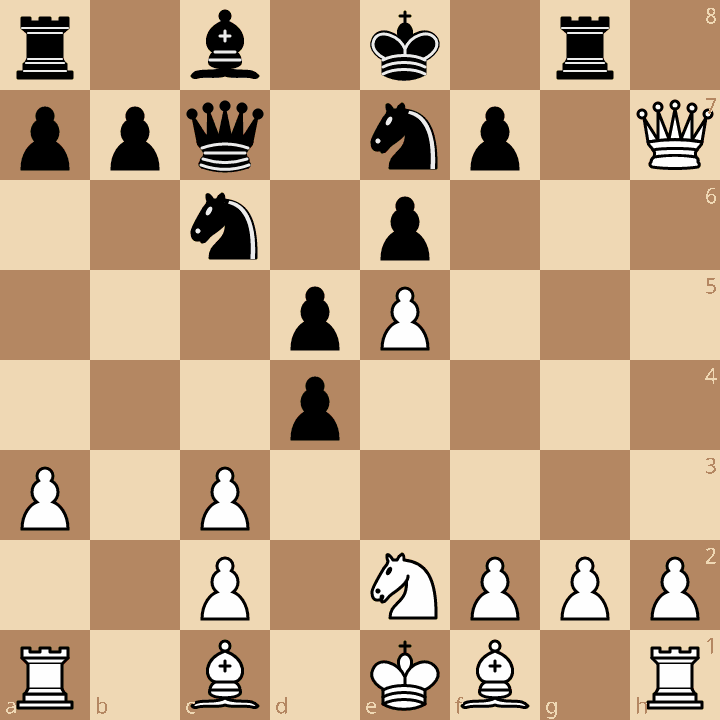
Black develops the second knight, increasing pressure on d4 and e5. Both knights are now actively placed — Ne7 can reroute to f5 or g6, while Nc6 attacks the center directly. Black has excellent compensation: rapid development, open lines, and a lead in piece coordination despite being two pawns down. The position is razor-sharp with chances for both sides. White must play precisely to consolidate the extra pawns.
Alternative Moves
Key Takeaways
- 3...Bb4 pins the knight — the defining Winawer move that creates structural imbalances
- Attack the base of the pawn chain with ...c5 — the most important French Defense idea
- 7...Qc7 offers the "poisoned" g7 pawn — material for initiative
- Black's compensation comes from rapid development, open lines, and pressure on White's weak c-pawns
- Both sides must play precisely in this razor-sharp position — White has material, Black has the initiative
Now play it through
Step through every move on a real board, try the wrong ones, and ask Knighty why they fail.
Summary
Ready to Practice?
Take this lesson with you
Free account requiredWith every variation — opens in Lichess & ChessBase