
French Defense - Exchange Variation
A solid, symmetrical variation where both sides develop naturally. Learn how to create imbalances from equal structures.
Try Interactive LessonIntroduction
Lesson Content
The King's Pawn opening — White claims the center and opens diagonals for the queen and kingside bishop. The most popular first move in chess. Black's main responses: - 1. ..e5 — Open Game, matching White's center - 1. ..c5 — Sicilian Defense, fighting for d4 asymmetrically - 1. ..e6 — French Defense, preparing ..d5 - 1. ..c6 — Caro-Kann, also preparing ..d5
The French Defense — Black prepares ..d5 to challenge White's center on the next move. The pawn on e6 supports d5 but blocks the light-squared bishop, which is the main strategic downside of the French. The French leads to rich strategic battles around White's pawn chain.
Alternative Moves
White builds the ideal pawn center. Now Black will challenge it with 2. ..d5, creating the characteristic French pawn tension. White's third-move choice defines the variation: - 3. Nc3 then 3. ..Bb4 (Winawer) or 3. ..Nf6 (Classical) - 3. e5 — Advance Variation - 3. Nd2 — Tarrasch Variation
Black challenges White's e4 pawn head-on. This is the defining move of the French Defense — creating immediate central tension that White must resolve.
Alternative Moves
The Exchange Variation — White releases the central tension immediately. This is the simplest reply, leading to a symmetrical pawn structure. The upside is a risk-free position; the downside is that it releases all of Black's opening problems — especially the light-squared bishop, which is no longer blocked by a pawn on e6. White's more ambitious alternatives: - 3. Nc3 — main line, maintaining tension - 3. e5 — Advance, gaining space - 3. Nd2 — Tarrasch, flexible development
Recapturing restores the symmetrical pawn center with d4 vs d5. The position is now perfectly balanced structurally — the real battle will be about piece activity, outpost control, and who creates threats first. Notice that Black's light-squared bishop is no longer trapped behind the e6 pawn — a key difference from other French lines.
White develops the knight to its most natural square, controlling d4 and e5. The knight also prepares kingside castling. In the symmetrical Exchange structure, piece development is crucial — the first player to create an imbalance gains the initiative.
Black mirrors White's development, placing the knight on its best square. The knight controls e4 and d5 while preparing to castle. The symmetry is deliberate — in the Exchange French, Black is happy to match White move for move, knowing that the symmetrical structure makes it hard for White to claim an advantage.
Alternative Moves
The bishop develops to d3, eyeing the kingside along the b1-h7 diagonal. This is the most natural square — it supports a future Ne5 and can contribute to a kingside attack. White could also play Bb5+ but Bd3 is more flexible, not committing to an early exchange.
Black develops the bishop actively, again mirroring White. On d6, the bishop controls the important e5 square and supports potential kingside play with ..Qe7 or ..Re8. Unlike in other French variations, the dark-squared bishop has a clear development path here — one of Black's advantages in the Exchange.
Alternative Moves
White castles kingside, securing the king and connecting the rooks. The rook on f1 can later shift to e1 to contest the open e-file — a key battleground in the Exchange French.
Black castles to match. Both kings are safe, and the fight for the open e-file begins. From here, the game revolves around subtle piece maneuvers and finding the right moment to break the symmetry. The rook on f8 is already well-placed to potentially move to e8.
A useful prophylactic move — White prevents Black's bishop from coming to g4 to pin the Nf3. In the Exchange French, the pin ..Bg4 would be annoying, potentially forcing White to compromise the kingside pawn structure. This is a common idea in symmetrical positions: small moves that prevent the opponent's active plans.
Black mirrors the prophylaxis, preventing Bg5 which would pin the Nf6 to the queen. This mutual prophylaxis is a hallmark of the Exchange French — both sides make useful waiting moves while keeping the position balanced. The pawn on h6 also creates a potential retreat square on h7 for the bishop later.
Alternative Moves
White develops the last minor piece, supporting the d-pawn and controlling e4. The knight on c3 also eyes the e2 and b5 squares, keeping options open for both kingside and queenside play.
Black solidifies the d5 pawn, creating a small but important asymmetry. The pawn on c6 supports d5 firmly and prepares to develop the knight to d7 without worrying about central stability. This also prevents Nb5, which could target the d6 bishop or jump to d6.
Alternative Moves
White seizes the open e-file with the rook. The e-file is the most important file in the Exchange French — whichever side controls it gains a lasting advantage. The rook on e1 also supports a potential Ne5 outpost, White's primary middlegame idea.
Black completes development with the knight heading to d7. From here, the knight can reroute to f8 for kingside defense, or support a future ..c5 pawn break. With all pieces developed, Black is ready to contest the e-file with ..Re8 and look for active play.
Alternative Moves
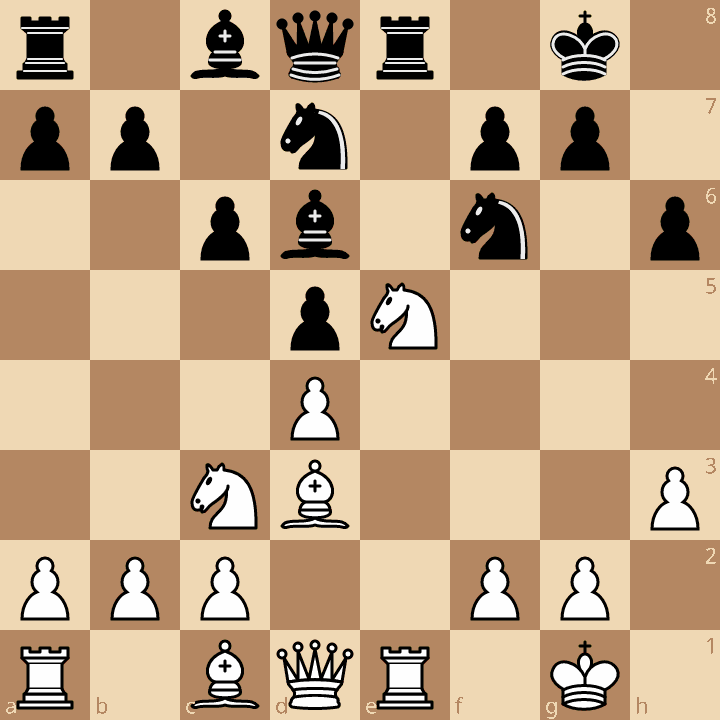
White plants the knight on the powerful e5 outpost — the most thematic plan in the Exchange French. The knight on e5 is ideally centralized, attacking f7 and supporting potential kingside play. Black must decide: challenge the knight with ..Nxe5 (allowing dxe5 with a space advantage) or work around it.
Black contests the open e-file, the key battleground in this structure. The rook on e8 opposes White's rook and supports potential piece exchanges that would ease Black's position. From here, Black can consider ..Nf8 (rerouting for kingside defense), ..Nxe5 (trading the strong knight), or preparing ..c5 to challenge White's center.
Alternative Moves
Key Takeaways
- The Exchange releases Black's light-squared bishop — the main French weakness disappears
- The open e-file is the key battleground — contest it with rooks early
- h3/h6 prophylaxis prevents annoying bishop pins in the symmetrical structure
- White's Ne5 outpost is the primary attacking idea — Black must address it
- Break the symmetry with ...c5 when the time is right to create counterplay
Now play it through
Step through every move on a real board, try the wrong ones, and ask Knighty why they fail.
Summary
Ready to Practice?
Take this lesson with you
Free account requiredWith every variation — opens in Lichess & ChessBase