
Hungarian Defense
A solid, low-risk reply to the Italian Game where Black develops the bishop to e7 instead of the more aggressive c5 or ♘︎f6.
Try Interactive LessonIntroduction
Lesson Content
The King's Pawn opening — White claims the center and opens diagonals for the queen and kingside bishop. The most popular first move in chess. Black's main responses: - 1. ..e5 — Open Game, matching White's center - 1. ..c5 — Sicilian Defense, fighting for d4 asymmetrically - 1. ..e6 — French Defense, preparing ..d5 - 1. ..c6 — Caro-Kann, also preparing ..d5
Match White in the center with your own king pawn.
Black mirrors White's central claim, establishing a symmetrical pawn center. This leads to the Open Games — the oldest and most classical family of openings. The e5 pawn controls d4 and f4, limiting White's expansion options.
White develops the knight to its most natural square, attacking the e5 pawn immediately. The knight also controls d4 and prepares kingside castling. This is the most common second move, leading to a vast tree of openings including the Italian, Ruy Lopez, and Scotch.
Defend your e5 pawn while developing a piece.
♘︎c6 — Black defends the e5 pawn with the most natural developing move. The knight on c6 also controls the important d4 and e5 squares. From here White's third move defines the opening: - 3. ♗︎c4 — Italian Game - 3. ♗︎b5 — Ruy Lopez - 3. d4 — Scotch Game - 3. ♘︎c3 — Three Knights Game (Four Knights after 3. ..♘︎f6)
The bishop develops to c4, aiming at Black's vulnerable f7 square — the weakest point in the starting position since only the king defends it. This is the defining move of the Italian Game. White's alternatives here lead to entirely different openings: - 3. ♗︎b5 — the Ruy Lopez, pressuring the ♘︎c6 defender - 3. d4 — the Scotch Game, immediately challenging the center - 3. ♘︎c3 — the Three/Four Knights, delaying the decision
Develop the bishop to e7 for a safe, solid setup.
♗︎e7 — The Hungarian Defense! Instead of the active 3. ..♗︎c5 (Giuoco Piano) or the combative 3. ..♘︎f6 (Two Knights Defense), Black places the bishop on e7 — a modest but rock-solid square. The bishop on e7 avoids all the sharp tactical lines that arise after 3. ..♗︎c5 or 3. ..♘︎f6. Black prioritizes safety and a compact structure, planning to complete development with ..♘︎f6, ..d6, and ...O-O before seeking counterplay.
Alternative Moves
White strikes at the center immediately, the most principled response to Black's passive setup. Since Black's bishop on e7 doesn't pressure d4 (unlike ♗︎c5), White can advance freely. This is White's most testing move, aiming to open the position and exploit the lead in development.
Alternative Moves
Capture the d4 pawn to maintain material balance.
exd4 — Black captures the d4 pawn. This is the most practical response, keeping material equal and half-opening the e-file for future rook activity after castling.
Alternative Moves
White recaptures with the knight, centralizing it powerfully on d4. The knight controls key squares (c6, e6, f5, b5) and White maintains a development advantage.
Develop the knight to attack the e4 pawn.
♘︎f6 — Black develops the knight to f6, attacking the e4 pawn and preparing to castle. This is the most natural move, continuing Black's plan of solid, classical development.
Alternative Moves
White defends the e4 pawn and completes queenside knight development. The knight on c3 supports a future e5 or ♘︎d5 advance and controls d5.
Castle to safety before White builds up further.
O-O — Black castles to safety, completing the first phase of development. The king is secure behind the pawn shield, and the f8 rook will support the center.
White also castles, securing the king. Both sides have completed basic development, but White retains more central influence with the knight on d4 and pawn on e4.
Solidify the center with a modest pawn move.
Black solidifies the center with ..d6, supporting the e5 square and creating a sturdy pawn structure. The bishop on c8 can now develop via ..♗︎e6 or ..♗︎g4, and the position is very solid. This is the backbone of the Hungarian setup — a compact, hard-to-crack formation.
Alternative Moves
White exchanges the centralized knight for Black's c6 knight. This gives Black doubled c-pawns but also half-opens the b-file and bishop diagonals. White simplifies to exploit the structural imbalance.
Recapture toward the center to maintain your pawn structure.
Recapturing toward the center with the b-pawn. The doubled c-pawns are a minor weakness, but Black gains the semi-open b-file for the rook and the c6 pawn supports a future ..d5 break. Recapturing with ..bxc6 (not ..dxc6) keeps the d6 pawn solidly in place.
Alternative Moves
White develops the last minor piece, placing the bishop on an active diagonal where it pressures the d6 pawn and controls the e5 square. White's development is now fully complete.
Reroute the knight to a more flexible square.
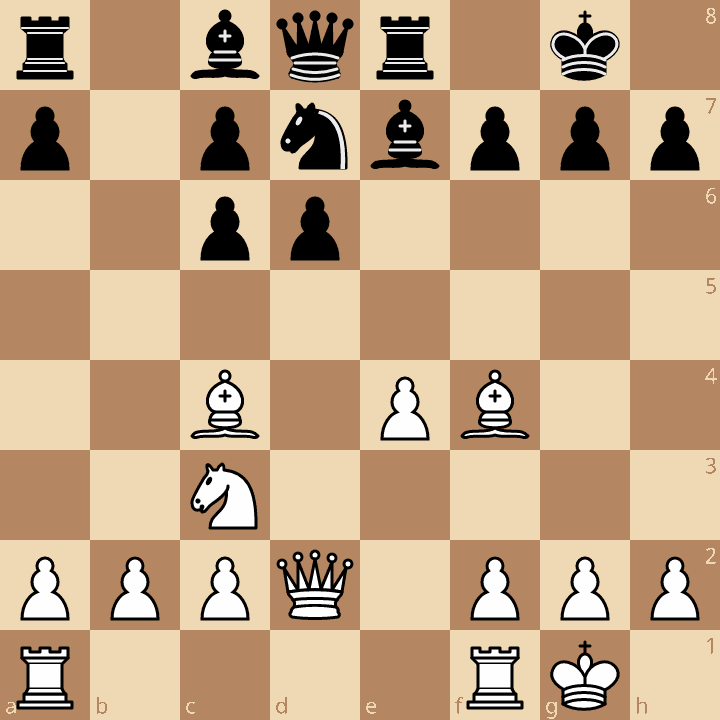
The knight reroutes from f6, heading for better squares. From d7 the knight can go to b6 (pressuring c4), e5 (a strong central outpost), or f8 (defending the kingside). This flexible knight maneuver is a key idea in the Hungarian Defense — the knight often improves via ..♘︎d7-b6 or ..♘︎d7-e5.
Alternative Moves
White connects the rooks and prepares to place them on central files (d1, e1). The queen on d2 also supports the ♗︎f4 and keeps options open for ♖︎ad1 or ♖︎fe1.
Place the rook on the half-open e-file to pressure e4.
♖︎e8 — Black places the rook on the half-open e-file, eyeing the e4 pawn. The rook's pressure on e4 prevents White from playing e5 easily and prepares potential tactics along the e-file. Black's position is solid and compact. The next steps involve activating the bishops (..♗︎f8, ..♗︎b7) and seeking counterplay with ..c5 or ..d5.
Alternative Moves
Key Takeaways
- 3...♗︎e7 is safe and solid, avoiding the sharp lines of 3...♗︎c5 and 3...♘︎f6
- Black accepts a slightly passive position in exchange for rock-solid structure
- After ...bxc6, the doubled c-pawns support a future ...d5 center break
- The knight maneuver ...♘︎f6-d7 is key, heading for b6, e5, or f8
- Black's counterplay comes from the e-file and the ...d5 or ...c5 pawn breaks
Now play it through
Step through every move on a real board, try the wrong ones, and ask Knighty why they fail.
Related Lessons
Summary
Ready to Practice?
Next in this opening family
Fried Liver Attack
Take this lesson with you
Free account requiredWith every variation — opens in Lichess & ChessBase