
KID Fianchetto Variation
White mirrors Black's fianchetto strategy, leading to strategic battles where both bishops eye the center from the flanks.
Try Interactive LessonIntroduction
Lesson Content
The Queen's Pawn opening — White claims the center with the d-pawn, which is immediately defended by the queen. This tends to lead to more strategic, closed positions compared to 1. e4. Black's main responses: - 1. ..d5 — Queen's Gambit and Slav setups - 1. ..♘︎f6 — Indian Defenses (King's Indian, Nimzo-Indian, etc.) - 1. ..f5 — Dutch Defense
Develop the knight to control the e4 square.
♘︎f6 — Black develops the knight and controls e4, preventing White from building the ideal e4+d4 center easily. This is the gateway to all Indian Defense systems. Black delays committing a pawn structure, staying flexible to choose between King's Indian, Nimzo-Indian, Queen's Indian, and more.
Alternative Moves
White reinforces control of d5 and grabs more space. Combined with d4, the two pawns dominate the center. Now Black's response determines the opening system: - 2. ..e6 — Nimzo-Indian (after 3. ♘︎c3 ♗︎b4) or Queen's Indian - 2. ..g6 — King's Indian or Grunfeld - 2. ..c5 — Benoni structures - 2. ..e5 — Budapest Gambit
Prepare the bishop fianchetto.
g6 — Black prepares to fianchetto the bishop on g7, leading to either the King's Indian Defense (..d6, ..♗︎g7) or the Grunfeld Defense (..d5, ..♗︎g7). Both are hypermodern — Black allows White a big center, then attacks it. The choice between King's Indian and Grunfeld typically comes on move 3 or 4.
Alternative Moves
White develops naturally, keeping options open. This flexible move can lead to the Fianchetto Variation (g3, ♗︎g2) or transpose into other systems. White's alternatives define the character of the game: - 3. ♘︎c3 — main line King's Indian, allowing the Classical and Sämisch - 3. f3 — Sämisch setup directly - 3. g3 — immediate fianchetto commitment
Complete the fianchetto and activate your bishop.
The bishop takes its powerful diagonal, controlling the long a1-h8 diagonal. This is the signature piece of the King's Indian — the ♗︎g7 is a sleeping dragon that becomes powerful when the center opens. The bishop supports ..e5 and ..d5 breaks while also providing latent pressure on White's queenside.
Alternative Moves
The Fianchetto Variation! White mirrors Black's setup by preparing ♗︎g2. This is the most positional approach against the KID — White avoids the sharp pawn pushes of the Classical (e4+d5) and Sämisch (f3) lines. The double-fianchetto structure leads to a strategic battle where both bishops operate from the flanks. Karpov and Kramnik were masters of this system.
Castle to safety before expanding in the center.
O-O — Black castles early, securing king safety before committing to a central pawn structure. This is more flexible than immediately playing ..d6 — Black retains options like ..d5 (Grunfeld-style) or ..c5 (Benoni-style). Castling also prepares ..♖︎e8 to support the coming ..e5 break.
Alternative Moves
White completes the fianchetto. The ♗︎g2 controls the long h1-a8 diagonal, exerting pressure on d5 and supporting the c4/d4 pawn center. Together with ♘︎f3, White is ready to castle. The ♗︎g2 is White's key piece in this system — it supports the center, defends the king, and can become very powerful in endgames.
Support the e5 advance with your d-pawn.
Black commits to the King's Indian structure by supporting a future ..e5. The d6 pawn controls e5 and c5, forming the backbone of Black's position. This move distinguishes the King's Indian from the Grunfeld (where Black plays ..d5). Black's plan is to build with ..♘︎bd7, ..e5, and then seek counterplay with ..f5 or ..c6 + ..d5.
Alternative Moves
White castles, completing kingside development. Both kings are now safe behind their fianchettoed bishops. The game transitions from the opening to a strategic middlegame. White will now play ♘︎c3, solidifying the center and preparing e4 to claim more space.
Develop your knight to support the e5 push.
♘︎bd7 — Black develops the knight to d7, supporting the ..e5 advance. The knight on d7 is flexible — it can go to c5 (pressuring e4) or b6 (hitting c4). This is the standard developing move in the KID Fianchetto, preferred over ..♘︎c6 which would block the c-pawn.
Alternative Moves
White develops the queenside knight, supporting e4 and reinforcing d5. The knight on c3 is the backbone of White's central control. Now White is ready to play e4, establishing a strong pawn duo on d4+e4 that claims significant central space.
Push to the center to activate your bishop and claim space.
The key central advance! Black stakes a claim in the center and activates the ♗︎g7, which now has a clear diagonal. The pawn on e5 also restricts the ♘︎f3 and fights for control of d4. This is the defining move of the Classical KID — Black is ready to follow up with ..♖︎e8, ..c6, and eventually the thematic ..f5 or ..d5 break.
Alternative Moves
White establishes the big pawn center with d4+e4, claiming space and controlling key central squares. The center is now locked in tension — d4 vs e5. The e4 pawn also gives the ♗︎g2 more scope along the diagonal and supports a future d5 advance to gain even more space.
Prevent Nd5 and prepare the ...d5 break.
A multipurpose prophylactic move. The c6 pawn prevents White's ♘︎d5, supports a future ..d5 break, and opens the d8-a5 diagonal for the queen. This is the hallmark of the Classical Fianchetto — Black builds a solid structure first, then seeks counterplay. The position is rich in strategic ideas for both sides.
Alternative Moves
A useful prophylactic move — White prevents ..♗︎g4 or ..♘︎g4 and prepares ♗︎e3 without being disturbed. The pawn on h3 also supports a future g4 advance if White wants to play on the kingside. This quiet move is typical of the Fianchetto Variation's strategic character — both sides improve their positions gradually.
Activate your rook on the e-file to support your center.
♖︎e8 — The rook moves to e8, adding support to the e5 pawn and preparing for tactical possibilities if the center opens. The rook also eyes the e4 pawn, which could become a target. From here Black has multiple plans: ..♘︎f8-e6, ..a5 for queenside play, or the thematic ..f5 break to attack White's center.
Alternative Moves
Key Takeaways
- The Fianchetto (g3, ♗︎g2) is White's most positional KID system
- Black's ...♘︎bd7 + ...e5 builds a solid central presence
- ...c6 is key — prevents ♘︎d5 and prepares the ...d5 break
- The ♗︎g7 becomes powerful once the center opens
- Both sides maneuver for advantage — Black targets ...f5 or ...d5 breaks
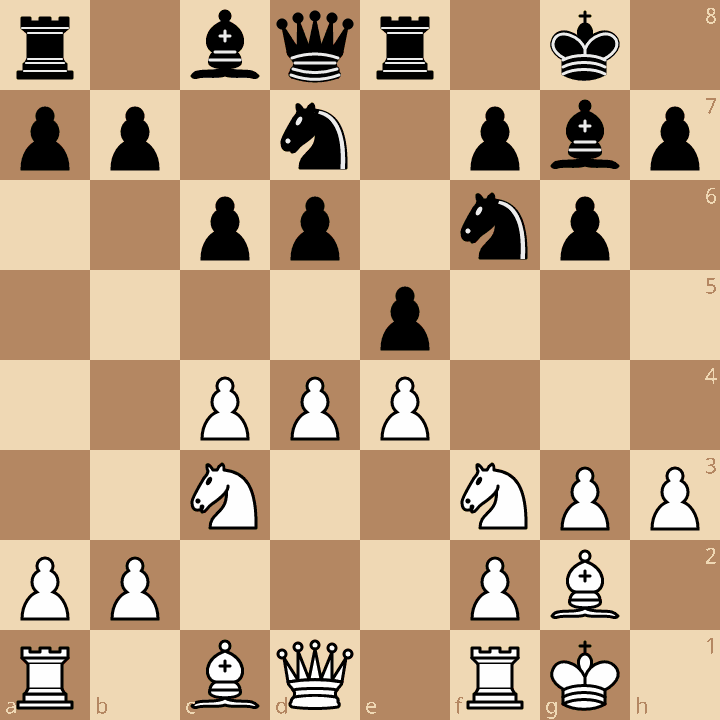
Now play it through
Step through every move on a real board, try the wrong ones, and ask Knighty why they fail.
Related Lessons
Summary
Ready to Practice?
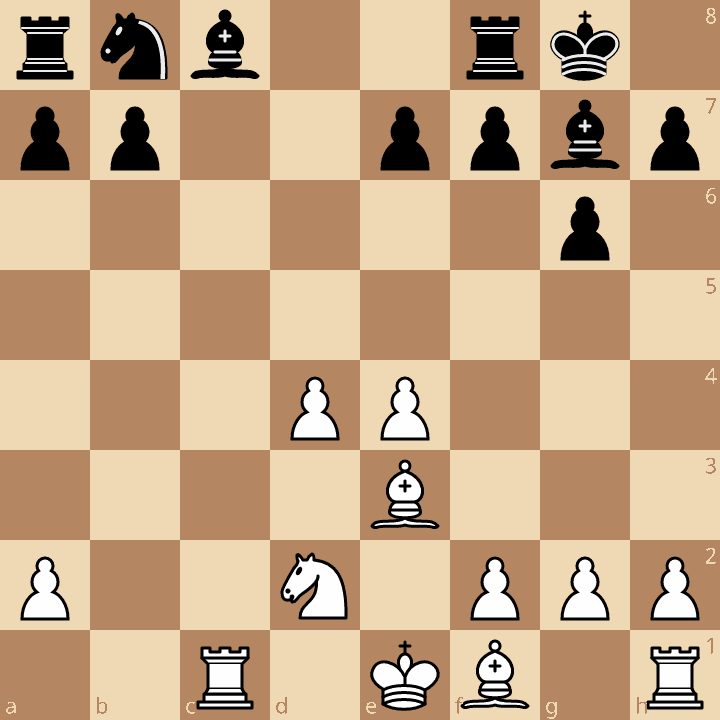
Next in this opening family
Grunfeld Defense - Exchange Variation
Take this lesson with you
Free account requiredWith every variation — opens in Lichess & ChessBase