
King's Indian - Sämisch Variation
A powerful White system with f3, Be3, and queenside castling — aiming for a controlled attack against the King's Indian.
Try Interactive LessonIntroduction
Lesson Content
The Queen's Pawn opening — White claims the center and opens diagonals for the queen and kingside bishop. The most popular first move in chess. Black's main responses: - 1. ..d5 — Queen's Gambit and Slav setups - 1. ..Nf6 — Indian Defenses (King's Indian, Nimzo-Indian, etc.) - 1. ..f5 — Dutch Defense
Black develops the knight and controls e4, preventing White from building the ideal e4+d4 center easily. This is the gateway to all Indian Defense systems. Black delays committing a pawn structure, staying flexible to choose between King's Indian, Nimzo-Indian, Queen's Indian, and more.
White reinforces control of d5 and grabs more space. Combined with d4, the two pawns dominate the center. Now Black's response determines the opening system: - 2. ..e6 — Nimzo-Indian (after 3. Nc3 Bb4) or Queen's Indian - 2. ..g6 — King's Indian or Grunfeld - 2. ..c5 — Benoni structures - 2. ..e5 — Budapest Gambit
Black prepares to fianchetto the bishop on g7, leading to either the King's Indian Defense (..d6, ..Bg7) or the Grunfeld Defense (..d5, ..Bg7). Both are hypermodern — Black allows White a big center, then attacks it. The choice between King's Indian and Grunfeld typically comes on move 3 or 4.
White develops the knight to its natural square, reinforcing control of d5 and e4. This is the standard move, preparing to build the full center with e4.
Alternative Moves
Black completes the fianchetto. The bishop on g7 is the King's Indian's signature piece — it looks passive now but becomes a monster once the center opens. It controls the long a1-h8 diagonal.
Alternative Moves
White builds the ideal pawn center — pawns on d4, c4, and e4 control a massive amount of space. This is the payoff for developing Nc3 first. Black must now decide how to challenge this center.
Alternative Moves
The defining move of the King's Indian — Black plays ..d6 instead of ..d5, accepting a cramped position for now. The plan is to later break with ..e5 or ..c5, unleashing the Bg7. This distinguishes the KID from the Grunfeld (where Black plays ..d5 immediately).
The Sämisch! White plays 5. f3, a move that looks slow but serves multiple purposes: - Reinforces e4, making the center rock-solid - Prevents ..Ng4 harassing the Be3 - Prepares Be3 + Qd2 + O-O-O for a queenside castling setup This is the foundation of White's entire attacking scheme.
Alternative Moves
Black castles kingside, tucking the king to safety. This also connects the rooks and prepares the thematic ..e5 and ..f5 pawn storms.
The bishop develops to e3 — its ideal square in the Sämisch. From here it supports d4, controls c5, and works with Qd2 to prepare queenside castling. The f3 pawn ensures no Black knight can harass it with ..Ng4.
Alternative Moves
Black's most principled response — challenging White's d4 pawn and activating the Bg7 along the long diagonal. This is the Orthodox King's Indian, leading to the sharpest positions. Black's alternatives: - 6. ..c5 — Benoni-style play, also very sharp - 6. ..Nc6 — flexible, keeping options open
Alternative Moves
White closes the center! This locks the pawn structure and sets up opposite-side attacks — White will push on the queenside (c5 break) while Black attacks on the kingside (..f5, ..f4). A race begins.
Alternative Moves
The knight retreats to h5, clearing the f-file for Black's thematic ..f5 break. From h5, the knight may reroute to f4 via ..Nf4, targeting d3 and g2. This is the most popular continuation, though 7. ..Nfd7 is a solid alternative preparing ..f5 without moving the knight to the rim.
Alternative Moves
The queen connects with Be3, preparing queenside castling with O-O-O. The Qd2+Be3 battery also threatens Bh6, trading off Black's powerful dark-squared bishop.
Alternative Moves
Black launches the kingside attack! The ..f5 break is the heart of the King's Indian — Black aims to open the f-file, break through with ..f4, and attack White's king (which will castle queenside). The position is now a classic opposite-side attack race.
White castles queenside — the defining moment of the Sämisch. The king is safe on the queenside while the h-rook can later support play on the kingside or center. Both sides now have clear attacking targets.
Alternative Moves
Black develops the last minor piece, preparing to reroute the knight to c5 where it attacks e4 and d3. The knight on d7 also supports the ..f4 advance.
The bishop develops to d3, defending e4 and aiming at the kingside along the b1-h7 diagonal. From d3, the bishop can retreat to c2 if needed, keeping pressure on Black's kingside.
Alternative Moves
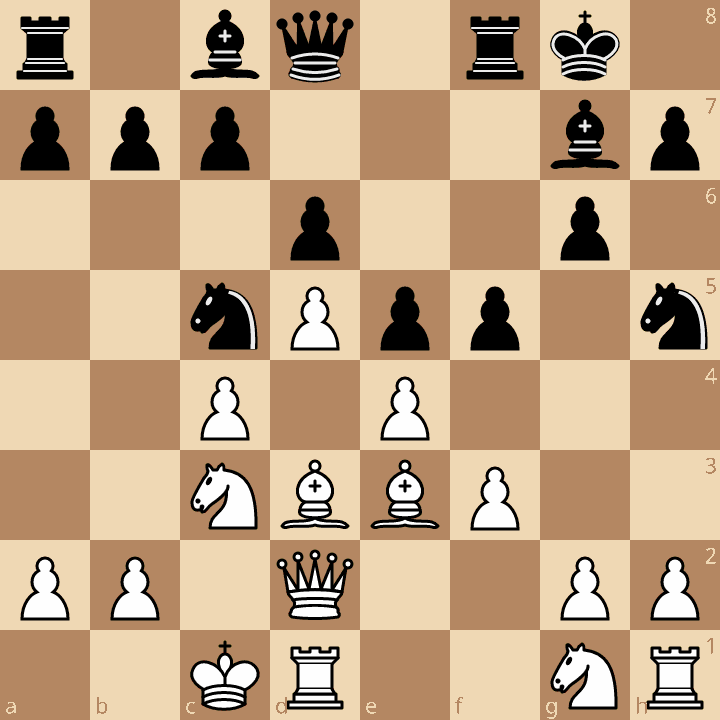
Black's knight reaches its ideal outpost on c5, attacking both e4 and d3. This is one of Black's best pieces in the King's Indian — the knight is very hard to dislodge and creates constant pressure.
Key Takeaways
- 5.f3 is the Sämisch — it reinforces e4 and prepares Be3 without allowing ...Ng4
- The setup is Be3 + Qd2 + O-O-O — queenside castling is essential
- 7.d5 locks the center, creating opposite-side attacking races
- Black's plan is ...Nh5, ...f5, and ...f4 — a kingside pawn storm
- White's plan is c5 break and queenside pressure, with a solid center
Now play it through
Step through every move on a real board, try the wrong ones, and ask Knighty why they fail.
Summary
Ready to Practice?
Take this lesson with you
Free account requiredWith every variation — opens in Lichess & ChessBase