
King's Gambit Accepted - Modern Defense
White sacrifices a pawn for rapid development and open lines. Learn the Modern Defense main line with ♗︎c4 and quick castling.
Try Interactive LessonIntroduction
Lesson Content
Start by controlling the center with your king pawn.
e4 — The King's Pawn opening — White claims the center and opens diagonals for the queen and kingside bishop. The most popular first move in chess. Black's main responses: - 1. ..e5 — Open Game, matching White's center - 1. ..c5 — Sicilian Defense, fighting for d4 asymmetrically - 1. ..e6 — French Defense, preparing ..d5 - 1. ..c6 — Caro-Kann, also preparing ..d5
Black mirrors White's central claim, establishing a symmetrical pawn center. This leads to the Open Games — the oldest and most classical family of openings. The e5 pawn controls d4 and f4, limiting White's expansion options.
Offer the f-pawn to open lines and seize the initiative.
f4 — The King's Gambit! White offers the f-pawn to blast open the center and seize the initiative. This is one of the most aggressive second moves in chess — sacrificing material for rapid development and attacking chances. Black's main responses: - 2. ..exf4 — King's Gambit Accepted, taking the pawn - 2. ..d5 — Falkbeer Countergambit, striking back immediately - 2. ..♗︎c5 — King's Gambit Declined, solid but passive
Alternative Moves
Black accepts the gambit, winning a pawn. The e-file is now half-open and White's f-pawn is gone — but so is Black's control of the d4 square. White will aim to exploit the open lines.
Develop your knight to prevent Qh4+ and prepare castling.
♘︎f3 — White develops the knight to its best square, preventing Black's ♕︎h4+ check. The knight also controls d4 and prepares kingside castling. This is the King's Knight Gambit — the most popular and principled continuation.
Alternative Moves
The Modern Defense — Black strikes back in the center immediately rather than holding the f4 pawn with ..g5. This is the most principled response, used by Aronian, Adams, and Gelfand against the world's best. Black opens lines for development and challenges White to prove compensation.
Alternative Moves
Capture to open the center and maintain a central pawn.
exd5 — White captures, opening the center completely. The d5 pawn gives White a temporary extra pawn in the center, and the position becomes very open — ideal for White's lead in development.
Alternative Moves
Black develops the knight and attacks the d5 pawn. This is the Abbazia Defense — Black aims to recapture on d5 with the knight, centralizing powerfully.
Develop your bishop to protect d5 and target f7.
♗︎c4 — The bishop develops to an active diagonal, protecting the d5 pawn while eyeing the vulnerable f7 square. This is Carlsen's choice — maintaining central control and preparing to castle. White's alternatives lead to different character: - 5. ♗︎b5+ — checking first to disrupt Black's development - 5. c4 — supporting d5 with a pawn chain
Alternative Moves
Black recaptures the pawn with the knight, placing it powerfully in the center. Black is still a pawn up thanks to the extra f4 pawn.
Castle to safety and activate your rook on the f-file.
O-O — Castle immediately! This is the heart of the King's Gambit strategy — rapid castling activates the rook on the half-open f-file, pointing directly at Black's f4 pawn. White is down a pawn but ahead in development.
Alternative Moves
Black develops the bishop to a safe square and prepares to castle. This is a practical choice — solid and flexible, played by Aronian against Carlsen and Svidler against Fedorov at the highest level.
Alternative Moves
Develop your knight to pressure the center.
♘︎c3 — White develops the knight toward the center, adding pressure on the d5 knight. The knight also supports a future d4 push. White is building up pieces rapidly while Black still needs to castle.
Alternative Moves
Black develops the bishop and challenges White's c4 bishop. The bishop on e6 also supports the d5 knight. Black is catching up in development.
Trade off the strong centralized knight.
White trades bishop for knight — removing Black's powerfully centralized piece. After 8. ..♗︎xd5, White will establish the ideal center with d4 and recover the gambit pawn with ♗︎xf4.
Alternative Moves
Black recaptures with the bishop, maintaining a centralized piece. The d5 bishop is well-placed, controlling key central squares.
Build the strong central pawn to control key squares.
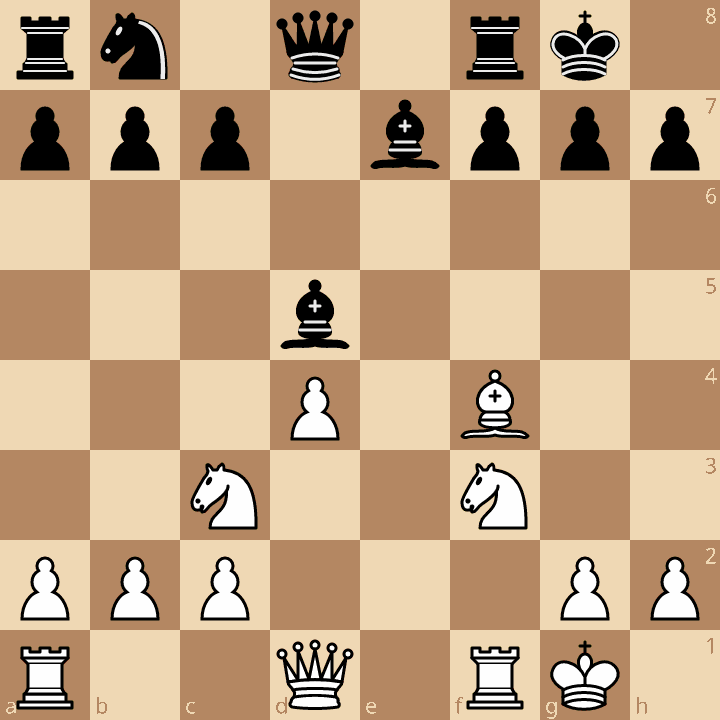
White occupies the center. The d4 pawn controls c5 and e5, giving White a spatial advantage. Combined with the c1 bishop, whose diagonal to f4 is now open, White is ready to recover the gambit material.
Alternative Moves
Black castles to safety. Both kings are now secure, and the position becomes a strategic battle. White has the center and will recover the f4 pawn; Black has a solid position.
Recapture the gambit pawn with your bishop.
♗︎xf4 — White recovers the gambit pawn! The position is now roughly equal in material, but White has achieved the ideal King's Gambit outcome: active pieces, a strong d4 center, an active bishop on f4, and open lines for the rooks.
Key Takeaways
- 2.f4 sacrifices a pawn for open lines and rapid development — don't be afraid to gambit
- 3.♘︎f3 prevents ♕︎h4+ and prepares castling — always consider king safety
- Quick castling (O-O) activates the rook on the f-file — the key to the gambit
- ♗︎c4 and d4 together create a powerful center with attacking potential
- After ♗︎xf4, White recovers the pawn with superior piece activity — the gambit's reward
Now play it through
Step through every move on a real board, try the wrong ones, and ask Knighty why they fail.
Related Lessons
Summary
Ready to Practice?
Next in this opening family
King's Gambit Declined - Classical
Take this lesson with you
Free account requiredWith every variation — opens in Lichess & ChessBase