
King's Gambit Declined - Classical
Black declines the King's Gambit with 2...♗︎c5, keeping a solid center and targeting f2. A practical, low-risk approach to neutralize White's aggression.
Try Interactive LessonIntroduction
Lesson Content
The King's Pawn opening — White claims the center and opens diagonals for the queen and kingside bishop. The most popular first move in chess. Black's main responses: - 1. ..e5 — Open Game, matching White's center - 1. ..c5 — Sicilian Defense, fighting for d4 asymmetrically - 1. ..e6 — French Defense, preparing ..d5 - 1. ..c6 — Caro-Kann, also preparing ..d5
Match White in the center with your own king pawn.
Black mirrors White's central claim, establishing a symmetrical pawn center. This leads to the Open Games — the oldest and most classical family of openings. The e5 pawn controls d4 and f4, limiting White's expansion options.
The King's Gambit! White offers the f-pawn to blast open the center and seize the initiative. This weakens the e1–h4 diagonal and the f2 square — weaknesses Black can exploit by declining. Black's main responses: - 2. ..exf4 — King's Gambit Accepted, taking the pawn - 2. ..♗︎c5 — Classical Decline, targeting f2 - 2. ..d5 — Falkbeer Countergambit, striking back immediately
Develop your bishop to target the weakened f2 square.
♗︎c5 — The Classical Decline — Black develops the bishop to its most active diagonal, targeting the weakened f2 square. By not capturing on f4, Black keeps the strong e5 pawn in the center and avoids the sharp complications of the King's Gambit Accepted. The bishop on c5 puts immediate pressure on f2, exploiting the weakness created by 2. f4.
Alternative Moves
White develops naturally, controlling e5 and d4 while preparing to castle. The knight also prevents any tricks with ..♕︎h4+ that could arise after careless play. White must play carefully — the f2 square is under pressure from the ♗︎c5.
Support your e5 pawn and prepare knight development.
Black solidifies the e5 pawn and prepares to develop the kingside knight to f6. The pawn on d6 also opens the diagonal for the light-squared bishop. This is the main line of the Classical KGD — solid and principled.
Alternative Moves
White prepares d4 to challenge Black's center — the same idea as in the Italian Game's Giuoco Piano. The pawn on c3 supports a future d4 push to seize central space. White's alternatives: - 4. ♗︎c4 — developing immediately, Italian-style - 4. ♘︎c3 — natural development but doesn't prepare d4 as directly
Retreat your bishop to safety while keeping pressure on f2.
♗︎b6 — The bishop retreats to b6, maintaining pressure on the a7–g1 diagonal and keeping f2 in its sights. From b6, the bishop is safe from d4 attacks while still influencing the center. The bishop will remain a powerful piece on this diagonal throughout the middlegame.
Alternative Moves
White half-opens the f-file by exchanging on e5. This gives White the half-open f-file for the rook after castling, which is the typical King's Gambit compensation. The trade also removes the central tension, leading to a more strategic middlegame.
Recapture to maintain your central presence.
dxe5 — Black recaptures, maintaining a strong central pawn on e5. The d-file opens, which will benefit Black's queen and eventually the rooks. Black's center remains solid.
White develops the bishop to the active c4 square, eyeing the f7 pawn. This is the natural Italian-style development, aiming at Black's king position. White's alternatives: - 6. ♘︎a3 — unusual, heading for c4 - 6. d3 — solid but less ambitious
Develop your knight to defend e5 and control the center.
♘︎c6 — Black develops the knight to its most natural square, defending the e5 pawn and controlling d4. The knight works well with the ♗︎b6 — both pieces influence the center.
Alternative Moves
White supports the e4 pawn solidly and opens the diagonal for the dark-squared bishop. This is a modest but sound approach — White builds up slowly rather than rushing d4.
Develop your knight and prepare to castle.
♘︎f6 — Black develops the kingside knight, attacking the e4 pawn and preparing to castle. With both knights and the bishop developed, Black is ahead in development and ready to castle kingside.
White supports the e4 pawn with the queen and prepares to castle. The queen on e2 also keeps the option of castling to either side, while White still needs to develop the b1-knight and c1-bishop.
Castle to complete your development.
O-O — Castle to safety! Black has a comfortable position — solid center, active pieces, and the bishop on b6 still pressuring f2. White hasn't castled yet, which gives Black a slight initiative.
White develops the c1 bishop and offers to trade the dark-squared bishops. Trading would eliminate Black's pressure on f2.
Trade bishops to simplify and gain time.
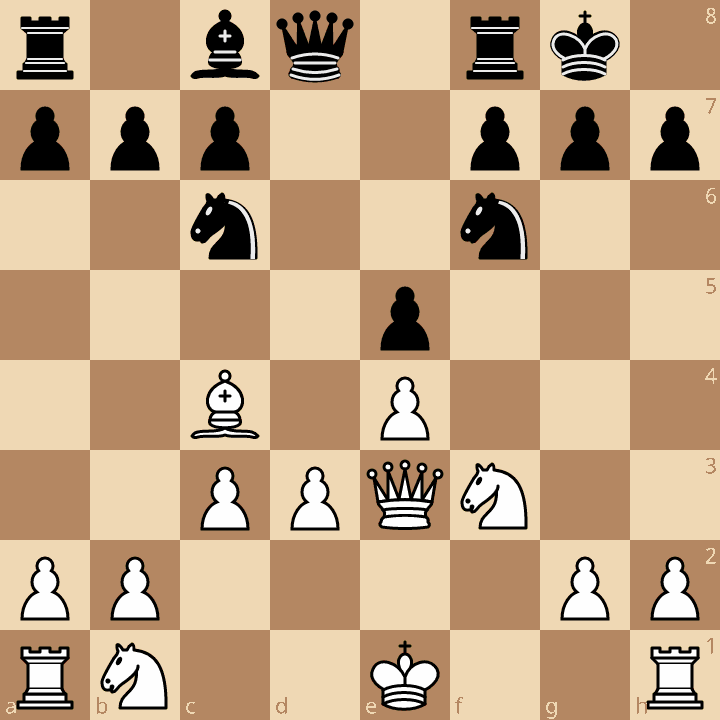
♗︎xe3 — Black trades the bishops. While the ♗︎b6 was a strong piece, the trade forces White's queen to a slightly passive square. The resulting position is roughly equal.
Alternative Moves
White recaptures with the queen — the only option. The queen on e3 is reasonably placed but slightly passive. White still needs to develop the b1-knight and castle, while Black is nearly fully developed with a comfortable position. Black has successfully neutralized the King's Gambit — equal material, solid center, and smooth development.
Key Takeaways
- 2...♗︎c5 declines the gambit while targeting f2 — White's key weakness after 2.f4
- Keep the e5 pawn to maintain a strong center — only trade when you can recapture
- The bishop on b6 stays active on the a7–g1 diagonal throughout
- Develop all pieces before launching any attack — Black castles first in this line
- Declining the gambit avoids sharp tactics and leads to strategically rich positions
Now play it through
Step through every move on a real board, try the wrong ones, and ask Knighty why they fail.
Related Lessons
Summary
Ready to Practice?
Next in this opening family
King's Gambit Accepted - Modern Defense
Take this lesson with you
Free account requiredWith every variation — opens in Lichess & ChessBase