
King's Indian Defense - Classical Main Line
Build a massive pawn center against Black's fianchetto setup
Try Interactive LessonIntroduction
Lesson Content
The Queen's Pawn opening — White claims the center with the d-pawn, which is immediately defended by the queen. This tends to lead to more strategic, closed positions compared to 1. e4. Black's main responses: - 1. ..d5 — Queen's Gambit and Slav setups - 1. ..Nf6 — Indian Defenses (King's Indian, Nimzo-Indian, etc.) - 1. ..f5 — Dutch Defense
Alternative Moves
Black develops the knight and controls e4, preventing White from building the ideal e4+d4 center easily. This is the gateway to all Indian Defense systems. Black delays committing a pawn structure, staying flexible to choose between King's Indian, Nimzo-Indian, Queen's Indian, and more.
White reinforces control of d5 and grabs more space. Combined with d4, the two pawns dominate the center. Now Black's response determines the opening system: - 2. ..e6 — Nimzo-Indian (after 3. Nc3 Bb4) or Queen's Indian - 2. ..g6 — King's Indian or Grunfeld - 2. ..c5 — Benoni structures - 2. ..e5 — Budapest Gambit
Alternative Moves
Black prepares to fianchetto the bishop on g7, leading to either the King's Indian Defense (..d6, ..Bg7) or the Grunfeld Defense (..d5, ..Bg7). Both are hypermodern — Black allows White a big center, then attacks it. The choice between King's Indian and Grunfeld typically comes on move 3 or 4.
Developing the knight to its best square, supporting the planned e4 advance. The knight on c3 controls the key d5 and e4 squares while contributing to White's full center buildup. White's alternatives here lead to different systems: - 3. Nf3 — more restrained, delaying e4 - 3. f3 — the Samisch Variation, supporting e4 aggressively
Alternative Moves
The fianchetto completes the King's Indian bishop setup. From g7, the bishop exerts powerful long-diagonal pressure, targeting the d4 pawn and the entire a1-h8 diagonal. This bishop is Black's most important piece — once the center closes with d5, it becomes a monster attacking the base of White's pawn chain.
Building the full classical pawn center: c4-d4-e4. White now controls an enormous amount of central space — this is the maximum center that Black deliberately allowed. The tension between White's big center and Black's plan to undermine it with ..e5 defines the entire King's Indian Defense.
Alternative Moves
Black supports the crucial ..e5 break and keeps the position flexible. The ..d6 pawn also prevents White from playing e5 to cramp Black further. With ..d6, the characteristic King's Indian pawn structure takes shape — Black accepts a space disadvantage temporarily, planning to strike back with ..e5 at the right moment.
Natural development, placing the knight on its most active square. From f3, the knight defends both d4 and e4 while preparing to castle kingside. White's alternatives define different sub-systems: - 5. f3 — the Samisch, supporting e4 aggressively - 5. Be2 — the Classical move order (shown here after Nf3) - 5. f4 — the Four Pawns Attack, the most aggressive
Alternative Moves
Black castles immediately, prioritizing king safety before launching counterplay. The rook also moves to f8, where it will support the ..f5 kingside pawn storm later. This is a critical timing decision — Black needs the king safe before the center closes and flank attacks begin.
The defining move of the Classical Variation. The bishop on e2 develops modestly but flexibly, supporting kingside castling and keeping all options open for the middlegame. White's alternatives define different systems: - 6. Bg5 — the Averbakh Variation, with pinning ideas - 6. Be3 — can be met by ..Ng4, harassing the bishop - 6. f3 — transposing to Samisch structures
Alternative Moves
The signature King's Indian counterstrike! Black challenges White's center directly, staking a claim in the center and activating the g7 bishop which now bears down on d4. This move transforms the game — the center will either remain in tension or close after d5, leading to the classic opposite-wing attacks that define the KID.
Castling to safety before the critical central decision. White must now choose between closing the center with d5 — locking in opposite-wing attacks — or maintaining tension with moves like dxe5 or Be3. The castle-first approach is the most flexible, keeping all options open for one more move.
Alternative Moves
Black develops the last minor piece and adds pressure to the d4 pawn, which is now under fire from both the Bg7 and Nc6. This forces White's hand — the center must be resolved. After ..Nc6, White almost always plays d5, because maintaining the tension becomes impractical with so much pressure on d4.
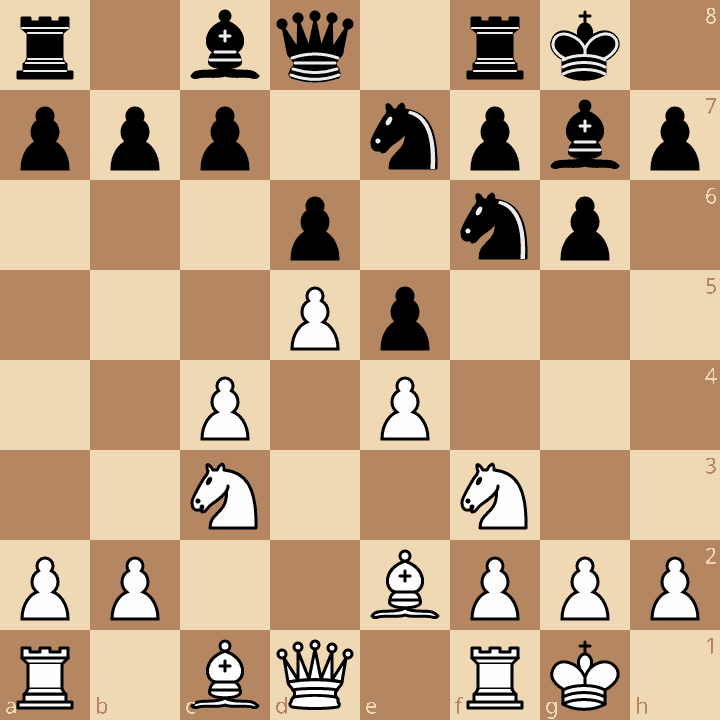
Closing the center with d5 — the most principled decision. This starts the classic King's Indian middlegame: White attacks on the queenside with c5 and minority play, while Black storms the kingside with ..f5, ..f4, and piece sacrifices. The closed center means direct contact is minimal, giving both sides time to marshal forces for their respective flank attacks.
Alternative Moves
The knight retreats to e7 to support the ..f5 kingside pawn storm — Black's primary attacking plan. From e7, the knight can reroute to g6 or f5, both excellent attacking squares. With the center locked, Black's plan is clear: ..f5, ..f4, ..g5, ..Ng6-f4 or ..Nf5, crashing through on the kingside. The race between White's queenside and Black's kingside attack is one of chess's most thrilling strategic battles.
Key Takeaways
- c4 + d4 + e4 creates a massive pawn center
- Black's Bg7 fianchetto pressures the d4 pawn from the diagonal
- Be2 + O-O is the Classical approach—solid and flexible
- d5 closes the center when Black plays ...e5
- After d5: White plays for c5 (queenside), Black plays for f5 (kingside)
Now play it through
Step through every move on a real board, try the wrong ones, and ask Knighty why they fail.
Summary
Ready to Practice?
Take this lesson with you
Free account requiredWith every variation — opens in Lichess & ChessBase