
Latvian Gambit
A bold counter-gambit where Black sacrifices the f-pawn for active piece play and tactical complications after 1.e4 e5 2.Nf3 f5.
Try Interactive LessonIntroduction
Lesson Content
The King's Pawn opening — White claims the center and opens diagonals for the queen and kingside bishop. The most popular first move in chess. Black's main responses: - 1. ..e5 — Open Game, matching White's center - 1. ..c5 — Sicilian Defense, fighting for d4 asymmetrically - 1. ..e6 — French Defense, preparing ..d5 - 1. ..c6 — Caro-Kann, also preparing ..d5
Black mirrors White's central claim, establishing a symmetrical pawn center. This leads to the Open Games — the oldest and most classical family of openings. The e5 pawn controls d4 and f4, limiting White's expansion options.
White develops the knight to its most natural square, attacking the e5 pawn immediately. The knight also controls d4 and prepares kingside castling. This is the most common second move, leading to a vast tree of openings including the Italian, Ruy Lopez, and Scotch.
The Latvian Gambit! Instead of defending e5 with the natural 2. ..Nc6, Black counter-attacks White's e4 pawn directly. This is an audacious choice — Black weakens the kingside and allows 3. Nxe5, but in return gains dynamic counterplay and open lines for the pieces. The move creates immediate tension: White must decide how to handle both the attacked e4 pawn and the undefended e5 pawn.
Alternative Moves
White accepts the challenge by capturing the undefended e5 pawn with the knight. This is the most principled response — White grabs a pawn and occupies a strong central square. Alternatives like 3. Bc4 or 3. Nc3 also give White good chances, but 3. Nxe5 directly tests the gambit's soundness.
Alternative Moves
The classical main line of the Latvian Gambit. The queen attacks the Ne5 directly, forcing it to move. While early queen moves are usually discouraged, here the queen serves a clear purpose — after the knight retreats and Black captures on e4, the queen will also eye the f2 square along the open f-file. Black's alternatives: - 3. ..Nf6 — the modern approach, developing a piece - 3. ..Qe7 — also attacks the knight but is more passive
Alternative Moves
White retreats the knight to c4, a useful square where it eyes the d6 and e5 squares. The knight cannot stay on e5 due to the queen attack, and Nc4 keeps it actively placed rather than retreating passively. From c4, the knight may later reroute to e3 or e5, maintaining pressure on Black's position.
Alternative Moves
Black captures the e4 pawn, gaining material back and opening the f-file. The position is now equal in material (pawn for pawn), and Black has the extra central e4 pawn as compensation for the weakened kingside. The open f-file will become an important attacking asset later, especially after Black develops and castles queenside.
Alternative Moves
White develops the knight to c3, attacking the advanced e4 pawn and preparing to control the center. Both knights are now actively placed — Nc3 eyes d5 and e4, while Nc4 controls d6 and e5. White's development advantage is the main compensation for the symmetrical pawn count.
The queen retreats to f7, a safe square where it protects the e-pawn indirectly and stays connected to the kingside. This is the best square — the queen avoids harassment while keeping an eye on the b3-g8 diagonal. From f7, the queen supports a future ..d5 central break, which is Black's key equalizing idea.
Alternative Moves
White reroutes the knight from c4 to e3, an excellent centralized square. The knight on e3 targets d5 and f5, key squares in the center and on Black's weakened kingside. The knight maneuver Nc4-e3 is a common theme — White uses both knights to pressure d5 and restrict Black's pawn breaks.
The critical central break! Black pushes ..d5 to challenge White's control and open lines for the pieces. This is the thematic move in the Latvian Gambit — Black must fight for the center before White consolidates. The d5 push also frees the c8-bishop, which has been locked in since the opening. Without this break, Black's position would become cramped.
Alternative Moves
White captures on d5 with the e3-knight, occupying a powerful central outpost. The knight on d5 controls key squares (c7, e7, b6, f6) and restricts Black's development. White chooses Nexd5 over Ncxd5 to keep the c3-knight pressuring the e4 pawn — a practical decision that maintains maximum tension.
Black kicks the powerful knight from d5. This pawn move is forced in spirit — leaving the knight on d5 unchallenged would give White a dominant position. After the knight retreats, Black will have a more comfortable pawn structure with the c6-d5 setup possible. The c6 pawn also provides a solid base for Black's queenside development.
Alternative Moves
The knight returns to e3, maintaining central influence. The knight retreat may seem like lost time, but Ne3 keeps the piece on an active square where it still eyes d5 and f5. White's lead in development remains — both knights are well-placed while Black still needs to develop the bishops and castle.
Black develops the knight to its most natural square, controlling d5 and e4. The knight on f6 is the backbone of Black's position — it defends key central squares and prepares kingside or queenside castling. With ..Nf6, Black begins to catch up in development after the early queen adventure.
White challenges the advanced e4 pawn with d3. This is the most natural way to undermine Black's extra central pawn — after the exchange, White's bishop will develop actively to d3 with tempo. The d3 break opens the position for White's bishop pair and completes the fight for the center.
Alternative Moves
Black captures on d3, opening the position. The e4 pawn is exchanged, but this was inevitable — holding it long-term was impractical with both white knights pressuring it. The exchange opens the d-file and diagonal for White's bishop, but Black is catching up in development.
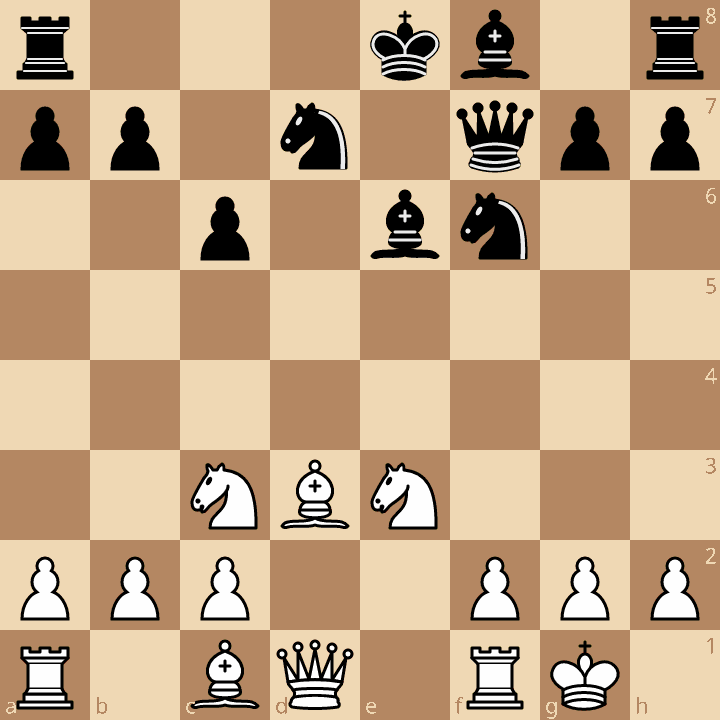
White recaptures with the bishop, which now sits actively on d3. The bishop eyes the h7 pawn and controls the b1-h7 diagonal — a dangerous attacking resource if Black castles kingside. White has completed the development of both knights and the bishop, and is ready to castle on the next move.
Black finally develops the light-squared bishop, which was locked in since move one. The bishop on e6 is actively placed — it supports ..d5, eyes the a2-g8 diagonal, and prepares queenside castling. Developing the bishop to e6 rather than other squares gives Black a solid, coordinated setup. The queen on f7 and bishop on e6 form a strong battery.
Alternative Moves
White castles kingside, securing the king and connecting the rooks. With development nearly complete and the bishop actively placed on d3, White has a comfortable position with lasting pressure. White's typical plans from here include Nf5 (attacking the bishop), Nc4-d6, or doubling rooks on the d-file.
Black develops the last minor piece, preparing to castle queenside with ...O-O-O. The knight on d7 supports the Nf6, controls e5, and keeps the position flexible. With all minor pieces developed, Black is ready to castle long and activate the rooks. Despite the slightly worse position, Black has compensation in the form of active pieces and a solid pawn structure.
Alternative Moves
Key Takeaways
- 2...f5 counter-attacks the e4 pawn instead of defending e5
- 3...Qf6 attacks the knight and creates threats against f2
- The ...d5 break is essential to free Black's pieces and fight for the center
- Black often castles queenside to use the open f-file for attack
- White must play accurately — the Latvian creates tactical complexity that rewards the prepared player
Now play it through
Step through every move on a real board, try the wrong ones, and ask Knighty why they fail.
Summary
Ready to Practice?
Take this lesson with you
Free account requiredWith every variation — opens in Lichess & ChessBase