
London System - Main Line
Solid, easy-to-learn system with the bishop on f4
Try Interactive LessonIntroduction
Lesson Content
The Queen's Pawn opening — White claims the center with the d-pawn, which is immediately defended by the queen. This tends to lead to more strategic, closed positions compared to 1. e4. Black's main responses: - 1. ..d5 — Queen's Gambit and Slav setups - 1. ..Nf6 — Indian Defenses (King's Indian, Nimzo-Indian, etc.) - 1. ..f5 — Dutch Defense
Alternative Moves
Black matches White in the center, leading to the Queen's Pawn Game. The symmetrical center typically results in strategic maneuvering rather than immediate tactical battles. White's most popular continuation is 2. c4 — the Queen's Gambit.
The London System — White develops the dark-squared bishop before playing e3, which would block it in. This is a practical, low-theory system where White follows the same setup (Bf4, e3, Nf3, Be2, O-O) regardless of Black's response. The London is popular at all levels for its simplicity and reliability.
Alternative Moves
Black develops the knight to its most natural square, controlling the e4 square and preventing White from easily pushing e4. The knight on f6 is a versatile piece that contributes to both defense and counterplay. Black keeps options open — ..c5 challenging the center, ..Bf5 developing the bishop, or ..e6 for a solid setup.
Solidifying the d4 pawn and opening the f1-a6 diagonal for the light-squared bishop. Crucially, the dark-squared bishop is *already* developed to f4 — playing e3 now doesn't trap it behind the pawn chain. This Bf4-before-e3 sequence is the defining idea of the London System. If White had played e3 first, the dark-squared bishop would be permanently restricted.
Alternative Moves
Black strikes at the center with the most principled response, challenging White's d4 pawn immediately. The ..c5 break is the main way to fight for equality against the London System. If White captures (dxc5), Black recaptures and obtains a good position. If White holds with c3, the characteristic London "pyramid" takes shape.
Supporting the d4 pawn and creating the trademark London "pyramid" — pawns on c3, d4, and e3. This is an incredibly solid structure that's very difficult for Black to breach. The pyramid gives White a spatial advantage in the center while keeping everything defended. The downside is that the c3 pawn blocks the Nc3 development square, so the knight must go to d2.
Alternative Moves
Black develops the knight naturally, adding a second attacker to the d4 pawn. The knight on c6 also controls e5 and d4, key central squares. With pieces building up around the center, the position will soon clarify — whether through a ..cxd4 exchange or continued maneuvering.
The knight develops to d2 because c3 is occupied by the pawn. From d2, the knight supports e4 ideas and can reroute to f3 or b3 depending on the position. The Nd2 + Ngf3 development scheme is a signature of the London System — it looks unusual but works well with the c3-d4-e3 pawn structure.
Alternative Moves
Black reinforces d5 and prepares to develop the dark-squared bishop. The e6 pawn provides a solid foundation, though it does lock in the light-squared bishop behind the pawn chain. Black's light-squared bishop problem mirrors the Queen's Gambit Declined — the bishop on c8 needs a plan (often ..b6 and ..Bb7) to become active.
Completing knight development with both knights now actively placed. The f3 knight controls e5 and d4, while the d2 knight can jump to b3, e4, or f1 depending on what the position requires. White's development scheme is nearly complete — only the light-squared bishop and castling remain.
Alternative Moves
Black develops the bishop to d6, directly challenging the London bishop on f4. This is one of the most common and effective ideas against the London System — if White trades, Black gets the bishop pair; if White retreats, Black gains a tempo. The ..Bd6 challenge is a recurring theme that every London player must know how to handle.
Retreating the bishop to g3 rather than trading. The bishop remains active on the h2-b8 diagonal, and from g3 it performs a useful defensive role protecting the kingside. Trading with Bxd6 is also perfectly fine, but keeping the bishop preserves tension and avoids giving Black the bishop pair. The position remains balanced with chances for both sides.
Alternative Moves
Black castles kingside, completing the most important opening task. With the king safe, Black can focus on middlegame plans — typically ..b6 and ..Bb7, activating the light-squared bishop. Both sides are now approaching a fully developed position, which is typical of the London System — slow maneuvering rather than early tactical fireworks.
Developing the light-squared bishop to d3, where it eyes the kingside (particularly the h7 square) and supports a potential e4 pawn break. This completes White's minor piece development. With Bd3, White is ready to castle and enter the middlegame. The bishop on d3 and the potential Bxg6 trade later is a typical London attacking resource.
Alternative Moves
Black prepares the fianchetto with ..Bb7, solving the light-squared bishop problem. This is the most common plan in the London System for Black — the bishop on b7 will target the e4 and d5 squares. The ..b6/..Bb7 setup also creates potential queenside counterplay along the a-file and c-file.
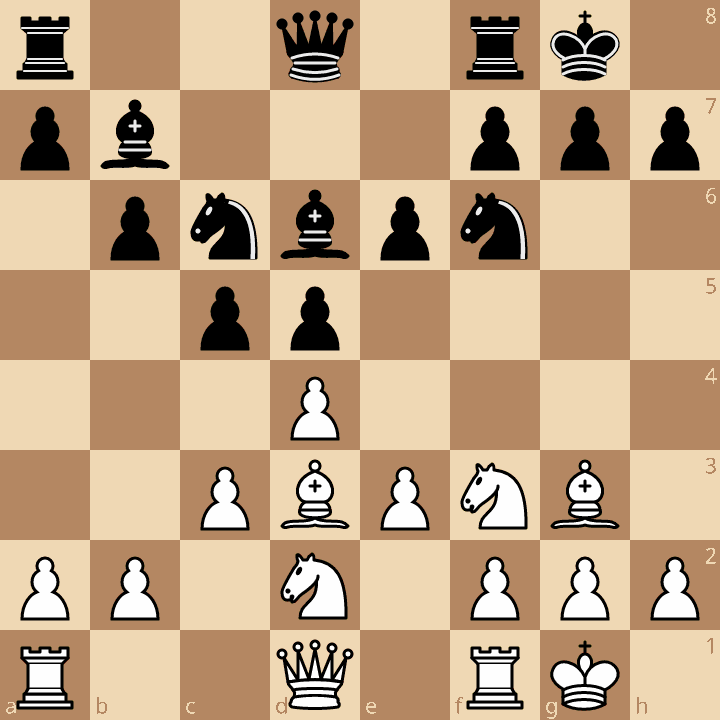
Castling completes the London System setup. White's position is a textbook example of the London structure: the c3-d4-e3 pyramid, bishop on g3, knights on d2 and f3, bishop on d3, and a safely castled king. From here, White's typical plans include e4 (if achievable), Ne5 to plant a knight in the center, or Qe2 followed by doubling rooks.
Alternative Moves
Black completes the fianchetto, solving the light-squared bishop problem. The bishop on b7 is now active, targeting the long diagonal and putting pressure on e4 and d5. Both sides are fully developed in a roughly equal position. The London System has achieved its goal: a solid, playable middlegame with clear plans for both sides — no deep opening theory required.
Key Takeaways
- Bf4 before e3 is the key London idea
- c3-d4-e3 forms a solid pawn pyramid
- The same setup works against many Black defenses
- Nd2 + Ngf3 is a flexible knight development
- Solid, easy to learn, hard to refute
Now play it through
Step through every move on a real board, try the wrong ones, and ask Knighty why they fail.
Summary
Ready to Practice?
Take this lesson with you
Free account requiredWith every variation — opens in Lichess & ChessBase