
Modern Defense - Standard Line
Fianchetto the bishop early, then strike at the center with ...e5
Try Interactive LessonIntroduction
Lesson Content
The King's Pawn opening — White claims the center and opens diagonals for the queen and kingside bishop. The most popular first move in chess. Black's main responses: - 1. ..e5 — Open Game, matching White's center - 1. ..c5 — Sicilian Defense, fighting for d4 asymmetrically - 1. ..e6 — French Defense, preparing ..d5 - 1. ..c6 — Caro-Kann, also preparing ..d5
Prepare the bishop fianchetto with your g-pawn.
The Modern Defense! Instead of contesting the center with a pawn, Black prepares to fianchetto the bishop on g7. This is a hypermodern approach — Black allows White to build a big center, planning to attack it later. The g6 move also starts preparing kingside castling and gives the bishop a powerful diagonal from g7.
Alternative Moves
White builds the ideal pawn center with e4 and d4. This is the most natural and principled response — occupying the center while Black has delayed contesting it. Alternatives: - 2. ♘︎f3 — flexible, but less ambitious - 2. d3 — too passive, not punishing Black's delay
Complete the fianchetto and activate your bishop.
♗︎g7 — The bishop completes the fianchetto, taking up a powerful post on the long diagonal. From g7, the bishop eyes the center squares d4 and e5, and will become a monster once the center opens. This is the signature piece placement of the Modern Defense — the bishop controls the entire a1-h8 diagonal.
Alternative Moves
White develops the knight to its natural square, defending e4 and controlling d5. The Standard Line of the Modern Defense begins. Alternatives: - 3. c4 — the Averbakh System, grabbing more space - 3. ♘︎f3 — quieter development, keeping f4 ideas off the table
Support the e5 square and prepare your central break.
Black claims space and supports a future ..e5 pawn break. The pawn on d6 controls e5, preventing White from advancing there easily. This is the Standard Defense setup within the Modern. Black keeps the position flexible — the c-pawn, e-pawn, and knights are all uncommitted.
Alternative Moves
White develops the second knight, controlling e5 and d4. This is the Two Knights Variation of the Modern Defense. Alternatives: - 4. f4 — Austrian Attack, the most aggressive - 4. ♗︎e3 — preparing ♕︎d2 and possible opposite-side castling - 4. ♗︎g5 — pinning after ..♘︎f6
Develop your knight to attack the e4 pawn.
♘︎f6 — Black develops the knight to its most natural square, attacking the e4 pawn and preparing to castle. The knight also supports the key ..e5 break that Black is planning. With this move, the position resembles a Pirc Defense — but Black reached it via the Modern move order, which can avoid certain aggressive White setups.
Alternative Moves
White develops the bishop to a solid square, preparing to castle kingside. A calm, classical approach. Alternatives: - 5. ♗︎d3 — more aggressive but blocks the d-file - 5. h3 — preventing ..♗︎g4 pins
Get your king to safety before the central fight begins.
O-O — Black castles to safety immediately. The king is secure, the rook activates on f8, and Black is ready to start the central battle with ..e5. Castling early is important before opening the center.
Alternative Moves
White also castles, completing basic development. Both sides are now castled and the middlegame battle is about to begin.
Strike at the center with the move you've been preparing!
The key central break! Black challenges White's d4 pawn head-on. This is the moment the Modern Defense has been building toward — the fianchettoed bishop on g7 will become extremely active once the center opens. After the trade on e5, the d-file opens for the heavy pieces.
Alternative Moves
White captures, opening the center. The d-file is now open and the position becomes more dynamic. Black will recapture with the d-pawn, equalizing the center.
Recapture to maintain your central presence.
dxe5 — Black recaptures, establishing a pawn on e5. The center is now symmetric and the d-file is open. Black has achieved the ideal Modern Defense setup — active pieces, solid structure, and equal central control.
White pins the ♘︎f6 against Black's queen. The bishop on g5 creates pressure and makes it harder for Black to play freely. White hopes to exploit the pin tactically. Alternatives: - 8. ♘︎xe5 — captures a pawn but simplifies after ♘︎xe4, leading to equal trades
Develop the knight to defend against the pin.
♘︎bd7 — Black develops the knight while defending against the pin. The knight on d7 adds an extra defender to f6 and can reroute to c5 or f8. It also prepares to unpin with ..h6 if needed.
Alternative Moves
White connects the rooks and prepares to double on the d-file. The queen on d2 also supports a potential ♗︎h6 idea, trading Black's powerful fianchettoed bishop.
Secure your queenside and prevent piece intrusions.
A solid, multi-purpose move. The c6 pawn shores up the d5 square, prevents ♘︎c3-d5 jumps, and prepares ..♕︎c7 to eye the c-file. Black's position is compact and hard to break down.
Alternative Moves
White places the rook on the open d-file, the most natural square. The rook pressures Black's position along the d-file.
Place your queen where it supports the e5 pawn.
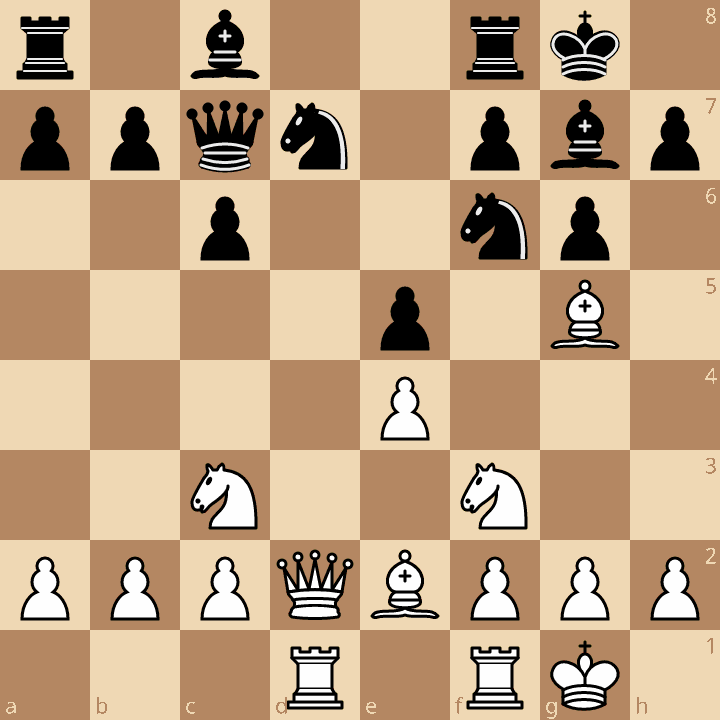
♕︎c7 — Black places the queen on c7 — an ideal square. The queen supports the e5 pawn, eyes the c-file, and keeps the option of ..b5 expansion. Black has achieved a fully equal, active position from the Modern Defense.
Alternative Moves
Key Takeaways
- 1...g6 and 2...♗︎g7 — fianchetto first, decide on the center later
- The ♗︎g7 is the star piece — it pressures d4 from the long diagonal
- ...e5 is the key central break Black prepares from the start
- ♘︎bd7 handles the ♗︎g5 pin while keeping the c-pawn flexible
- ...c6 and ...♕︎c7 complete a solid, active setup for Black
Now play it through
Step through every move on a real board, try the wrong ones, and ask Knighty why they fail.
Related Lessons
Summary
Ready to Practice?
Take this lesson with you
Free account requiredWith every variation — opens in Lichess & ChessBase