
Owen Defense - Standard Line
Fianchetto the queenside bishop early, then challenge the center with ...c5 and ...e5 ideas
Try Interactive LessonIntroduction
Lesson Content
The King's Pawn opening — White claims the center and opens diagonals for the queen and kingside bishop. The most popular first move in chess. Black's main responses: - 1. ..e5 — Open Game, matching White's center - 1. ..c5 — Sicilian Defense, fighting for d4 asymmetrically - 1. ..e6 — French Defense, preparing ..d5 - 1. ..c6 — Caro-Kann, also preparing ..d5
The Owen Defense! Black prepares to fianchetto the queenside bishop to b7, aiming it at the long a8-h1 diagonal. This is a hypermodern approach — Black develops a piece to pressure e4 rather than contesting the center with pawns. The b6 move also keeps maximum flexibility for Black's central pawn structure.
Alternative Moves
White builds the ideal pawn center with e4 and d4. This is the most natural and principled response — occupying the center while Black has delayed contesting it. Alternatives: - 2. Nc3 — develops a piece but less ambitious - 2. d3 — too passive, doesn't punish Black's delay
The bishop completes the fianchetto, taking up a powerful post on the long diagonal. From b7, the bishop exerts long-range pressure on e4 and beyond — this is the signature idea of the Owen Defense. Unlike the French Defense (1. ..e6), the bishop is already active before Black commits to a pawn structure.
Alternative Moves
White develops the bishop to an active diagonal, defending e4 and eyeing the kingside. The bishop on d3 supports a potential e5 advance and can target h7 in some attacking lines. Alternatives: - 3. Nc3 — natural development, but the Bd3 line is more flexible - 3. f3 — overprotects e4 but blocks the knight
Black solidifies the center and prepares both ..d5 and ..c5 breaks. The pawn on e6 supports a future d5 push and also opens the diagonal for the dark-squared bishop. This creates a French-like structure, but with the crucial difference that the Bb7 is already active — solving the main strategic problem of the French Defense.
Alternative Moves
White develops the knight to its most natural square, controlling e5 and d4. This prepares kingside castling and keeps the position flexible. Alternatives: - 4. Nc3 — also good, supporting e4 - 4. f4 — aggressive but weakens the kingside
Black challenges the d4 pawn immediately! This is the key counterattacking move — striking at White's center before it becomes too established. The c5 break creates tension and opens lines for Black's pieces. The Bb7 supports this plan perfectly, as the diagonal pressure on e4 ties down White's forces.
Alternative Moves
White reinforces the d4 pawn, maintaining the strong center. The c3 pawn creates a solid pawn chain and prevents Black from easily dissolving the tension. Alternatives: - 5. dxc5 — captures but gives up the center - 5. e5 — gains space but commits early
Black develops the knight to its most natural square, adding pressure to the e4 pawn. The knight and bishop on b7 both target e4, making it harder for White to maintain the full center. This also prepares kingside castling and keeps the position flexible.
Alternative Moves
White develops the knight to d2, reinforcing e4. The knight on d2 avoids blocking the c-pawn (already committed to c3) and can reroute to f1-g3 or support e4 directly. Alternatives: - 6. Qe2 — supports e4 but blocks the bishop - 6. Bg5 — pins the knight but doesn't solve e4 pressure
Black develops the bishop to a solid square, preparing to castle kingside. The bishop on e7 is modest but flexible — it supports both ..d5 and ..d6 structures and doesn't commit to an aggressive diagonal yet. With both bishops developed and castling ready, Black's position is compact and well-coordinated.
Alternative Moves
White castles to safety, connecting the rooks. With a strong pawn center and well-developed pieces, White is ready for the middlegame.
Black castles to safety immediately. Both sides are now castled and the real battle for the center is about to begin. It's essential to get the king safe before the central tension breaks open.
Alternative Moves
White places the rook behind the e4 pawn, adding extra support. The rook on e1 reinforces the center and prepares for the e5 advance. Alternatives: - 8. Qe2 — also supports e4 but is more committal
Black develops the last minor piece, adding pressure to the d4 pawn and the e5 square. The knight on c6 also prepares to jump to d5 or a5 depending on how the center resolves. With all pieces developed, Black's position is ready for the central battle.
Alternative Moves
White advances the e-pawn, gaining space and pushing the Nf6 back. This is the natural culmination of White's center — the pawn on e5 restricts Black's knight and clamps down on the kingside. Black must now decide how to handle the knight — retreat is necessary but the destination matters.
The knight retreats to the powerful d5 outpost! This is much better than a passive retreat to e8 or h5. On d5, the knight occupies a dominant central square, supported by the e6 pawn and pressuring White's c3 and e3 squares. The Bb7 supports the knight perfectly — this is the Owen Defense's payoff for the early fianchetto.
Alternative Moves
White captures on c5, opening the d-file. The idea is to exploit the open lines before Black can consolidate. White gets central space with e5 and hopes to create pressure. Alternatives: - 10. Qc2 — maintains tension but Black is comfortable - 10. Ne4 — reroutes the knight but opens the d2 square
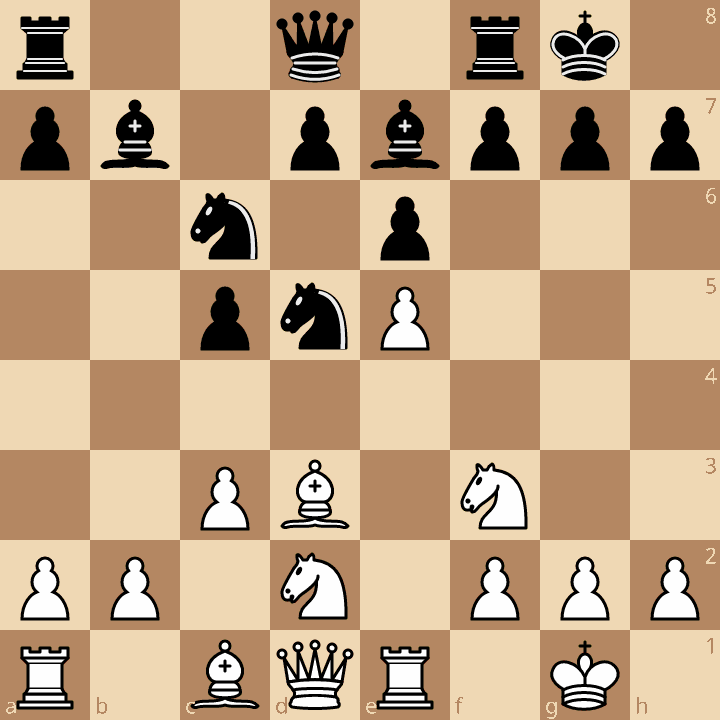
Black recaptures with the b-pawn, keeping the strong knight on d5 and opening the b-file for the rook. The position is now open and dynamic — Black has a solid central knight, an active Bb7, and the half-open b-file for counterplay. Black has achieved a playable position from the Owen Defense with active piece play and clear plans.
Key Takeaways
- 1...b6 and 2...Bb7 — fianchetto the queenside bishop to pressure e4 from a distance
- The Bb7 solves the French Defense's main problem — the light-squared bishop is active from the start
- ...c5 is the key central break, challenging White's d4 pawn
- After e5, retreat with Nd5 to a powerful outpost rather than passively with Ne8
- bxc5 opens the b-file for rook counterplay while maintaining the strong Nd5
Now play it through
Step through every move on a real board, try the wrong ones, and ask Knighty why they fail.
Summary
Ready to Practice?
Take this lesson with you
Free account requiredWith every variation — opens in Lichess & ChessBase